
The Gen Z Show: Gen Z consumes shorter content that requires less attention span
The Gen Z Show: Gen Z consumes shorter content that requires less attention span
How do Gen Z members consume content? The BT-PRICE Gen Z Consumption Behaviour Survey finds it prefers shorter formats that require less attention spans.
Archna Shukla
- Feb 2, 2026,
- Updated Feb 12, 2026 7:12 PM IST
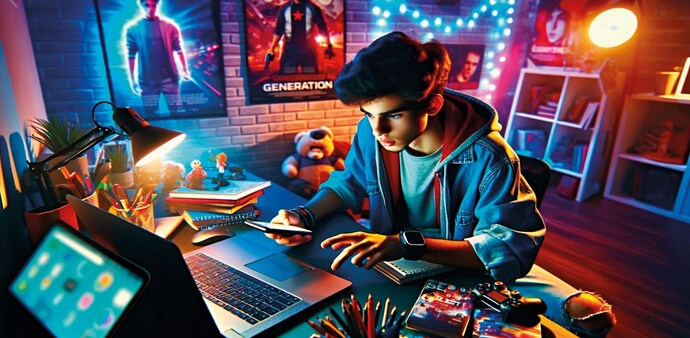
Gone are the days of “appointment viewing” on a static screen in the living room. Gen Z has pivoted to a multi-screen, digital, on-the-go media consumption ecosystem. This generation seamlessly negotiates a massively fragmented, always-on, mobile-first landscape seeking customised information and experiences.
Hey!
Already a subscriber? Sign In
THIS IS A PREMIUM STORY FROM BUSINESS TODAY.
Subscribe to Business Today Digital and continue enjoying India's premier business offering uninterrupted
only FOR
₹999 / Year
Unlimited Digital Access + Ad Lite Experience
Cancel Anytime
-
 Unlimited access to Business Today website
 -
 Exclusive insights on Corporate India's working, every quarter
 -
 Access to our special editions, features, and priceless archives
 -
 Get front-seat access to events such as BT Best Banks, Best CEOs and Mindrush
Gone are the days of “appointment viewing” on a static screen in the living room. Gen Z has pivoted to a multi-screen, digital, on-the-go media consumption ecosystem. This generation seamlessly negotiates a massively fragmented, always-on, mobile-first landscape seeking customised information and experiences.
“Media has three primary use cases—escapism, information, and self-aggrandisement,” says Ashish Pherwani, Leader, Media & Entertainment sector, EY. “This hasn’t changed for Gen Z in as far as the relevance of media is concerned. What has changed is the how, the when, and the where.”
Advertisement
Content is and will always be the king. Be it GenZ or any other generation, good, engaging and relevant content will always find takers.
-Ashish Pherwani, Leader, Media & Entertainment Sector, EY
Gen Z, for instance, still wants to stay informed and is an active consumer of news and opinions, but it doesn’t go to legacy media platforms such as physical newspapers or TV channels. An industry research shows that Gen Z sources its news from targeted sources on social platforms and prefers shorter formats.
According to UK-based consultancy Brand Finance, Gen Z’s attention span has shrunk from 20-30 minutes a few years ago to 8-10 minutes now. This makes formats such as “shorts” and “reels” more popular among them.
General entertainment, however, remains a mixed bag for this generation. The BT–PRICE Gen Z Consumption Behaviour Survey, for instance, finds that Gen Z follows a hybrid entertainment model by blending digital-first formats with selective out-of-home experiences.
Advertisement
Brand Finance, which conducts global research each year with over 2,00,000 respondents for its Brand Valuation report, has similar findings. “Shorts and reels are favoured, but they do switch to big screens,” says Ajimon Francis, Managing Director, Brand Finance, India.
Using influencers to engage with GenZ is quite effective. But the choice of influencers has to be right.
- Ajimon Francis,MD, Brand Finance, India
Claiming that nearly one in two users on JioHotStar platforms belongs is a Gen Z, a spokesperson says the generation responds to engaging content on platforms other than social media, too. “Discovery (of content) may begin with a moment, a highlight, or a live cultural event, but sustained viewing follows when relevance and authenticity align.”
On the big screen at home, Gen Z prefers sports events with cricket still reigning supreme among the male audiences. Reality shows such as Big Boss are popular but so are romance, comedy and action genres for OTT platforms and cinemas.
Advertisement
Wanted ‘PLUs’
Celebrities such as film or sports stars are losing favour among the Gen Z when it comes to seeking credible information or recommendations of any kind. This consumer set follows “influencers” or individual content creators that have garnered following based on their well-researched and responsible content.
A study commissioned by Meta India in September found that nearly half the festive shoppers interviewed followed influencers and two-thirds of them said that they trusted the brands that collaborated with credible creators.
This is because influencers are seen as “PLUs (people like us)”, and hence, are considered more trustworthy, unlike celebrities who are known to endorse products or information for monetary gains and without any accountability.
Be it media consumption or making purchase decisions, another ally that Gen Z collaborates with is generative AI. The Meta study quoted above found that over 80% of festive shoppers, that included a large section of Gen Z, “harnessed generative AI to spark gift ideas and discover inspiration”.
Likewise, Gen Z would commit to a long-format TV series or a movie in cinemas or on streaming platforms only after some influencer recommends it.
Socio-economic factors
Advertisement
Research from Deloitte, Nielsen, and Horowitz shows that globally, Gen Z is gearing towards free, ad-supported streaming TV, or FAST, over-paid subscriptions. The primary reasons for this shift are the increasing cost of subscriptions.
India is likely to see the same trend as FAST options emerge. Meanwhile, the BT-Price survey shows that of their total entertainment budget, Indian Gen Z spends the most, 52%, on cinemas, followed by 51% on YouTube creators. “This highlights their preference for both shared cultural moments and creator-led, on-demand content,” says the survey. OTT platforms (47%) remain a core entertainment staple, particularly among metro residents, post-graduates and higher-income groups, finds the survey.
The survey further reveals that live and experiential formats scale sharply with income and education. Stand-up comedy (43%) and concerts or live events (35%) show big takers among affluent Gen Z, entrepreneurs and post-graduates, rising to over 60% at higher income levels.
In contrast, lower-income and less-educated cohorts remain more reliant on free or low-cost digital entertainment.
According to YouTube India, this year marked a shift in the universalisation of content irrespective of its original language. “In 2025, content went global, local, and universal all at once. India’s creators are no longer limited by regional nuances; they are building on them.”
Advertisement
Citing an example, YouTube India says that Mr Beast, its most popular content creator globally, didn’t merely visit India this year but “he moved in digitally with his channel gaining over 47 million subscribers”. This became possible because Mr Beast’s content was made available in seven different audio tracks.
The Gen Z Brandwagon
At 380 million, Gen Z is a large, yet not the mainstream, target group for most advertisers because it has yet to emerge as the bread-winner or the primary decision maker when it comes to big-ticket or household expenses.
Still, this generation spends big bucks on personal hygiene and grooming, apparels, fashion accessories and cosmetics, electronics and gadgets, and services such as hospitality, travel and indoor as well as outdoor entertainment.
According to estimates, Gen Z consumption, currently, amounts to around Rs 1 lakh crore, thus, making it difficult for brands to ignore it or wait till it eventually comes to hold the household purse strings. Besides, brands need to build familiarity and affinity with this customer group for the future, and hence, need to invest in engaging with them even now.
Incidentally, this generation is using social platforms for making purchases too. This has led to “social media driving D2C, or direct-to-consumer, brands in a big way,” says Francis, adding that the “assurance of easy returns, exchanges and refunds is accelerating the phenomenon.”
Advertisement
The Future
When Gen Z ascends to become the mainstream consumer, the media landscape will likely crystallise into a layered ecosystem where personal will coexist with collective experience. “The future of entertainment is not binary,” says a JioHotStar spokesperson.
Indeed, consumption is likely to remain predominantly mobile-first—unless a newer tech option emerges—and social by default, yet the traditional television screen will retain its utility for “high-impact cultural moments” that demand a shared experience, he says, adding that “platforms that understand and design for this layered behaviour are better positioned to build relevance at scale.”
In other words, it’s not the product but its positioning that requires fresh strategy. Observers say that the product—whether it is a three-hour long film or a 24-hour news cycle—must have the flexibility to be repurposed for myriad short and long format media platforms.
Read more!