
Uncertainty Looms with India Inc’s Spirits Remaining Low in Q3FY26
India Inc's spirits in Q3FY26 remained low.
Surabhi
- Feb 6, 2026,
- Updated Feb 6, 2026 5:14 PM IST
The Indian economy is ending FY26 on a high note. GDP growth is seen to be resilient despite 50% tariffs by the US. The momentum is likely to continue in FY27, albeit at a slightly softer pace.
Hey!
Already a subscriber? Sign In
THIS IS A PREMIUM STORY FROM BUSINESS TODAY.
Subscribe to Business Today Digital and continue enjoying India's premier business offering uninterrupted
only FOR
₹999 / Year
Unlimited Digital Access + Ad Lite Experience
Cancel Anytime
-
 Unlimited access to Business Today website
 -
 Exclusive insights on Corporate India's working, every quarter
 -
 Access to our special editions, features, and priceless archives
 -
 Get front-seat access to events such as BT Best Banks, Best CEOs and Mindrush
The Indian economy is ending FY26 on a high note. GDP growth is seen to be resilient despite 50% tariffs by the US. The momentum is likely to continue in FY27, albeit at a slightly softer pace.
But this mood of cautious optimism does not seem to reflect on the ground, where many companies are apprehensive about growth and private consumption while battling the impact of the US tariffs.
Advertisement
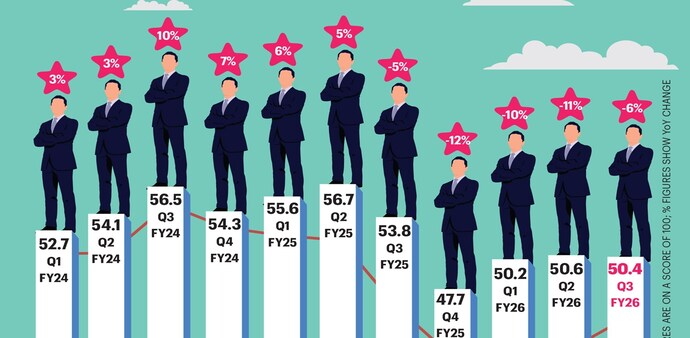
This is reflected in the BT-C Fore Business Confidence Survey of 500 Chief Executive Officers and Chief Financial Officers for the third quarter of the fiscal. The survey, which measured business confidence in the October-December 2025 quarter and was conducted between January 2 and 13, 2026, shows that sentiments have slipped marginally.
The Business Confidence Index rose to 50.4 (on a scale of 100) in the quarter ended December 2025, from 50.6 in the July-September 2025 quarter and much below the 53.8 recorded a year ago in October-December 2024. While this was the second highest reading in 2025, it was just a notch above the 50 mark. A dip below 50 denotes a contraction in confidence.
Advertisement
Business confidence, as measured by the BCI, remained muted across sectors and industry sizes with sentiment in the services sector and among small and micro-sized firms remaining below the 50 mark.
Experts say while goods and services tax (GST) and income tax cuts have boosted consumer demand this fiscal, the momentum may not sustain in the upcoming quarters.
In fact, the IMF too has projected in its recently released World Economic Outlook Update that India’s GDP growth will moderate to 6.4% in FY27 “as cyclical and temporary factors wane.” But on a brighter note, it has revised the FY26 GDP growth forecast upwards by 0.7 percentage point to 7.3%.
“There is an underlying momentum in the economy, and so there is overall growth, which is reflected in headline GDP numbers. Inflation has been low and oil prices stable; these have helped demand. But industry is not doing very well, as reflected in data from the index of industrial production,” says Sunil Sinha, Professor of Economics at Chandigarh-based Institute of Development and Communication.
Advertisement
Sinha warns of emerging challenges even though the current situation is not a problem. Income growth has happened on expected lines and income tax and GST cuts can only give a short-term fillip. As a result, greenfield investments by companies are yet to take place across sectors, he says.
Aditi Nayar, Chief Economist, ICRA, says that at 50%, the tariffs on India are extremely high and are likely to start hurting some labour-intensive sectors. The agency expects FY26 GDP growth at 7.4% , boosted by sizeable monetary stimulus and liquidity support, direct and indirect tax cuts, and subdued inflation. “These factors are expected to support growth in FY27 as well,” she says, adding that the key risk to the economy largely stems from the materialisation of the trade deal with the US.
The BCI also points to this mood of uncertainty. Respondents rated overall economic prospects facing their businesses in the January-March 2026 quarter at just 4.9 on a scale of 10, much lower compared to the third quarter. They were also not very upbeat on demand and hiring conditions for the quarter.
Advertisement
On whether they expect continuation of the economic growth momentum in FY27, just 16% expect growth to remain robust. A total of 38% said it would be slower due to external challenges while 46% said they were uncertain about the economic outlook.
The impact of the US tariffs was also fully felt in the third quarter of the fiscal. As many as 54% of the respondents said it led to lower orders while 13% said it led them to diversify exports. Only 27% said the tariffs did not impact them. Surprisingly, 6% reported higher orders.
Higher tariffs impact nearly 55% of India’s exports. Merchandise exports from India grew just 1.8% in December 2025 on a year-on-year basis to $38.51 billion.
The GST cuts, however, helped sales in the third quarter of the fiscal for 55% of the respondents, although just 38% expect consumer demand to remain strong going forward due to this massive rationalisation of the indirect tax regime.
Nayar remains upbeat about consumption demand. “Overall, the outlook for rural demand appears upbeat in the near term, given robust kharif output and healthy trends in rabi sowing. Besides, the combination of GST rate rejig, sizeable income tax relief, 125 bps policy rate cuts leading to lower borrowing costs, and moderation in food inflation is expected to augur well for urban consumption,” she says.
Advertisement
The GST cuts that led to record sales in the festive season, however, did not result in more jobs; only 16% respondents said they hired more workers to meet festive season demand.
The good news for consumers is that with inflation remaining much below the Reserve Bank of India’s tolerance zone, only 32% of the companies surveyed are planning a price hike in the new fiscal year, while 38% said they did not have any such plan.
The BCI survey also highlighted the problem of air pollution, which is now hampering productivity for companies. To a pointed question whether recurrent air pollution has impacted business operations, 51% responded in the affirmative, noting that it has led to an increase in employees working from home and loss of productivity.
Significantly, the Labour Codes seem to be a welcome reform for companies despite concerns on wage and employee benefit payouts. As many as 37% of respondents said the most important impact of the Codes would be a reduction in the compliance burden while 22% said they would help in easier hiring and retrenchment of workers. Only 18% said the most important aspect of the Codes would be a higher wage bill.
Advertisement
The expectation now is that the government would continue its reform agenda to offset the impact of the tariffs. India Inc could well gain much needed confidence from these policy moves. Here’s to new tidings in the new year!
@surabhi_prasad
Read more!