
West Asia war: Does India have to brace up for an austere summer?
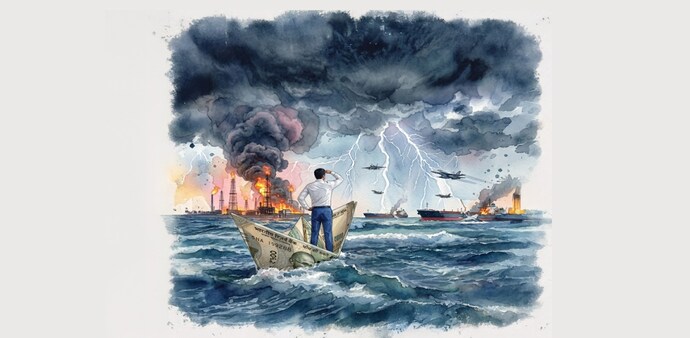
It's a tough year for the economy with the West Asia war and forecast of a poor monsoon dampening growth prospects, raising price pressures and hurting the current account. Can India ride out the storm again?
Surabhi
- May 26, 2026,
- Updated May 26, 2026 6:34 PM IST
A little over two months into the West Asia war, Prime Minister Narendra Modi’s call for consumption cuts made everyone sit up and take notice. Until then, it had been largely business as usual for most, although there had been some impact from the conflict in almost everyone’s lives. Consumers were facing higher prices of most goods, barring petrol and diesel, while businesses were battling challenges in securing energy supplies and raw material imports as well as in sending out export cargoes.
Advertisement
India is facing this huge global energy crisis strongly. But now the demand of the time is that petrol, diesel, gas, [etc], should be used with great restraint.
-PRIME MINISTER NARENDRA MODI
However, the Prime Minister’s exhortation to cut down on the use of petrol and diesel as well as discretionary spending on gold, amongst other measures to save foreign exchange, raised larger concerns over the well-being of the economy and whether a fresh and perhaps, larger-than-anticipated, crisis was brewing. In the ensuing days, the government swung into action and took a handful of measures to curb forex outflows, which also coincided with the conclusion of assembly polls in five states.
First, the Centre more than doubled the customs duty on precious metals, including gold silver and platinum, which was followed by state-owned oil marketing companies raising retail prices of petrol and diesel by Rs 3 per litre each, followed by another 90 paise hike and then restricting silver imports through nominated agencies.
Advertisement
Questions over the health of the economy and what’s in store for consumers abound with worries over second round inflation, more measures to control balance of payments and slowing growth. After all, for much of the past few quarters of FY26, and right up to the presentation of the Union Budget on February 1 and ensuing weeks, it had been smooth sailing for the Indian economy, which was seen to go through a so-called Goldilocks phase of high growth and low inflation.
The economy, through nimble policy moves and strong internal demand, had brushed off the potential hit from the 50% tariffs imposed by US President Donald Trump and had done better than expected with an estimated growth of 7.6% last fiscal and a pickup in private consumption on the back of cuts in income tax and goods and services tax (GST) rates.
Advertisement
But over the past two-and-a-half months, this picture started to change with questions emanating now over how long the economy can remain resilient to external and domestic challenges.
Adding to the external volatilities, the monsoons are also seen to be below average this year, leading to at least some worries over how it would impact crop production and prices and the rural sector, which is a significant source of private consumption.
New Forecast
From the time the Budget was presented, when India was seen to grow by 6.8% to 7.2% this fiscal, with upside to growth projections, most economists and agencies believe that GDP growth will slow down and have revised projections to anywhere between 6.5% and 6.9%. Another year of 7% growth in FY27, which was once seen to be within reach, now looks out of the question.
The main reason for this is the continuing high prices of crude oil, with Brent crude remaining above $100 a barrel. This is seen to be a major drag on growth and will spur inflation. Most agencies expect crude oil prices to average $90-95 per barrel this year and warn that commodity prices will also remain high, even if the war were to end immediately. Accordingly, retail inflation, which has been climbing over the past few months, is now seen to average close to 5% this fiscal. CPI inflation at a 14-month high of 3.48% came as a pleasant surprise to most analysts who have warned that the real pain is yet to start. But wholesale price index (WPI)-based inflation at 8.3% in April and the ensuing fuel price hike indicate that retail prices are also set to rise sharply in the coming months and will be reflected in the data for May and June.
Advertisement
“The downside risks to the economy have begun materialising with over two months of unresolved West Asia conflict. The closure of the Strait of Hormuz has created the largest energy shock on record alongside trade and supply chain disruption,” notes a recent report by Crisil, which has lowered GDP growth forecast to 6.6% for FY27 and CPI inflation to 5.1%.
Crisil Intelligence has revised its Brent crude price forecast to $90-95 per barrel for fiscal 2027 from $82-87. “Besides the repercussions of the ongoing West Asia conflict, El Niño conditions leading to sub-normal monsoon are also expected to impact India’s growth-inflation mix this fiscal,” it said.
High energy prices will drive up domestic inflation. Second round effects through higher input costs are also seen seeping into core inflation.
-Dipti Deshpande, Principal Economist, Crisil
Dipti Deshpande, Principal Economist at Crisil, points out that with the conflict now continuing beyond two months, significant disruption of energy infrastructure resulting in energy price spikes and shortages will impact industrial output. “Similarly, high energy prices will drive up domestic inflation. Second round effects through higher input costs are also seen seeping into core inflation,” she adds.
The World Bank Group’s latest Commodity Markets Outlook in April warned that energy prices are set to surge to a four-year high of 24% in 2026 and overall commodity prices by 26% this year driven by soaring energy and fertiliser prices as well as higher prices of several metals. In fact, it has projected fertiliser prices to jump up by 31% in 2026, led by a 60% rise in urea prices.
Advertisement
Such forecasts clearly don’t bode well for India, which is the third-largest energy importer and depends heavily on West Asia for fuel, gas and fertilisers supplies.
The World Bank expects India to grow by 6.6% this fiscal. Aurélien Kruse, Lead Economist of India at World Bank, in an interview to BT, says that India is a net importer of energy and so it’s clear that there’s going to be an impact of the war on the economy. He, however, points out that net energy imports as a share of GDP is only about 3% for India compared to several other economies.
Deficits Under Pressure
Along with a rising fuel bill, the surge in oil prices has also led to further depreciation in the rupee, making imports more expensive and creating challenges in meeting targets for the twin deficits. The Indian rupee, which ended 2025 at 89.88 against the US dollar, has continued to fall and breached 96 to the dollar in mid-May. Forex reserves, which had crossed $700 billion in January and February, depleted to around $698 billion in April.
Advertisement
As a result, pressure is increasing on fiscal and current account deficits. Fiscal consolidation over the past few years has served the Indian economy well with the fiscal deficit coming in at 4.4% of the GDP in FY26. But with tax relief measures, an excise duty cut to maintain retail fuel prices and higher allocation to fertiliser subsidy—at least an additional Rs 35,000 crore over the Rs 1.7 lakh crore allocation for FY27—the deficit is seen to widen substantially, with some estimating it at 4.6% of the GDP.
Due to high oil prices, there will be an impact on the fiscal deficit. The Centre will either have to expand the target for the deficit or cut down on expenditure.
-N.R. Bhanumurthy, Director, Madras School of Economics
At a recent event, Expenditure Secretary V Vualnam said fiscal stress is very much a reality and the coming quarters will be challenging.
N.R. Bhanumurthy, Director of the Madras School of Economics, says high oil prices will impact the fiscal deficit. The government will either have to expand the target for the deficit or cut down on expenditure. He adds multiple factors are affecting the rupee—the pressure from the Trump tariffs last year and now the West Asia crisis. Foreign capital outflows, which predate the current crisis, have also weakened sentiments on the rupee, he says.
Prime Minister Modi’s austerity call should be read in this context—as a measure to boost forex reserves. Avoiding discretionary gold purchases and foreign trips for a year and curbing spending on fuel and fertilisers would help keep the current account deficit in check, given the significant spending undertaken on them. While gold imports fell in volume terms in FY26 by 4.7% to 721.03 tonnes, the value of such imports shot up 24% to $71.98 billion. Nearly 57% of outward remittances under the Liberalised Remittance Scheme are for foreign travel. Meanwhile, silver imports have remained high all through FY26, both in value and volume terms, led by a rise in prices and demand. They surged by 42.03% in FY26 to 7,334.96 tonnes last fiscal, surging by nearly 150% in value terms to $12.05 billion from FY25.
In April 2026 as well, gold imports surged nearly 82% year on year to $5.6 billion, amounting to 7.8% of the total imports.
A report by JM Financial points out that oil accounts for nearly 20% of India’s total imports, gold for about 9% and fertilisers for 2%. Close to 58% remittances of $30 billion in FY25 under LRS have been for international travel, up from 35% in FY19. Remittances for investments in equity is another category that has more than doubled to 8.4% versus 3.1% in FY19, it says.
“India’s forex reserves are currently comfortable at $690 billion, covering 11 months of imports; however, if the supply disruption extends for a few more weeks, it would warrant tangible measures,” the report warns.
Foreign trade is also under pressure with the ongoing blockade of the Strait of Hormuz. Merchandise exports in April rose 13.8% to $43.56 billion but the trade deficit was at a three-month high as the oil import bill surged 53% month on month to $18.6 billion.
A report by YES Bank estimates that the measures to contain gold imports will help reduce import volumes to around $420 tonnes this fiscal from 720 tonnes last fiscal.
The current account deficit, which was at 1.3% of the GDP in the December 2025 quarter, is seen to rise to 2% or more this fiscal. While it is worrying, analysts say it is manageable. “The pressure on the current account deficit is very real,” Bhanumurthy underlines, noting that the Reserve Bank of India (RBI) and the finance ministry have taken measures to address it in recent months.
Chief Economic Advisor V. Anantha Nageswaran elaborated on the scale of the challenge and said that the West Asia crisis has turned into a “live balance-of-payments stress test” for India and has direct implications for inflation, current account deficit and the rupee. “Managing the current account credibly, financing it sustainably, and preventing further currency depreciation are the central macroeconomic imperatives of this fiscal year,” he said at the CII Annual Business Summit.
Kruse of World Bank believes that concerns over the capital account, especially the low foreign direct investment, are much bigger for India. “The capital account story is the one that’s a bit more mysterious in the sense that you’ve seen portfolio investment decelerating and net FDI at levels that are too low for a country that’s growing as India is,” he says.
The fall in foreign investments has baffled policymakers and analysts and measures are expected to improve inflows. A CareEdge report noted that FPI outflows for FY26 were recorded at $16.6 billion, as against inflows of $2.7 billion in FY25. During the first 11 months FY26, India’s net FDI inflows were modest at $6.3 billion, following a poor $1 billion in FY25. Even though there was an improvement compared to last year, it remains below the long-term average of $31 billion (FY15-FY24).
The Monsoon Uncertainty
Amidst this volatile external environment, the uncertainty over the monsoons has created more worries. With a super El Niño seen to be developing this year, the India Meteorological Department has forecast the monsoon for 2026 at 92% of the long period average.
While it is early days, there are concerns that this could hit growth and income prospects for rural India and further fuel inflationary pressures. Already, food inflation has been rising as prices of kitchen staples like tomatoes and onions have risen along with prices of edible oil. As a precautionary step, the government has already banned sugar exports till September 30. The impact of below average monsoons on pulses and oilseed production, which typically get impacted in such years, will also have to be monitored.
However, the government remains hopeful considering the higher reservoir levels and expectation that much of the sowing will be completed before El Niño conditions develop later in the summer.
The promotion of natural farming and allocation for it in the last two Budgets will help tide over any fertiliser shortage.
-P.K. Joshi, VP, National Academy of Agricultural Sciences
Agricultural Economist P.K. Joshi, who is Vice President of the National Academy of Agricultural Sciences, concurs with this assessment and says that in the last 10-12 years, several studies have shown that Indian agriculture has become resilient to climate change.
“Even in the last three to four years, despite droughts in several regions, our agriculture has remained resilient and poor rains have not impacted productivity. Use of irrigation has ensured that poor rains do not impact production. As a result, the forecast of a below average monsoon should not have a significant impact on agriculture production this fiscal,” he says, adding that a NITI Aayog study had shown that earlier, the normal growth rate in agriculture was 3%, but the new normal is 4%.
“The government is working on ensuring adequate stock of fertilisers. The promotion of natural farming and allocation for it in the last two Budgets will also help tide over any fertiliser shortage. In the meanwhile, there should be more focus on improving fertiliser efficiency at the farm unit level,” says Joshi.
However, Deshpande of Crisil says the adverse impact of heatwaves and a below-normal southwest monsoon are upside risks to food inflation.
With multiple challenges before the economy, the finance ministry is closely monitoring the developments and awaiting cues from the RBI in its next policy review in June. Data on GDP growth in Q4 of FY26 as well as provisional estimates for the full year will be out on June 5, providing a better picture of the economy.
PM Modi’s warning that this is turning into a decade of disasters for the world is a necessary corrective, but it needs to be followed by honest diagnostics and policy pivots that confront the paradox of macro stability without micro dynamism, says Dhananjay Sinha, CEO and Co-Head Institutional Equities at financial services firm Systematix Group. “Only by grounding ambition in granular realities, overhauled data, equitable incomes and labour absorbing growth, can India turn vulnerability into enduring resilience in a fractured world,” he underlines.
For now, it is clear that the Budget math will have to be revisited and goalposts and targets changed. Expectations are that the second half of the year could be better, if the war ends soon. What most economists agree on is that India entered this crisis from a position of strength and urgent measures could help stabilise the economy. What happens next, on the external front and with the monsoon, is anybody’s guess, but we need to get our house in order.
@surabhi_prasad
A little over two months into the West Asia war, Prime Minister Narendra Modi’s call for consumption cuts made everyone sit up and take notice. Until then, it had been largely business as usual for most, although there had been some impact from the conflict in almost everyone’s lives. Consumers were facing higher prices of most goods, barring petrol and diesel, while businesses were battling challenges in securing energy supplies and raw material imports as well as in sending out export cargoes.
Advertisement
India is facing this huge global energy crisis strongly. But now the demand of the time is that petrol, diesel, gas, [etc], should be used with great restraint.
-PRIME MINISTER NARENDRA MODI
However, the Prime Minister’s exhortation to cut down on the use of petrol and diesel as well as discretionary spending on gold, amongst other measures to save foreign exchange, raised larger concerns over the well-being of the economy and whether a fresh and perhaps, larger-than-anticipated, crisis was brewing. In the ensuing days, the government swung into action and took a handful of measures to curb forex outflows, which also coincided with the conclusion of assembly polls in five states.
First, the Centre more than doubled the customs duty on precious metals, including gold silver and platinum, which was followed by state-owned oil marketing companies raising retail prices of petrol and diesel by Rs 3 per litre each, followed by another 90 paise hike and then restricting silver imports through nominated agencies.
Advertisement
Questions over the health of the economy and what’s in store for consumers abound with worries over second round inflation, more measures to control balance of payments and slowing growth. After all, for much of the past few quarters of FY26, and right up to the presentation of the Union Budget on February 1 and ensuing weeks, it had been smooth sailing for the Indian economy, which was seen to go through a so-called Goldilocks phase of high growth and low inflation.
The economy, through nimble policy moves and strong internal demand, had brushed off the potential hit from the 50% tariffs imposed by US President Donald Trump and had done better than expected with an estimated growth of 7.6% last fiscal and a pickup in private consumption on the back of cuts in income tax and goods and services tax (GST) rates.
Advertisement
But over the past two-and-a-half months, this picture started to change with questions emanating now over how long the economy can remain resilient to external and domestic challenges.
Adding to the external volatilities, the monsoons are also seen to be below average this year, leading to at least some worries over how it would impact crop production and prices and the rural sector, which is a significant source of private consumption.
New Forecast
From the time the Budget was presented, when India was seen to grow by 6.8% to 7.2% this fiscal, with upside to growth projections, most economists and agencies believe that GDP growth will slow down and have revised projections to anywhere between 6.5% and 6.9%. Another year of 7% growth in FY27, which was once seen to be within reach, now looks out of the question.
The main reason for this is the continuing high prices of crude oil, with Brent crude remaining above $100 a barrel. This is seen to be a major drag on growth and will spur inflation. Most agencies expect crude oil prices to average $90-95 per barrel this year and warn that commodity prices will also remain high, even if the war were to end immediately. Accordingly, retail inflation, which has been climbing over the past few months, is now seen to average close to 5% this fiscal. CPI inflation at a 14-month high of 3.48% came as a pleasant surprise to most analysts who have warned that the real pain is yet to start. But wholesale price index (WPI)-based inflation at 8.3% in April and the ensuing fuel price hike indicate that retail prices are also set to rise sharply in the coming months and will be reflected in the data for May and June.
Advertisement
“The downside risks to the economy have begun materialising with over two months of unresolved West Asia conflict. The closure of the Strait of Hormuz has created the largest energy shock on record alongside trade and supply chain disruption,” notes a recent report by Crisil, which has lowered GDP growth forecast to 6.6% for FY27 and CPI inflation to 5.1%.
Crisil Intelligence has revised its Brent crude price forecast to $90-95 per barrel for fiscal 2027 from $82-87. “Besides the repercussions of the ongoing West Asia conflict, El Niño conditions leading to sub-normal monsoon are also expected to impact India’s growth-inflation mix this fiscal,” it said.
High energy prices will drive up domestic inflation. Second round effects through higher input costs are also seen seeping into core inflation.
-Dipti Deshpande, Principal Economist, Crisil
Dipti Deshpande, Principal Economist at Crisil, points out that with the conflict now continuing beyond two months, significant disruption of energy infrastructure resulting in energy price spikes and shortages will impact industrial output. “Similarly, high energy prices will drive up domestic inflation. Second round effects through higher input costs are also seen seeping into core inflation,” she adds.
The World Bank Group’s latest Commodity Markets Outlook in April warned that energy prices are set to surge to a four-year high of 24% in 2026 and overall commodity prices by 26% this year driven by soaring energy and fertiliser prices as well as higher prices of several metals. In fact, it has projected fertiliser prices to jump up by 31% in 2026, led by a 60% rise in urea prices.
Advertisement
Such forecasts clearly don’t bode well for India, which is the third-largest energy importer and depends heavily on West Asia for fuel, gas and fertilisers supplies.
The World Bank expects India to grow by 6.6% this fiscal. Aurélien Kruse, Lead Economist of India at World Bank, in an interview to BT, says that India is a net importer of energy and so it’s clear that there’s going to be an impact of the war on the economy. He, however, points out that net energy imports as a share of GDP is only about 3% for India compared to several other economies.
Deficits Under Pressure
Along with a rising fuel bill, the surge in oil prices has also led to further depreciation in the rupee, making imports more expensive and creating challenges in meeting targets for the twin deficits. The Indian rupee, which ended 2025 at 89.88 against the US dollar, has continued to fall and breached 96 to the dollar in mid-May. Forex reserves, which had crossed $700 billion in January and February, depleted to around $698 billion in April.
Advertisement
As a result, pressure is increasing on fiscal and current account deficits. Fiscal consolidation over the past few years has served the Indian economy well with the fiscal deficit coming in at 4.4% of the GDP in FY26. But with tax relief measures, an excise duty cut to maintain retail fuel prices and higher allocation to fertiliser subsidy—at least an additional Rs 35,000 crore over the Rs 1.7 lakh crore allocation for FY27—the deficit is seen to widen substantially, with some estimating it at 4.6% of the GDP.
Due to high oil prices, there will be an impact on the fiscal deficit. The Centre will either have to expand the target for the deficit or cut down on expenditure.
-N.R. Bhanumurthy, Director, Madras School of Economics
At a recent event, Expenditure Secretary V Vualnam said fiscal stress is very much a reality and the coming quarters will be challenging.
N.R. Bhanumurthy, Director of the Madras School of Economics, says high oil prices will impact the fiscal deficit. The government will either have to expand the target for the deficit or cut down on expenditure. He adds multiple factors are affecting the rupee—the pressure from the Trump tariffs last year and now the West Asia crisis. Foreign capital outflows, which predate the current crisis, have also weakened sentiments on the rupee, he says.
Prime Minister Modi’s austerity call should be read in this context—as a measure to boost forex reserves. Avoiding discretionary gold purchases and foreign trips for a year and curbing spending on fuel and fertilisers would help keep the current account deficit in check, given the significant spending undertaken on them. While gold imports fell in volume terms in FY26 by 4.7% to 721.03 tonnes, the value of such imports shot up 24% to $71.98 billion. Nearly 57% of outward remittances under the Liberalised Remittance Scheme are for foreign travel. Meanwhile, silver imports have remained high all through FY26, both in value and volume terms, led by a rise in prices and demand. They surged by 42.03% in FY26 to 7,334.96 tonnes last fiscal, surging by nearly 150% in value terms to $12.05 billion from FY25.
In April 2026 as well, gold imports surged nearly 82% year on year to $5.6 billion, amounting to 7.8% of the total imports.
A report by JM Financial points out that oil accounts for nearly 20% of India’s total imports, gold for about 9% and fertilisers for 2%. Close to 58% remittances of $30 billion in FY25 under LRS have been for international travel, up from 35% in FY19. Remittances for investments in equity is another category that has more than doubled to 8.4% versus 3.1% in FY19, it says.
“India’s forex reserves are currently comfortable at $690 billion, covering 11 months of imports; however, if the supply disruption extends for a few more weeks, it would warrant tangible measures,” the report warns.
Foreign trade is also under pressure with the ongoing blockade of the Strait of Hormuz. Merchandise exports in April rose 13.8% to $43.56 billion but the trade deficit was at a three-month high as the oil import bill surged 53% month on month to $18.6 billion.
A report by YES Bank estimates that the measures to contain gold imports will help reduce import volumes to around $420 tonnes this fiscal from 720 tonnes last fiscal.
The current account deficit, which was at 1.3% of the GDP in the December 2025 quarter, is seen to rise to 2% or more this fiscal. While it is worrying, analysts say it is manageable. “The pressure on the current account deficit is very real,” Bhanumurthy underlines, noting that the Reserve Bank of India (RBI) and the finance ministry have taken measures to address it in recent months.
Chief Economic Advisor V. Anantha Nageswaran elaborated on the scale of the challenge and said that the West Asia crisis has turned into a “live balance-of-payments stress test” for India and has direct implications for inflation, current account deficit and the rupee. “Managing the current account credibly, financing it sustainably, and preventing further currency depreciation are the central macroeconomic imperatives of this fiscal year,” he said at the CII Annual Business Summit.
Kruse of World Bank believes that concerns over the capital account, especially the low foreign direct investment, are much bigger for India. “The capital account story is the one that’s a bit more mysterious in the sense that you’ve seen portfolio investment decelerating and net FDI at levels that are too low for a country that’s growing as India is,” he says.
The fall in foreign investments has baffled policymakers and analysts and measures are expected to improve inflows. A CareEdge report noted that FPI outflows for FY26 were recorded at $16.6 billion, as against inflows of $2.7 billion in FY25. During the first 11 months FY26, India’s net FDI inflows were modest at $6.3 billion, following a poor $1 billion in FY25. Even though there was an improvement compared to last year, it remains below the long-term average of $31 billion (FY15-FY24).
The Monsoon Uncertainty
Amidst this volatile external environment, the uncertainty over the monsoons has created more worries. With a super El Niño seen to be developing this year, the India Meteorological Department has forecast the monsoon for 2026 at 92% of the long period average.
While it is early days, there are concerns that this could hit growth and income prospects for rural India and further fuel inflationary pressures. Already, food inflation has been rising as prices of kitchen staples like tomatoes and onions have risen along with prices of edible oil. As a precautionary step, the government has already banned sugar exports till September 30. The impact of below average monsoons on pulses and oilseed production, which typically get impacted in such years, will also have to be monitored.
However, the government remains hopeful considering the higher reservoir levels and expectation that much of the sowing will be completed before El Niño conditions develop later in the summer.
The promotion of natural farming and allocation for it in the last two Budgets will help tide over any fertiliser shortage.
-P.K. Joshi, VP, National Academy of Agricultural Sciences
Agricultural Economist P.K. Joshi, who is Vice President of the National Academy of Agricultural Sciences, concurs with this assessment and says that in the last 10-12 years, several studies have shown that Indian agriculture has become resilient to climate change.
“Even in the last three to four years, despite droughts in several regions, our agriculture has remained resilient and poor rains have not impacted productivity. Use of irrigation has ensured that poor rains do not impact production. As a result, the forecast of a below average monsoon should not have a significant impact on agriculture production this fiscal,” he says, adding that a NITI Aayog study had shown that earlier, the normal growth rate in agriculture was 3%, but the new normal is 4%.
“The government is working on ensuring adequate stock of fertilisers. The promotion of natural farming and allocation for it in the last two Budgets will also help tide over any fertiliser shortage. In the meanwhile, there should be more focus on improving fertiliser efficiency at the farm unit level,” says Joshi.
However, Deshpande of Crisil says the adverse impact of heatwaves and a below-normal southwest monsoon are upside risks to food inflation.
With multiple challenges before the economy, the finance ministry is closely monitoring the developments and awaiting cues from the RBI in its next policy review in June. Data on GDP growth in Q4 of FY26 as well as provisional estimates for the full year will be out on June 5, providing a better picture of the economy.
PM Modi’s warning that this is turning into a decade of disasters for the world is a necessary corrective, but it needs to be followed by honest diagnostics and policy pivots that confront the paradox of macro stability without micro dynamism, says Dhananjay Sinha, CEO and Co-Head Institutional Equities at financial services firm Systematix Group. “Only by grounding ambition in granular realities, overhauled data, equitable incomes and labour absorbing growth, can India turn vulnerability into enduring resilience in a fractured world,” he underlines.
For now, it is clear that the Budget math will have to be revisited and goalposts and targets changed. Expectations are that the second half of the year could be better, if the war ends soon. What most economists agree on is that India entered this crisis from a position of strength and urgent measures could help stabilise the economy. What happens next, on the external front and with the monsoon, is anybody’s guess, but we need to get our house in order.
@surabhi_prasad
Read more!