
Why Railways’ target of doubling freight traffic over the next five years looks ambitious
Why Railways’ target of doubling freight traffic over the next five years looks ambitious
With a shift to road transport and capacity constraints, the Railways target of doubling freight traffic over the next five years looks ambitious.
Richa Sharma
- Jun 3, 2025,
- Updated Jun 3, 2025 6:27 PM IST
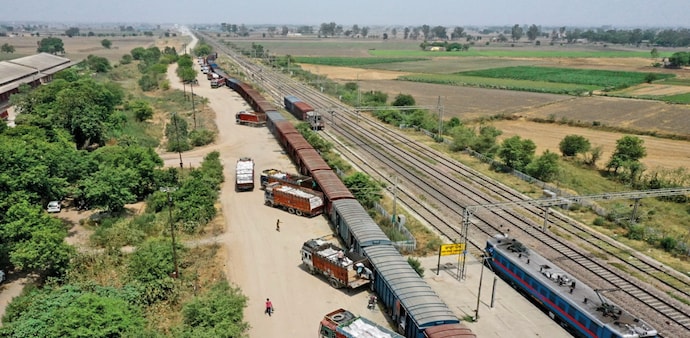
A train ride in India was once incomplete without the rattle of a passing coal-laden goods train. Throughout the 1990s, it was a familiar sight: black trains disappearing into the distance, leaving behind dust and diesel as they trudged along with unhurried intent. Coal was the fuel for progress, and rail the preferred carrier. Three decades on, while coal still holds its place, the railways are transporting far fewer commodities than before. Steel, iron and cement companies, which were once massive users of the rail network, have discovered a faster and more convenient way to transport their goods—trucks. Despite big bets involving billions of dollars, such as the Dedicated Freight Corridor (DFC), the share of trains in overall goods movement has stubbornly refused to budge. Even the movement of foreign containers is declining.
Hey!
Already a subscriber? Sign In
THIS IS A PREMIUM STORY FROM BUSINESS TODAY.
Subscribe to Business Today Digital and continue enjoying India's premier business offering uninterrupted
only FOR
₹999 / Year
Unlimited Digital Access + Ad Lite Experience
Cancel Anytime
-
 Unlimited access to Business Today website
 -
 Exclusive insights on Corporate India's working, every quarter
 -
 Access to our special editions, features, and priceless archives
 -
 Get front-seat access to events such as BT Best Banks, Best CEOs and Mindrush
A train ride in India was once incomplete without the rattle of a passing coal-laden goods train. Throughout the 1990s, it was a familiar sight: black trains disappearing into the distance, leaving behind dust and diesel as they trudged along with unhurried intent. Coal was the fuel for progress, and rail the preferred carrier. Three decades on, while coal still holds its place, the railways are transporting far fewer commodities than before. Steel, iron and cement companies, which were once massive users of the rail network, have discovered a faster and more convenient way to transport their goods—trucks. Despite big bets involving billions of dollars, such as the Dedicated Freight Corridor (DFC), the share of trains in overall goods movement has stubbornly refused to budge. Even the movement of foreign containers is declining.
Advertisement
The rail network is vital for carrying bulk commodities needed by industry and energy producers—coal for thermal power plants, iron ore, coking coal and limestone for steel plants, finished steel for manufacturing and construction, cement, food grains for national distribution, fertilizers for agriculture, and refined petroleum products for use by the common man. Also, freight earnings contribute 60-65% to the railways’ top line and are the backbone of its finances, allowing it to subsidise passenger fares.
Can the railways regain its lost territory? Does it have the time, and the instruments, to do so?
Advertisement
What's Ailing?
India transports around 6.3 billion tonnes of freight in a year. The annualised growth is roughly 6%. However, the share of railways in freight has remained around 26% over the last decade. In FY25, the growth was a mere 1.68% year-on-year, the lowest in the last five years, due to a decline in loading of most commodities.
Coal production grew 7.28% in 2024 compared to 8.2% in 2023 as the country’s energy demand touched a record 1,039.59 million tonnes (MT). Coal makes up for over 50% of the railways’ freight basket. The other half is non-coal freight, consisting of cement, iron, steel, food grains and export/import (EXIM) or goods containers. The growth of non-coal freight fell around 1 per cent from 803 MT in FY24 to 794.6 MT in FY25.
Advertisement
What is worrisome is the drop in the share of steel and cement in the overall freight transported by the railways. These commodities are now being increasingly moved by road due to faster connectivity on account of the massive upgrade of road infrastructure over the years and better cost economics. Carrying goods for shorter distances by railways is expensive than carrying them by road, according to industry players.
As far as the railways’ revenue is concerned, freight accounts for nearly 65%, with coal, iron ore and cement being the major contributors. The sluggish growth in freight also means a modest 3.7% growth in freight earnings in FY25 compared to 7% in FY24. To address falling revenues, the railways have set a target of doubling freight loading in the next five years. The goal is to reach 3,000 MT by 2030 from 1,617 MT at present.
“As far as the railways’ freight target is concerned, I see it touching 2,000 MT by 2030 in place of 3,000 MT, primarily because of capacity constraints on tracks. We know that the country’s GDP is growing at a fast pace and there is investment in the economy. If railways can’t carry, the freight will move to the road,” Manish Puri, President, of the Association of Container Train Operators (ACTO), tells Business Today.
Advertisement
ACTO is a lobby group for the container sector, which accounts for 5% of railways’ freight and is expected to offer growth opportunities in the coming years. Road handles approximately 65% of freight volume, followed by rail, which has a 26% share. Other modes of transport include coastal shipping, inland waterways and pipelines, which together handle the remaining 9% of the freight volume. Industry players flag capacity constraints, high cost, failure to attract lighter goods players and inability to corner the short-distance market behind the problems with the railways’ freight segment.
Pricing Concerns
A FICCI–PwC report, Container Train Operations After 20 Years of Deregulation: The Way Forward, released this April, said freight rates charged per tonne-mile for rail transportation in India are among the highest in the world. In 2021, it was `8.6 compared to `2.8 in Russia, which was the lowest, followed by China at `3 and the US at `4.
One of the reasons is cross-subsidies. Higher freight rates enable passenger fare discounts. This increases logistics costs in India. For long-distance transportation and bulk goods, rail has historically been more economical than road, while road is cheaper for lower volumes and short distances. To compete with road logistics, the railways is working on a policy to attract shorter-distance cargo with competitive tariffs. Prabhas Dansana, Principal Executive Director, Traffic Transportation, Ministry of Railways, says steps have been taken to rationalise the pricing and tariff structure. “Recent steps such as low rates for containers carrying stainless steel coils and a rationalised rate for bulk cement in containers indicate the willingness of the railways to address the gaps,” says Dansana, adding the policy is a work in progress.
Advertisement
Despite significant investments in container infrastructure, the share of container movement by the railways grew only marginally from 4% to 5% between 2014 and 2024, according to the report. An increase in container freight volume indicates a shift towards more sustainable, efficient and cost-effective logistics systems, which benefit the economy, environment and industrial development.
Container freight currently stands at 80 MT of the total 1,617 MT of freight handled by the railways, which is close to 5% of the total volume. Of this, exports and imports contribute nearly 80% of the container segment. To increase container freight’s share in the country’s total commodities basket, it needs to reach 10% of the rail’s total freight basket by 2030.
Achieving this goal will require a significant shift in the composition of container traffic, with greater emphasis on expanding domestic container volumes. In FY25, domestic container freight has seen growth of over 19%, improving significantly from an average annual growth of 7.5% over the last ten years.
On the other hand, there has been a drop of 0.6% in EXIM container freight growth, reversing the previous trend of 7% annual growth between FY14 and FY24. This fall is partly due to a higher mix of trans-shipment cargo, which reduces reliance on rail transport, along with a shift towards cargo originating closer to ports, lessening the need for long-haul rail movement.
Advertisement
“To attract more container volumes, there is also a demand for changing the pricing system for containers, and railways should not charge based on the commodities, but pricing based on trains. This could lead to more flexibility in end-user pricing by rail operators and help attract more volumes of light cargo emerging from the manufacturing sector,” says Puri.
Reducing the cost of empty haulage, nominating more terminals as exclusive container rail terminals and examining flexibility in wagon maintenance to allow greater private sector participation are some of the other issues that need to be addressed to improve the share of the container loading ecosystem in the overall rail traffic.
Need To Diversify
There has been a growing concern, even within the railways, over over-dependence on coal in the freight basket and the need for diversification of commodities. Though coal’s share is expected to remain high currently due to India’s dependence on the fuel for meeting power demand, it would gradually reduce as the country transitions to non-fossil fuels to meet energy needs.
“In the UK, Germany and the US, coal was a major portion of freight for railways some years back. This is like what we see in India now. However, today, in the UK, it (coal) is almost close to nil, in Germany, it is 5-10%. It is declining in the US also. Railways globally have taken measures to ensure that they do not lose the total cargo despite the reduction in the share of coal in the total cargo,” Lalit Chandra Trivedi, former general manager, of East Central Railway, tells BT. He points out that there is no plan in India for this transition and the level of containerisation which was expected hasn’t happened yet. “The total contribution of containerised traffic in the loading of Indian railways is hardly 5% and whatever container movement is taking place is basically for the EXIM business. No domestic cargo moving is by the rail-bound container,” he says. Indian Railways believes that to increase its freight share, it needs to significantly increase container traffic. And the Dedicated Freight Corridor (DFC) was expected to play a huge role in addressing this.
DFC On Slow Track
The eastern and western DFCs have been constructed at a cumulative cost of over `94,000 crore to develop 2,843 km of running capacity to expedite the freight movement. However, delays in the project completion, especially in connecting the Jawaharlal Nehru Port Trust (JPNT) with the western DFC, have hindered the railways from reaping the full potential of the infrastructure. The overall DFC network is envisioned to span 8,500 km along the Golden Quadrilateral Network (GQN) of the railways for seamless and faster freight movement. The GQN accounts for approximately 16% of the total length of the rail network but handles 58% of its freight traffic. Five DFCs along the GQN were commissioned, of which only two are partly operational, namely the Western DFC and the Eastern DFC. The remaining corridors are still in the development stage and need to be expedited.
Whether the Indian Railways reclaim market share from road logistics in the coming years would depend on how quickly innovative measures are put in place to turn around its freight business.
@richajourno
Read more!