
With Fin AI at the Helm, Bajaj Finance Triumphs Ahead
Underscoring this consistency, this Sanjiv Bajaj-run consumer finance major has been ranked the Best Large NBFC in the BT-KPMG Survey of India’s Best Banks & NBFCs for the third consecutive year.
Anand Adhikari
- Mar 10, 2026,
- Updated Mar 10, 2026 4:06 PM IST
After spending more than two decades at the helm, Ratan Tata retired in 2012 as chairman of Tata Sons, but was asked to return in 2016 to restore stability after his successor Cyrus Mistry’s sudden exit. At Infosys, N.R. Narayana Murthy, after nearly three decades in the corner room, returned as Executive Chairman in 2013. Globally, Disney turned to Bob Iger, who had exited in 2020 after nearly a decade-and-a-half as the CEO, bringing him back two years later as the entertainment giant grappled with losses. In each case, the return was a stopgap move aimed at stabilising the institution during a moment of sudden instability.
Hey!
Already a subscriber? Sign In
THIS IS A PREMIUM STORY FROM BUSINESS TODAY.
Subscribe to Business Today Digital and continue enjoying India's premier business offering uninterrupted
only FOR
₹999 / Year
Unlimited Digital Access + Ad Lite Experience
Cancel Anytime
-
 Unlimited access to Business Today website
 -
 Exclusive insights on Corporate India's working, every quarter
 -
 Access to our special editions, features, and priceless archives
 -
 Get front-seat access to events such as BT Best Banks, Best CEOs and Mindrush
After spending more than two decades at the helm, Ratan Tata retired in 2012 as chairman of Tata Sons, but was asked to return in 2016 to restore stability after his successor Cyrus Mistry’s sudden exit. At Infosys, N.R. Narayana Murthy, after nearly three decades in the corner room, returned as Executive Chairman in 2013. Globally, Disney turned to Bob Iger, who had exited in 2020 after nearly a decade-and-a-half as the CEO, bringing him back two years later as the entertainment giant grappled with losses. In each case, the return was a stopgap move aimed at stabilising the institution during a moment of sudden instability.
Advertisement
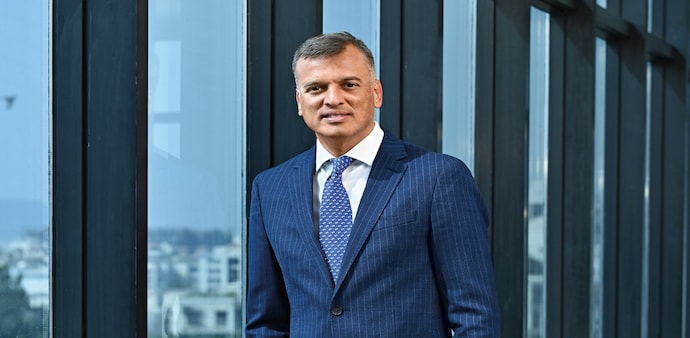
A similar pattern is unfolding at Bajaj Finance. Rajeev Jain, the professional who transformed the NBFC over nearly one-and-a-half decades as its MD & CEO, had to return to an executive role after the abrupt exit of his successor Anup Saha in 2025. In the absence of a ready successor, the board turned again to Jain, re-designating him as Vice Chairman and MD.
Despite some uncertainty over succession planning over the past few years, the country’s largest NBFC—with assets of `3.67 lakh crore—has continued to deliver strong performance. Underscoring this consistency, this Sanjiv Bajaj-run consumer finance major has been ranked the Best Large NBFC in the BT-KPMG Survey of India’s Best Banks & NBFCs for the third consecutive year.
Advertisement
Succession At Play
Bajaj Finance’s leadership transition resembles the classic GE succession model of the late 90s, when the outgoing CEO Jack Welch famously created a bench of three to four CEO-ready leaders before Jeff Immelt was finally selected. Interestingly, there is a direct GE connection here as well. Jain has previously held senior leadership roles at GE India and appears to be applying a similar institutional succession playbook. Today, Bajaj Finance has four Deputy CEOs – Manish Jain (also President-B2B & FD business), Sidhant Dadwal (also President-B2C & SME business), Harjeet Toor (President-Bharat Lending, MFI and Strategic Partnerships), and Manish Jain (also MD of Bajaj Financial Securities Ltd).
“Grooming and developing leadership talent and building a bench strength of leaders has always been an important area for us,” says Rajeev Jain. In fact, 90% of the top leaders at the NBFC have been with the company or the group for more than 10 years. As these leaders grow through various roles, their business and leadership mettle gets tested and refined.
Advertisement
The focus is on internal succession but the choice of Jain’s successor from the four Deputy CEOs remains open.
Business Model Change
The road ahead is mired with challenges. The new CEO will have to carry forward the AI agenda, where the company is already taking giant steps. “AI is not just a technology upgrade for us. It is a foundational capability we are weaving into our operating model,” says Jain. He adds that over the next three–five years, four factors will turn the company’s AI stack into a sustainable competitive moat—a business philosophy that embraces AI at scale; deep, proprietary data intelligence built over time; AI-native architecture with teams designed for scale; and strategic use of small language models in areas such as risk, fraud, collections, and customer service.
“We have invested in a dedicated 300-member AI organisation, structured across domains—voice, text, vision, agentic, data, and tech,” says Jain.
In fact, the lender has already completed a year of implementing its FinAI transformation. It has identified 123 high-impact areas across businesses and functions. The project is well beyond the pilot stage. “AI is embedded across every process—from sales and underwriting to service and collections—and we are seeing scaled outcomes across the organisation,” says Jain.
Advertisement
The company expects over `5,000 crore disbursals through conversational AI bots in FY26. At the enterprise level, starting Q3FY26, the Data for AI initiative is unlocking structural value. It has converted over 20 million voice interactions into text for all customer interactions. The company estimates that the initiative will enable `500 crore-plus annual disbursals by FY26. “This is a foundational shift that strengthens underwriting quality, cuts turnaround time, and meaningfully lowers manual dependency in documentation-heavy lending segments,” says Jain.
“Our Agentic AI POD reflects the future of service and operations. The operating model of the future will be agent-led, with human-in-the-loop, improving consistency and enhancing productivity,” he says.
The company also has a board-approved AI governance framework in place.
The benefits of the company’s AI implementation are already visible. “We’re seeing impact across costs, productivity, and customer experience today—and as we scale these capabilities across the company, the impact will be sustainable and exponential,” says Jain.
Today, nearly 48% of DIY customer servicing is handled by AI conversational (voice and text) BOTs. This frees up its teams to focus on more complex interactions while reducing operating load structurally. By March 2026, it expects over `5,000 crore personal loan business to be originated through AI-led channels. “It is fast becoming a mainstream channel for us,” says Jain.
Advertisement
By FY26, the company foresees nearly 300,000 plus DMS (debt management services) receipts through AI voice systems. “Our developers are seeing a 25% rise in productivity through AI coding assistants, and 25k+ test cases are now generated autonomously. We see the numbers increasing in FY27. This allows us to ship features faster and with higher quality,” says Jain.
“Operating expenses-to-net total income should go down by 150 bps from current levels of 32.8% over the next three-four years,” says Jain.
“The automation and use of data will result in saving opex and increasing productivity,” says Akshay Tiwari, AVP—Equity Research Analyst, Asit C Mehta Investment Interrmediates.
“A dramatic transition to new customer groups (e.g., heavy commercial vehicles or very high value mortgages) may cause the company to generate a temporary spike in credit costs. However, we believe that the company will make the transition smoothly as it has created a strong risk-first DNA,” says Gurvinder Juneja, Partner, portfolio management services firm Fortuna Asset Managers.
Stock Performance
From 2022 to 2024, the company’s stock price remained stagnant as investors were concerned about the possibility of a fintech disruption.
Advertisement
However, by 2025, it was evident that Bajaj’s omnichannel ecosystem, which includes more than 100 million customers, has created an impenetrable fortress for any digital-only applications,” says Juneja of Fortuna Asset Managers. “There was some momentum in 2025 even as the broader market was down due to the strong AUM growth of 20%-plus, when banks and other financial companies struggled to see credit offtake,” says Akshay Tiwari of Asit C Mehta Investment. Tiwari says the company has outlined its LRS (Long Range Strategy) 2026-2030 to maintain strong growth momentum in varied segments. “The company has delivered strong executional capabilities in the past, which makes the street confident about the LRS. The LRS includes new avenues such as green financing where the company has limited presence. The stock price saw momentum owing to customer addition momentum, credit growth, and LRS 2026-2030,” he says.
Be it succession or AI, Bajaj Finance is taking the challenge head-on. “The previous leadership of Rajeev Jain has built the ‘disruptive execution machine’. The new leadership of Bajaj Finance is not just leading a business; they are actually leading a proprietary algorithm. The criticality is in keeping the culture consistency,” says Juneja of Fortuna Asset Managers.
And Rajeev Jain is not going anywhere. The Sanjiv Bajaj–Rajeev Jain combination will steer the company at the board level as late Rahul Bajaj & Nanoo Pamnani did in the first phase of the company's growth journey.
Read more!