
With international collaborations and dynamic courses, IIM Indore is staying ahead of the curve
With international collaborations and dynamic courses, IIM Indore is staying ahead of the curve
IIM Indore has retained its fifth position with continued focus on placements, international collaborations, and dynamic courses.
Richa Sharma
- Dec 2, 2025,
- Updated Dec 2, 2025 12:02 PM IST
With AI disrupting industries across sectors, what does the future hold for C-suite executives? IIM-Indore is trying to find the answer—by training management graduates to create a synergy between technology and emotional intelligence.
Hey!
Already a subscriber? Sign In
THIS IS A PREMIUM STORY FROM BUSINESS TODAY.
Subscribe to Business Today Digital and continue enjoying India's premier business offering uninterrupted
only FOR
₹999 / Year
Unlimited Digital Access + Ad Lite Experience
Cancel Anytime
-
 Unlimited access to Business Today website
 -
 Exclusive insights on Corporate India's working, every quarter
 -
 Access to our special editions, features, and priceless archives
 -
 Get front-seat access to events such as BT Best Banks, Best CEOs and Mindrush
With AI disrupting industries across sectors, what does the future hold for C-suite executives? IIM-Indore is trying to find the answer—by training management graduates to create a synergy between technology and emotional intelligence.
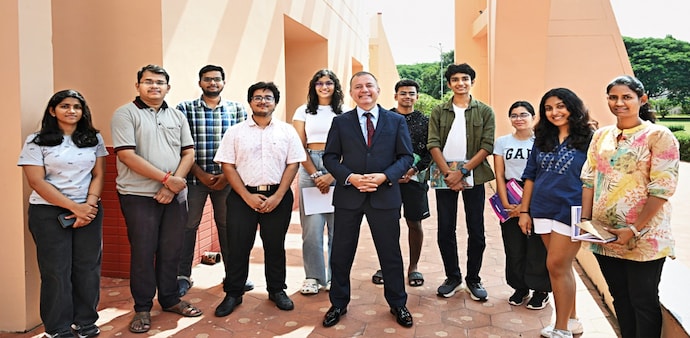
“The institute uses case-based pedagogy to train students. We give a business case and ask half the students to do it themselves and the other half to use AI tools such as ChatGPT and Gemini. Then we analyse what humans do better and what AI does better. Assuming generative AI delivers better results is not always true, and in some cases, human intervention is needed. Bringing that out in the classroom is important,” says Himanshu Rai, Director of IIM Indore.
Advertisement
Blindly trusting ChatGPT to do the right thing can be counterproductive, says Rai. “In a recruitment interview process, a consultancy company asked candidates to develop a PPT on leadership training model. The candidates used ChatGPT and were rejected, not because they used AI, but because their creatives showed all white males. The recruiter expected them to have noticed this ‘AI bias’ and correct it.”
As its mission states, the institute aims to be a contextually relevant business school with world-class academic standards to develop socially conscious managers. This strategy has also helped the institute make money as its revenues from executive education have increased six times in the last five years; they crossed Rs 100 crore this year. What’s more, all its students were placed in 2025, with a median salary of Rs 29.5 lakh per annum.
Advertisement
There are several reasons IIM Indore stands out. The curriculum is designed by an expert committee, also having corporate participation to design courses pertinent to Industry 5.0. Students are encouraged to develop leadership qualities, emotional intelligence, and resilience, which are essential as businesses face unprecedented change.
“In a digital-first world, technical expertise is essential, but human-centric skills—emotional intelligence, creativity, and critical thinking—are becoming more valuable. Automation and AI have made routine tasks obsolete, yet these technologies cannot replicate uniquely human qualities,” says Rai.
Skilling the faculty is a priority. The institute offers a generous allowance with which they can train themselves across the globe and ensure the availability of high-end computing machines and advanced digital resources.
Advertisement
IIM Indore has also started a diploma in AI-ML, and offers courses on Ethics in AI, and AI and Sustainability, keeping in mind their growing relevance.
“B-schools that focus on skilling students and continue to weed out redundant categories will remain at the top. With AI, certain jobs will become redundant. We, as a management institution, need to identify those categories and devise our courses accordingly,” says Rai.
The year 2025 began with the launch of three global executive education programmes—Global Sports Business Management, Global Healthcare Professional Programme, and Global Leadership Experience Programme for C-Suites.
“We are collaborating with world-class global institutes. In the last five years, over 40 foreign partners have come on board. About 16 foreign faculty members from international institutions visited us last year to teach and engage in collaborative research. This year, our one-year MBA, two-year MBA, Weekend-MBA, Executive Education (Open), and Executive Education (Custom), all of them are in the FT100 list,” says Rai.
As part of its socially conscious mission, the institute also works on nation building and addressing problems such as income disparity, rural challenges, urban infrastructure, and environment. “Our students stay in villages and work with the local administration to find solutions to problems in rural areas,” he adds.
Advertisement
As part of global cooperation, it has also conducted Customized Management Development Programmes for senior government officials from several countries and hosted a programme on Digital Public Infrastructure for 30 senior government officials from 20 nations.
What’s new? The institute is working to start a joint certification programme with international institutes and is in advanced talks with an international partner for a joint PhD programme.
@richajourno
Read more!