
Women in BFSI: The Power Ledger in BFSI
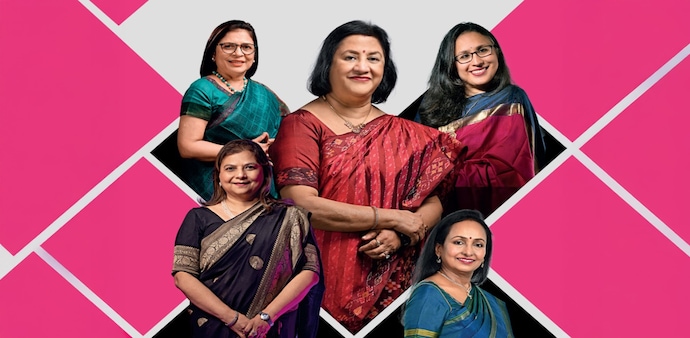
In the past few decades, women have quietly risen across India's banking, financial services, and insurance sector. Here women's leadership isn't the exception, it's the legacy.
Anand Adhikari
- Dec 20, 2025,
- Updated Dec 22, 2025 1:10 PM IST
When Arundhati Bhattacharya was transferred to Lucknow in the mid-2000s to become the new General Manager, she considered bidding goodbye to State Bank of India (SBI), the country’s largest bank. Her biggest worry was finding a good school for her daughter. The decision to move from her hometown, Kolkata, was difficult.
Advertisement
Her mentor M. S. Verma’s advice came in handy. The former chairman of SBI and TRAI encouraged her to take the opportunity saying she had come a long way and there was no question of giving up when she was so close to reaching the top. Bhattacharya took that advice—and it turned out to be the best decision she made, as years later she would shatter one of India’s oldest glass ceilings by becoming the first woman to head the country’s largest bank.
Vibha Padalkar, the MD & CEO of HDFC Life, didn’t have to look far for inspiration or advice like Bhattacharya, since most of it came from her family. “I come from a family that has had several accomplished women, including my mother, who was a trailblazer herself,” she says. Her mother was a 1964-batch IAS officer. Her aunts were accomplished in their respective fields, too, ranging from doctors to filmmakers. “The ‘finance spark’ was ignited by my uncle, who was a finance director himself,” recalls a beaming Padalkar.
Advertisement
Not every successful woman has such mentors at work or home. Every woman professional’s journey is different, yet each one carries a powerful story. And there are many such stories from the past few decades, especially in the BFSI sector—ICICI Bank’s Kalpana Morparia, Renuka Ramnath, and Lalita D. Gupte; HSBC’s Naina Lal Kidwai; and RBI deputy governor K. J. Udeshi (the first woman to hold the post) and later Shyamala Gopinath and Usha Thorat. They all began working in the 1970s, when a career was not the norm for women.
Renu Sud Karnad, former MD of HDFC Ltd and now an independent director on boards of several companies, offers a glimpse into those years and what kept her motivated. She started her journey at HDFC, where the mission was to help middle-class families buy a home—something that was very difficult before HDFC came into being in 1977.
Advertisement
“Knowing that our work made a real difference to society kept me driven, and I could see the impact of doing the job well,” Karnad says. Her parents and husband supported her fully. “When your focus stays on results, gender slowly stops being the defining factor. It took perseverance, but the belief that good work speaks louder than perceptions helped me stay the course,” says Karnad.
The women of her era began their journey despite facing numerous challenges. But something within kept pushing them forward, turning them into inspirations for many young women in subsequent years. That shows in numbers. According to a 2024 CareEdge-ESG analysis of 59 BFSI companies with a combined workforce of 1.89 million employees, including 632,000 women, the median female representation in the sector stands at 22%. Women accounted for 10-30% staff strength at most companies in FY24.
What’s Driving This
The shift did not happen overnight. “Over the years, the system has become more supportive of women,” says Karnad. Without doubt, HR policies around diversity, maternity leave, workplace safety, flexible work, mentorship, equality at work, and workplace harassment have given women more confidence to build a long career.
Advertisement
“I think that the BFSI/fintech sector is perhaps a bit easier for women to thrive in. The conducive environment is a combination of various factors, including employee-friendly policies, relatively younger workforce, increased use of technology, and a culture of inclusive leadership, which attracts more women to the workforce,” says Padalkar.
It helps that women can see real role models in finance now. As more women enter the industry, companies have realised that a diverse leadership strengthens teams and improves how businesses connect with customers, says Padalkar.
Karnad believes women today are no longer restricted by geography or hierarchy—digital platforms let them learn, lead, and draw inspiration from those who have broken barriers. This has expanded their horizons, showing them what’s possible. “Technology now enables women to showcase their abilities and access opportunities without depending on legacy networks,” she says.
Radhika Gupta, MD & CEO of Edelweiss Asset Management, attributes this to the power of the pipeline. “Over the past two decades, many more women entered finance at the entry level, and that cohort is now reaching leadership positions. So, this moment has been building quietly for a long time,” says Gupta, who was entrusted with large, complex assignments—like managing the acquisition of the Indian MF business of JP Morgan Mutual Fund in 2016-17.
Advertisement
Gupta points to changes in workplaces that have helped women, like the shift from the old command-and-control model to a more collaborative, empathetic, and flexible style of leadership, qualities where women often thrive. “Policy changes and organisational intent have also helped, but I’d say the biggest shift is cultural—we’re finally seeing ambition in women being celebrated, not questioned,” says Gupta.
She often comes across many young women today—even from Tier II and III cities—who tell her they want to be CEOs. That mindset didn’t exist a generation ago. There are stories, role models, and a growing belief that these ambitions are achievable. Besides, some women have incredible family and support systems around them. “I always tell young girls: use that support well; it’s your superpower,” says Gupta.
Amisha Vora, owner, Chairperson & Managing Director of PL Capital, believes that the BFSI sector has nurtured more women leaders because it is inherently merit-driven and performance-oriented. “In financial services, outcomes are tangible and measurable, which naturally limits the role of bias or informal networks that may influence career growth elsewhere. Moreover, the very nature of the sector—underwriting, risk evaluation, and long-term decision-making—aligns strongly with qualities many women bring,” she says.
Advertisement
The X Factor
Experience shows that women often bring qualities that serve particularly well in finance. “Earlier, leadership was largely defined by authority, speed, and decisiveness. Today, it is increasingly defined by clarity, emotional intelligence, and the ability to create alignment,” says Vora. Financial institutions are recognising that balanced leadership styles translate into better client engagement, stronger governance, and sustainable business performance. “As a result, the value of women’s leadership across the BFSI sector is being acknowledged more strongly than ever,” says Vora.
Gupta says women bring a distinct leadership energy—one that blends empathy, resilience, and long-term thinking. “CEOs today manage multiple stakeholders—investors, employees, customers, and regulators—and that ability to balance perspectives and build trust comes naturally to women,” she says.
Padalkar doesn’t believe women bring “less or more” energy—they simply bring their own strengths, she says. They bring in some fresh perspectives that might even be contrarian to popular thinking. “Given our consumer set is 50% female, companies would naturally benefit from taking advantage of all points of view, be it in driving strategy or customer outreach,” says Padalkar.
Besides, women tend to be careful with money, strong with relationships, and comfortable working as a team, explains Karnad. Financial institutions run on trust and empathy, and women handle these aspects naturally, she adds.
Karnad’s point is also supported by an IMF study, titled “Banking on Women Leaders: A Case for More?”. Banks with more women on boards and in leadership roles show greater stability, the study states. This includes lower non-performing loans.
“In a world increasingly shaped by technology and AI, human qualities like empathy, judgement, and emotional intelligence are becoming even more valuable. And beyond gender, any form of diverse thinking makes organisations stronger. Finance is no longer just about numbers; it’s about behaviour, trust, and sustainability. It’s heartening that this difference is now being valued, not just acknowledged,” says Gupta.
Accelerating Women’s Rise
Karnad says policies favourable to women alone are not enough. “Families and organisations both play a role. When companies invest in safety, flexible work, childcare support, and clear action against harassment, women do not have to choose between career and home. When families back their daughters and daughters-in-law the way they support sons, more women reach leadership,” she says.
Vora suggests that normalising flexible work arrangements, providing accessible childcare options, and fostering environments where both men and women share domestic responsibilities, can remove significant barriers that hold women back from reaching their full leadership potential. “This kind of systemic change would not only support women but also strengthen organisations by retaining diverse talent and enabling leaders to bring their best selves to work consistently,” she says.
The most important thing is to ensure that the hiring funnel of new recruits includes a good share of women, suggests Padalkar. The second is to provide a structured career path for women along with mentoring, and the third is the availability of flexible working arrangements during certain times in their careers. These factors can play a big role in enabling companies to produce women leaders, says Padalkar.
Gupta of Edelweiss says the real game-changer now could be support—especially around the years when women juggle careers and young families. “Having been a young mother myself, I’ve seen how critical mentoring, trust, and mental health support are during that phase. A woman doesn’t just need six months of maternity leave—she needs years of understanding, flexibility, and handholding. A six-month-old baby doesn’t stop needing a mother,” she adds.
Culture also matters enormously—like the language used in offices, the way managers behave, and the everyday signals that either include or exclude. “And finally, role modelling. We need more examples that show finance isn’t just for men, that ambition and family can coexist, and that women can lead in their own authentic way,” adds Gupta.
Clearly, women in BFSI are leading from the front, and it’s only a matter of time before other sectors witness a similar trend as technology, digital adoption and flexible work continue to break long-standing barriers.
When Arundhati Bhattacharya was transferred to Lucknow in the mid-2000s to become the new General Manager, she considered bidding goodbye to State Bank of India (SBI), the country’s largest bank. Her biggest worry was finding a good school for her daughter. The decision to move from her hometown, Kolkata, was difficult.
Advertisement
Her mentor M. S. Verma’s advice came in handy. The former chairman of SBI and TRAI encouraged her to take the opportunity saying she had come a long way and there was no question of giving up when she was so close to reaching the top. Bhattacharya took that advice—and it turned out to be the best decision she made, as years later she would shatter one of India’s oldest glass ceilings by becoming the first woman to head the country’s largest bank.
Vibha Padalkar, the MD & CEO of HDFC Life, didn’t have to look far for inspiration or advice like Bhattacharya, since most of it came from her family. “I come from a family that has had several accomplished women, including my mother, who was a trailblazer herself,” she says. Her mother was a 1964-batch IAS officer. Her aunts were accomplished in their respective fields, too, ranging from doctors to filmmakers. “The ‘finance spark’ was ignited by my uncle, who was a finance director himself,” recalls a beaming Padalkar.
Advertisement
Not every successful woman has such mentors at work or home. Every woman professional’s journey is different, yet each one carries a powerful story. And there are many such stories from the past few decades, especially in the BFSI sector—ICICI Bank’s Kalpana Morparia, Renuka Ramnath, and Lalita D. Gupte; HSBC’s Naina Lal Kidwai; and RBI deputy governor K. J. Udeshi (the first woman to hold the post) and later Shyamala Gopinath and Usha Thorat. They all began working in the 1970s, when a career was not the norm for women.
Renu Sud Karnad, former MD of HDFC Ltd and now an independent director on boards of several companies, offers a glimpse into those years and what kept her motivated. She started her journey at HDFC, where the mission was to help middle-class families buy a home—something that was very difficult before HDFC came into being in 1977.
Advertisement
“Knowing that our work made a real difference to society kept me driven, and I could see the impact of doing the job well,” Karnad says. Her parents and husband supported her fully. “When your focus stays on results, gender slowly stops being the defining factor. It took perseverance, but the belief that good work speaks louder than perceptions helped me stay the course,” says Karnad.
The women of her era began their journey despite facing numerous challenges. But something within kept pushing them forward, turning them into inspirations for many young women in subsequent years. That shows in numbers. According to a 2024 CareEdge-ESG analysis of 59 BFSI companies with a combined workforce of 1.89 million employees, including 632,000 women, the median female representation in the sector stands at 22%. Women accounted for 10-30% staff strength at most companies in FY24.
What’s Driving This
The shift did not happen overnight. “Over the years, the system has become more supportive of women,” says Karnad. Without doubt, HR policies around diversity, maternity leave, workplace safety, flexible work, mentorship, equality at work, and workplace harassment have given women more confidence to build a long career.
Advertisement
“I think that the BFSI/fintech sector is perhaps a bit easier for women to thrive in. The conducive environment is a combination of various factors, including employee-friendly policies, relatively younger workforce, increased use of technology, and a culture of inclusive leadership, which attracts more women to the workforce,” says Padalkar.
It helps that women can see real role models in finance now. As more women enter the industry, companies have realised that a diverse leadership strengthens teams and improves how businesses connect with customers, says Padalkar.
Karnad believes women today are no longer restricted by geography or hierarchy—digital platforms let them learn, lead, and draw inspiration from those who have broken barriers. This has expanded their horizons, showing them what’s possible. “Technology now enables women to showcase their abilities and access opportunities without depending on legacy networks,” she says.
Radhika Gupta, MD & CEO of Edelweiss Asset Management, attributes this to the power of the pipeline. “Over the past two decades, many more women entered finance at the entry level, and that cohort is now reaching leadership positions. So, this moment has been building quietly for a long time,” says Gupta, who was entrusted with large, complex assignments—like managing the acquisition of the Indian MF business of JP Morgan Mutual Fund in 2016-17.
Advertisement
Gupta points to changes in workplaces that have helped women, like the shift from the old command-and-control model to a more collaborative, empathetic, and flexible style of leadership, qualities where women often thrive. “Policy changes and organisational intent have also helped, but I’d say the biggest shift is cultural—we’re finally seeing ambition in women being celebrated, not questioned,” says Gupta.
She often comes across many young women today—even from Tier II and III cities—who tell her they want to be CEOs. That mindset didn’t exist a generation ago. There are stories, role models, and a growing belief that these ambitions are achievable. Besides, some women have incredible family and support systems around them. “I always tell young girls: use that support well; it’s your superpower,” says Gupta.
Amisha Vora, owner, Chairperson & Managing Director of PL Capital, believes that the BFSI sector has nurtured more women leaders because it is inherently merit-driven and performance-oriented. “In financial services, outcomes are tangible and measurable, which naturally limits the role of bias or informal networks that may influence career growth elsewhere. Moreover, the very nature of the sector—underwriting, risk evaluation, and long-term decision-making—aligns strongly with qualities many women bring,” she says.
Advertisement
The X Factor
Experience shows that women often bring qualities that serve particularly well in finance. “Earlier, leadership was largely defined by authority, speed, and decisiveness. Today, it is increasingly defined by clarity, emotional intelligence, and the ability to create alignment,” says Vora. Financial institutions are recognising that balanced leadership styles translate into better client engagement, stronger governance, and sustainable business performance. “As a result, the value of women’s leadership across the BFSI sector is being acknowledged more strongly than ever,” says Vora.
Gupta says women bring a distinct leadership energy—one that blends empathy, resilience, and long-term thinking. “CEOs today manage multiple stakeholders—investors, employees, customers, and regulators—and that ability to balance perspectives and build trust comes naturally to women,” she says.
Padalkar doesn’t believe women bring “less or more” energy—they simply bring their own strengths, she says. They bring in some fresh perspectives that might even be contrarian to popular thinking. “Given our consumer set is 50% female, companies would naturally benefit from taking advantage of all points of view, be it in driving strategy or customer outreach,” says Padalkar.
Besides, women tend to be careful with money, strong with relationships, and comfortable working as a team, explains Karnad. Financial institutions run on trust and empathy, and women handle these aspects naturally, she adds.
Karnad’s point is also supported by an IMF study, titled “Banking on Women Leaders: A Case for More?”. Banks with more women on boards and in leadership roles show greater stability, the study states. This includes lower non-performing loans.
“In a world increasingly shaped by technology and AI, human qualities like empathy, judgement, and emotional intelligence are becoming even more valuable. And beyond gender, any form of diverse thinking makes organisations stronger. Finance is no longer just about numbers; it’s about behaviour, trust, and sustainability. It’s heartening that this difference is now being valued, not just acknowledged,” says Gupta.
Accelerating Women’s Rise
Karnad says policies favourable to women alone are not enough. “Families and organisations both play a role. When companies invest in safety, flexible work, childcare support, and clear action against harassment, women do not have to choose between career and home. When families back their daughters and daughters-in-law the way they support sons, more women reach leadership,” she says.
Vora suggests that normalising flexible work arrangements, providing accessible childcare options, and fostering environments where both men and women share domestic responsibilities, can remove significant barriers that hold women back from reaching their full leadership potential. “This kind of systemic change would not only support women but also strengthen organisations by retaining diverse talent and enabling leaders to bring their best selves to work consistently,” she says.
The most important thing is to ensure that the hiring funnel of new recruits includes a good share of women, suggests Padalkar. The second is to provide a structured career path for women along with mentoring, and the third is the availability of flexible working arrangements during certain times in their careers. These factors can play a big role in enabling companies to produce women leaders, says Padalkar.
Gupta of Edelweiss says the real game-changer now could be support—especially around the years when women juggle careers and young families. “Having been a young mother myself, I’ve seen how critical mentoring, trust, and mental health support are during that phase. A woman doesn’t just need six months of maternity leave—she needs years of understanding, flexibility, and handholding. A six-month-old baby doesn’t stop needing a mother,” she adds.
Culture also matters enormously—like the language used in offices, the way managers behave, and the everyday signals that either include or exclude. “And finally, role modelling. We need more examples that show finance isn’t just for men, that ambition and family can coexist, and that women can lead in their own authentic way,” adds Gupta.
Clearly, women in BFSI are leading from the front, and it’s only a matter of time before other sectors witness a similar trend as technology, digital adoption and flexible work continue to break long-standing barriers.
Read more!