
AI at scale is the next growth engine: TCS CEO & MD K Krithivasan
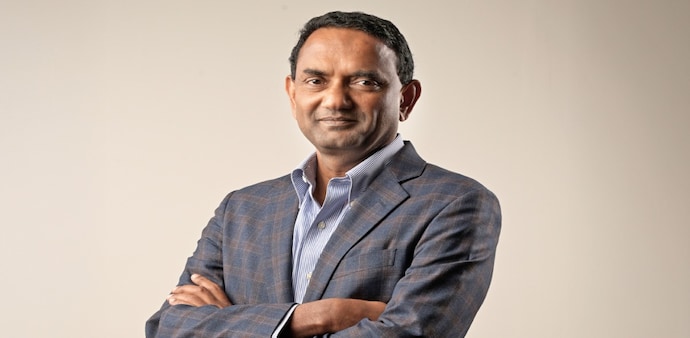
K. Krithivasan, CEO & MD, TCS, on leading the tech disruption and managing the fast-evolving AI landscape.
- Sep 8, 2025,
- Updated Sep 8, 2025 2:43 PM IST
Tata Consultancy Services has been the bellwether for the Indian IT industry, which is facing cost pressures and technology disruption, especially from artificial intelligence (AI). Despite this, TCS has retained its position in BT’s list of the top 10 most profitable companies. K. Krithivasan, Chief Executive Officer and Managing Director, explains what makes the company tick and the outlook for the future. Edited excerpts:
Q: From a strategic point of view, what has TCS got right in the last two-three years?
A: TCS has pursued a future-ready strategy built on three pillars: embedding AI at scale, bringing innovation closer to clients, and preparing our workforce for the skills of tomorrow. These aren’t just ideas, but key drivers that have allowed us to thrive in an environment marked by technological disruption, shifting client priorities and global uncertainty.
We have stayed ahead by investing in AI research and innovation centres in key geographies. These are collaborative spaces where our teams and clients work to build solutions, rapidly prototype ideas, and deploy industry-specific AI capabilities at speed. This ensures that our innovations are context-rich, relevant, and immediately deployable. Enterprises that are focused on scaling up AI adoption across applications, workflows and data performance remain strong.
Q: Clearly, a lot is being done on AI…
A: TCS’ talent strategy is centred around AI fluency for all. Our company-wide initiative, tcsAI, is scaling up access to AI across every function. From developer tools in the software development lifecycle (SDLC) to AI environments to perform experiments, learn and build, and GenAI-powered internal processes, we are enabling every TCS employee to work with AI ethically, creatively and productively. One of our first flagship programmes is the TCS AI Hackathon 2025. This is a global, hybrid event that invites employees from all functions to contribute ideas, build solutions and apply AI to real challenges. It is supported by weekly AI Fridays at in-person labs for everyone to build AI solutions.
Our strong ecosystem of partnerships has helped accelerate this journey. With NVIDIA, for instance, we have a dedicated unit combining their technology with our domain expertise to deliver industry-specific AI solutions across sectors such as telecom, manufacturing, and BFSI. We have recently expanded our long-standing collaboration with Microsoft to develop new AI and Cloud solutions to equip customers for the future. We have also enhanced and augmented our own platforms with AI, enabling clients to innovate faster, automate at scale and drive measurable business outcomes with greater speed and efficiency. This blend of industry-leading partnerships, strategic future-readiness and targeted investments in infrastructure and talent has solidified TCS’ position to lead and make bold bets for the future.
Q: Are rising costs becoming a challenge in the current global scenario?
A: The past few years have been marked by inflationary pressures, supply chain disruptions and global uncertainty. They have become a part of the everyday business landscape. Yet, we have maintained healthy margins and strong cash flows. This has been possible because of a disciplined focus on delivery and operational excellence. Delivering first-time-right is the best way to achieve strong margin performance.
Q: Can you elaborate a little on this point?
A: We manage our delivery pyramid mix with precision, structuring teams in a way that maximises both customer delight and efficiency. Our location strategy, built around balancing onsite, offshore, and nearshore delivery, means we can stay close to our clients where needed, while benefiting from cost efficiencies across our Global Network Delivery Model.
The other part is our ability to anticipate skills of the future. By upskilling and reskilling our workforce in AI, Cloud, cybersecurity, and data analytics, we ensure that teams can pivot quickly to meet evolving client demands. This ensures we can respond to market changes in real time.
Q: How does a strong balance sheet set you up to put in place a more robust business model?
A: This financial strength enables us to accelerate capability building in high-growth areas such as AI, cloud, cybersecurity, and quantum, while also investing in infrastructure from data centres to AI platforms. It means we can deliver transformation at scale. For instance, we recently set up an innovation centre in Singapore, expanding our AI research and innovation footprint to 13 hubs globally. Through this we are helping clients speed up innovation cycles by giving them faster access to advanced capabilities and TCS’ expertise. In Latin America, we strengthened our presence with a new AI-driven operations centre in Mexico City, and in Europe, we expanded our software-defined vehicle innovation capabilities with three new hubs.
A strong balance sheet also allows us to transform business models without waiting for disruption. We can reimagine delivery models, enter new markets, and expand infrastructure from a position of strength. And because we can take a long-term view, we align our investments with what clients will need tomorrow.
Q: As a tech-led company, how do you deal with disruption and yet create it yourself?
A: Dealing with disruption and driving it are two sides of the same coin. On the one hand, we are deeply embedded in our clients’ realities, helping them optimise costs, manage risks and adapt to ever-shifting technology cycles. With AI, for instance, the opportunities are immense, not only in enhancing delivery and accelerating technology adoption but also in democratising access so that its benefits reach society at large.
On the other side, we have built AI-powered platforms that are already helping clients reimagine everything from supply chains to retail pricing and energy efficiency. Our centres of excellence and delivery units are constantly developing new industry-specific solutions, whether in BFSI, telecom, manufacturing, or healthcare.
Q: There must be other things you must be doing here…
A: To further strengthen our ability to navigate this fast-changing environment, we have recently appointed a Chief Strategy Officer to help us build and adapt an evolving strategy that keeps us ahead of market shifts and a Chief Operating Officer to further enhance our operational excellence. In today’s dynamic business climate, where technology cycles are accelerating and client expectations are evolving in real time, these roles are critical for ensuring that strategic foresight and flawless execution go hand in hand.
We also invest in emerging technologies ahead of the curve: agentic AI, digital twins, physical AI, so we influence markets rather than simply respond to them. Our partnerships with players like NVIDIA, Microsoft, Google Cloud, and AWS, are accelerators in this journey.
Q: What will the revenue and profitability drivers be for TCS?
A: The evolving technology landscape provides multiple opportunities for growth. The first and most important driver will be AI-led transformation at scale. We are moving beyond pilot projects to full-scale enterprise adoption of AI across industries. Our dedicated AI & Data unit, industry-specific AI centres and proprietary platforms will power this shift, enabling clients to improve productivity, accelerate decision-making, and innovate at an unprecedented pace. By embedding AI into every stage of the value chain, we can help organisations unlock entirely new business models and revenue streams.
Complementing this will be industry-specific solutions that address complex challenges in sectors such as BFSI, manufacturing, healthcare, retail, and telecom.
Another key driver will be Cloud modernisation and integration. Many enterprises are accelerating their Cloud journeys, and we expect this to continue, often in tandem with AI adoption. Then there is cybersecurity. As data becomes the core of every enterprise, safeguarding it is no longer optional—in fact, it is critical to business. We see rising demand for advanced solutions such as sovereign cloud, zero-trust architectures, AI-powered threat detection, and managed security services. Responding to this, we recently launched a cloud platform for government and public sector enterprises to host mission-critical applications and protect sensitive data.
In India, there is a strong focus on indigenous technology leadership. TCS is playing a leading role in this self-reliance, including pioneering the country’s first domestically produced semiconductor chips in partnership with Tata Electronics. We are partnering with IBM and the government of Andhra Pradesh to build India’s largest quantum computing hub. These initiatives combine our strengths in chip design, AI, and Cloud to build a resilient, future-ready ecosystem. Lastly, operational excellence and workforce productivity will remain central to sustaining profitability. By combining human expertise with AI-enabled delivery models, automation and continuous skilling, we can ensure that growth is both sustainable and efficient for the long term.
@krishnagopalan
Tata Consultancy Services has been the bellwether for the Indian IT industry, which is facing cost pressures and technology disruption, especially from artificial intelligence (AI). Despite this, TCS has retained its position in BT’s list of the top 10 most profitable companies. K. Krithivasan, Chief Executive Officer and Managing Director, explains what makes the company tick and the outlook for the future. Edited excerpts:
Q: From a strategic point of view, what has TCS got right in the last two-three years?
A: TCS has pursued a future-ready strategy built on three pillars: embedding AI at scale, bringing innovation closer to clients, and preparing our workforce for the skills of tomorrow. These aren’t just ideas, but key drivers that have allowed us to thrive in an environment marked by technological disruption, shifting client priorities and global uncertainty.
We have stayed ahead by investing in AI research and innovation centres in key geographies. These are collaborative spaces where our teams and clients work to build solutions, rapidly prototype ideas, and deploy industry-specific AI capabilities at speed. This ensures that our innovations are context-rich, relevant, and immediately deployable. Enterprises that are focused on scaling up AI adoption across applications, workflows and data performance remain strong.
Q: Clearly, a lot is being done on AI…
A: TCS’ talent strategy is centred around AI fluency for all. Our company-wide initiative, tcsAI, is scaling up access to AI across every function. From developer tools in the software development lifecycle (SDLC) to AI environments to perform experiments, learn and build, and GenAI-powered internal processes, we are enabling every TCS employee to work with AI ethically, creatively and productively. One of our first flagship programmes is the TCS AI Hackathon 2025. This is a global, hybrid event that invites employees from all functions to contribute ideas, build solutions and apply AI to real challenges. It is supported by weekly AI Fridays at in-person labs for everyone to build AI solutions.
Our strong ecosystem of partnerships has helped accelerate this journey. With NVIDIA, for instance, we have a dedicated unit combining their technology with our domain expertise to deliver industry-specific AI solutions across sectors such as telecom, manufacturing, and BFSI. We have recently expanded our long-standing collaboration with Microsoft to develop new AI and Cloud solutions to equip customers for the future. We have also enhanced and augmented our own platforms with AI, enabling clients to innovate faster, automate at scale and drive measurable business outcomes with greater speed and efficiency. This blend of industry-leading partnerships, strategic future-readiness and targeted investments in infrastructure and talent has solidified TCS’ position to lead and make bold bets for the future.
Q: Are rising costs becoming a challenge in the current global scenario?
A: The past few years have been marked by inflationary pressures, supply chain disruptions and global uncertainty. They have become a part of the everyday business landscape. Yet, we have maintained healthy margins and strong cash flows. This has been possible because of a disciplined focus on delivery and operational excellence. Delivering first-time-right is the best way to achieve strong margin performance.
Q: Can you elaborate a little on this point?
A: We manage our delivery pyramid mix with precision, structuring teams in a way that maximises both customer delight and efficiency. Our location strategy, built around balancing onsite, offshore, and nearshore delivery, means we can stay close to our clients where needed, while benefiting from cost efficiencies across our Global Network Delivery Model.
The other part is our ability to anticipate skills of the future. By upskilling and reskilling our workforce in AI, Cloud, cybersecurity, and data analytics, we ensure that teams can pivot quickly to meet evolving client demands. This ensures we can respond to market changes in real time.
Q: How does a strong balance sheet set you up to put in place a more robust business model?
A: This financial strength enables us to accelerate capability building in high-growth areas such as AI, cloud, cybersecurity, and quantum, while also investing in infrastructure from data centres to AI platforms. It means we can deliver transformation at scale. For instance, we recently set up an innovation centre in Singapore, expanding our AI research and innovation footprint to 13 hubs globally. Through this we are helping clients speed up innovation cycles by giving them faster access to advanced capabilities and TCS’ expertise. In Latin America, we strengthened our presence with a new AI-driven operations centre in Mexico City, and in Europe, we expanded our software-defined vehicle innovation capabilities with three new hubs.
A strong balance sheet also allows us to transform business models without waiting for disruption. We can reimagine delivery models, enter new markets, and expand infrastructure from a position of strength. And because we can take a long-term view, we align our investments with what clients will need tomorrow.
Q: As a tech-led company, how do you deal with disruption and yet create it yourself?
A: Dealing with disruption and driving it are two sides of the same coin. On the one hand, we are deeply embedded in our clients’ realities, helping them optimise costs, manage risks and adapt to ever-shifting technology cycles. With AI, for instance, the opportunities are immense, not only in enhancing delivery and accelerating technology adoption but also in democratising access so that its benefits reach society at large.
On the other side, we have built AI-powered platforms that are already helping clients reimagine everything from supply chains to retail pricing and energy efficiency. Our centres of excellence and delivery units are constantly developing new industry-specific solutions, whether in BFSI, telecom, manufacturing, or healthcare.
Q: There must be other things you must be doing here…
A: To further strengthen our ability to navigate this fast-changing environment, we have recently appointed a Chief Strategy Officer to help us build and adapt an evolving strategy that keeps us ahead of market shifts and a Chief Operating Officer to further enhance our operational excellence. In today’s dynamic business climate, where technology cycles are accelerating and client expectations are evolving in real time, these roles are critical for ensuring that strategic foresight and flawless execution go hand in hand.
We also invest in emerging technologies ahead of the curve: agentic AI, digital twins, physical AI, so we influence markets rather than simply respond to them. Our partnerships with players like NVIDIA, Microsoft, Google Cloud, and AWS, are accelerators in this journey.
Q: What will the revenue and profitability drivers be for TCS?
A: The evolving technology landscape provides multiple opportunities for growth. The first and most important driver will be AI-led transformation at scale. We are moving beyond pilot projects to full-scale enterprise adoption of AI across industries. Our dedicated AI & Data unit, industry-specific AI centres and proprietary platforms will power this shift, enabling clients to improve productivity, accelerate decision-making, and innovate at an unprecedented pace. By embedding AI into every stage of the value chain, we can help organisations unlock entirely new business models and revenue streams.
Complementing this will be industry-specific solutions that address complex challenges in sectors such as BFSI, manufacturing, healthcare, retail, and telecom.
Another key driver will be Cloud modernisation and integration. Many enterprises are accelerating their Cloud journeys, and we expect this to continue, often in tandem with AI adoption. Then there is cybersecurity. As data becomes the core of every enterprise, safeguarding it is no longer optional—in fact, it is critical to business. We see rising demand for advanced solutions such as sovereign cloud, zero-trust architectures, AI-powered threat detection, and managed security services. Responding to this, we recently launched a cloud platform for government and public sector enterprises to host mission-critical applications and protect sensitive data.
In India, there is a strong focus on indigenous technology leadership. TCS is playing a leading role in this self-reliance, including pioneering the country’s first domestically produced semiconductor chips in partnership with Tata Electronics. We are partnering with IBM and the government of Andhra Pradesh to build India’s largest quantum computing hub. These initiatives combine our strengths in chip design, AI, and Cloud to build a resilient, future-ready ecosystem. Lastly, operational excellence and workforce productivity will remain central to sustaining profitability. By combining human expertise with AI-enabled delivery models, automation and continuous skilling, we can ensure that growth is both sustainable and efficient for the long term.
@krishnagopalan