
Free cash flow most relevant measure: Vellayan Subbiah on Murugappa Group's foray into new technology sectors
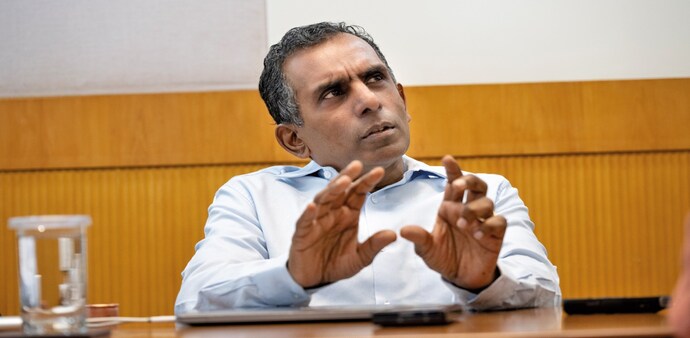
Vellayan Subbiah, who heads three companies in the Murugappa Group, on the conglomerate's forays into new technology sectors.
- Mar 30, 2026,
- Updated Mar 30, 2026 1:59 PM IST
To the world outside, the Chennai-based Murugappa Group is known for its quiet efficiency. The conglomerate runs many businesses and is on a constant quest to move into new business areas in a country with opportunities aplenty.
At the helm of three key group companies—Tube Investments of India, CG Power and Industrial Solutions and Cholamandalam Investment and Finance Company—sits Vellayan Subbiah. A fourth-generation member of the founding family, he is known for his turnaround prowess, among other things. In an interview with BT, Subbiah, who has been adjudged the Business Icon of the Year in the BT-PwC India’s Best CEOs list, talks about the challenges in running diversified businesses and the reason the group dove into semiconductors. Edited excerpts:
A lot has happened in your businesses over the past 18 to 24 months. What are some of the things you got right from a strategic perspective?
If we look at it a little closely, there are certain principles and a basic understanding that have evolved over time; and, to be honest, they are still evolving.
Let’s take Tube Investments of India for example. Usually, I like containing a problem down to a finite set of controllable variables. In 2018, we started a transformation exercise, and I clearly outlined that it had to grow around four parameters.
Here it was revenue growth, profit before tax to sales, and free cash flow to profit after tax. I am quite obsessed with free cash flow, it is easily the most important component. Many people say, “Revenue is vanity and profit is sanity.” To me, it’s actually free cash flow that is a more relevant measure for manufacturing companies. The fourth parameter is return on invested capital, or return on capital employed.
How well did that play out at TI?
These metrics were set in place. However, focusing just on free cash flow was not letting us keep revenue growing at a desired level.
That’s when it struck me that it was important to separate a free cash generation engine from a capital allocation engine. We then started the process of separating the two and it turned out to be an important discipline to establish.
At TI, what really happened was that the auto cycle had turned. As long it was doing well, we had revenue growth, but with the cycle turning there was pressure on revenue. What we realised was that in a cyclical business you can get caught when the industry goes through a rough patch, and that is a not a sustainable position over the medium-term. It became clear to us that we had to allocate capital somewhere outside the sector and diversify.
That was the trigger for the acquisition of CG Power, right?
Yes, it really came out of TI’s position at that point, and was driven by the desire to allocate capital elsewhere. CG Power was a good opportunity and an effective way to employ capital.
The next part of that story is unfolding now with CG Power generating a lot of cash. We are asking ourselves, “How do we allocate that?” It is just a way to look at opportunities for the future.
Our forays into newer areas in terms of technology, semiconductors started off after the outbreak of the Covid-19 pandemic. Plus, the government has been very supportive and to us, it is quite clear that these are the areas to invest in.
Where do you see the big opportunity in semiconductors at this stage?
The semiconductor value chain has three parts to it. One is the design and chips themselves, followed by the fabs that make the wafers. The third part is the OSAT (outsourced semiconductor assembly and testing). I think all three are required. This is also a way to get into capital equipment and India must be able to make that.
When you look at it, many things need to come together to create the whole ecosystem. Now, we are speaking of the supply side, but one must start thinking of demand as well.
The way I see it, this is becoming a national priority. We need ten more companies to join in this effort. We don’t speak very often of wanting competition, but the situation today is really about that. It is necessary to get the momentum going for the country. The government’s thinking is very complete and holistic. The onus is, therefore, on companies to start doing what is necessary to align with this national agenda.
You have taken some interesting and big bets in the recent past. How much has the decision-making process changed?
For the first time I feel a certain Indianness getting exhibited in different aspects of our operations, including how we make decisions as leaders.
I studied here and in the US, plus I got to work there at [consulting major] McKinsey. A lot of that training revolves around making good decisions with data and analytics. Then, there is the role of intuition, and India is known for this higher form of intelligence. It’s just a question of how you tap into it. I really think people are beginning to understand how you can get more in tune with intuition. It is something only the East gets as a concept.
Talking of taking those decisions, CG Power is a classic example of a company that was mired in many issues. It went into what is called a Swiss auction. When we entered that process we had to publish our price and anybody else could bid at that price. But then nobody else came in with an offer! I was really worried to see that no one was even interested. But you must base your decision on something. I have observed that all good, strong Indian business leaders back their intuition and judgement. We did exactly that.
You run a set of diversified businesses. Where does financial services firm Cholamandalam fit in with all this?
We have always focused on developing the core strength of businesses. A company with the ability to continuously compound over long periods makes us extremely comfortable. In a sense, all of us are catalysts in this process.
Cholamandalam is the only business where there is evidence of that compounding taking place over 16 years. The others have had a shorter run. The good thing for us is that Cholamandalam is showing us that it can continue to compound at a high rate for a long period.
@krishnagopalan
To the world outside, the Chennai-based Murugappa Group is known for its quiet efficiency. The conglomerate runs many businesses and is on a constant quest to move into new business areas in a country with opportunities aplenty.
At the helm of three key group companies—Tube Investments of India, CG Power and Industrial Solutions and Cholamandalam Investment and Finance Company—sits Vellayan Subbiah. A fourth-generation member of the founding family, he is known for his turnaround prowess, among other things. In an interview with BT, Subbiah, who has been adjudged the Business Icon of the Year in the BT-PwC India’s Best CEOs list, talks about the challenges in running diversified businesses and the reason the group dove into semiconductors. Edited excerpts:
A lot has happened in your businesses over the past 18 to 24 months. What are some of the things you got right from a strategic perspective?
If we look at it a little closely, there are certain principles and a basic understanding that have evolved over time; and, to be honest, they are still evolving.
Let’s take Tube Investments of India for example. Usually, I like containing a problem down to a finite set of controllable variables. In 2018, we started a transformation exercise, and I clearly outlined that it had to grow around four parameters.
Here it was revenue growth, profit before tax to sales, and free cash flow to profit after tax. I am quite obsessed with free cash flow, it is easily the most important component. Many people say, “Revenue is vanity and profit is sanity.” To me, it’s actually free cash flow that is a more relevant measure for manufacturing companies. The fourth parameter is return on invested capital, or return on capital employed.
How well did that play out at TI?
These metrics were set in place. However, focusing just on free cash flow was not letting us keep revenue growing at a desired level.
That’s when it struck me that it was important to separate a free cash generation engine from a capital allocation engine. We then started the process of separating the two and it turned out to be an important discipline to establish.
At TI, what really happened was that the auto cycle had turned. As long it was doing well, we had revenue growth, but with the cycle turning there was pressure on revenue. What we realised was that in a cyclical business you can get caught when the industry goes through a rough patch, and that is a not a sustainable position over the medium-term. It became clear to us that we had to allocate capital somewhere outside the sector and diversify.
That was the trigger for the acquisition of CG Power, right?
Yes, it really came out of TI’s position at that point, and was driven by the desire to allocate capital elsewhere. CG Power was a good opportunity and an effective way to employ capital.
The next part of that story is unfolding now with CG Power generating a lot of cash. We are asking ourselves, “How do we allocate that?” It is just a way to look at opportunities for the future.
Our forays into newer areas in terms of technology, semiconductors started off after the outbreak of the Covid-19 pandemic. Plus, the government has been very supportive and to us, it is quite clear that these are the areas to invest in.
Where do you see the big opportunity in semiconductors at this stage?
The semiconductor value chain has three parts to it. One is the design and chips themselves, followed by the fabs that make the wafers. The third part is the OSAT (outsourced semiconductor assembly and testing). I think all three are required. This is also a way to get into capital equipment and India must be able to make that.
When you look at it, many things need to come together to create the whole ecosystem. Now, we are speaking of the supply side, but one must start thinking of demand as well.
The way I see it, this is becoming a national priority. We need ten more companies to join in this effort. We don’t speak very often of wanting competition, but the situation today is really about that. It is necessary to get the momentum going for the country. The government’s thinking is very complete and holistic. The onus is, therefore, on companies to start doing what is necessary to align with this national agenda.
You have taken some interesting and big bets in the recent past. How much has the decision-making process changed?
For the first time I feel a certain Indianness getting exhibited in different aspects of our operations, including how we make decisions as leaders.
I studied here and in the US, plus I got to work there at [consulting major] McKinsey. A lot of that training revolves around making good decisions with data and analytics. Then, there is the role of intuition, and India is known for this higher form of intelligence. It’s just a question of how you tap into it. I really think people are beginning to understand how you can get more in tune with intuition. It is something only the East gets as a concept.
Talking of taking those decisions, CG Power is a classic example of a company that was mired in many issues. It went into what is called a Swiss auction. When we entered that process we had to publish our price and anybody else could bid at that price. But then nobody else came in with an offer! I was really worried to see that no one was even interested. But you must base your decision on something. I have observed that all good, strong Indian business leaders back their intuition and judgement. We did exactly that.
You run a set of diversified businesses. Where does financial services firm Cholamandalam fit in with all this?
We have always focused on developing the core strength of businesses. A company with the ability to continuously compound over long periods makes us extremely comfortable. In a sense, all of us are catalysts in this process.
Cholamandalam is the only business where there is evidence of that compounding taking place over 16 years. The others have had a shorter run. The good thing for us is that Cholamandalam is showing us that it can continue to compound at a high rate for a long period.
@krishnagopalan