
GST cut is the manifesto of 1.4 billion Indians: Finance Minister Nirmala Sitharaman
GST cut is the manifesto of 1.4 billion Indians: Finance Minister Nirmala Sitharaman
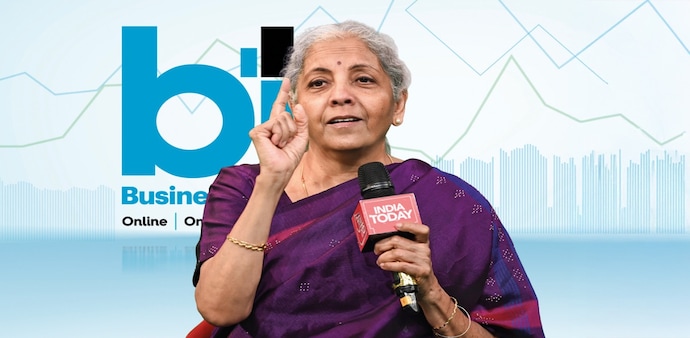
Finance Minister Nirmala Sitharaman on GST rate cuts, lessons from Covid-19, and more.
Team BT
- Sep 19, 2025,
- Updated Sep 19, 2025 4:54 PM IST
In Nirmala Sitharaman stands as a pillar in India’s economic leadership, being the country’s first Union Finance Minister to have presented eight consecutive Budgets. Her stewardship has been marked by resilience, vision, and transformative policy-making in the face of unprecedented challenges, including to the Covid-19 pandemic. Soon after the GST (goods and services tax) Council meeting, the finance minister attended an India Today Group multi-city townhall on the GST reforms. Edited excerpts of the interaction moderated by Sweta Singh and Marya Shakil:
Advertisement
Singh: Is GST finally a good and simple tax?
A: Absolutely, it is good and it is simple, no doubt. Because before GST came, every state had its own laws—excise duty, value-added tax (VAT), some state-level cesses, some local taxes. All such taxes were brought together to form the GST. At that time, [pre-GST] each state had a rate for an item; while implementing GST, the rate for any one item pre-GST was kept in mind and, during the introduction of GST, the rate was fixed with only a little movement to one side or the other. So, no pre-GST rate was too far away from the rate fixed under GST. That is why GST rates were kept close to earlier ones: an item near 5% pre-GST (whether 4%, 5% or 6%) went to 5%; if it was near the 12% rate (10%, 12%, 13%, 14%), it came to 12%, and so on. Today, I am surprised when the Opposition says that while implementing GST you kept the rates high, and now in the name of reform you’ve lowered them.
Advertisement
Those rates were not our free-will rates. We brought in whatever existed before.
Shakil: The Opposition also claims the changes are eight years too late. The timing, as always, is being questioned.
A: This country could have had GST even in the 1960s. It wasn’t done. Not even when Pranab Mukherjee repeatedly spoke about it for 10 years. In fact, I remember as a BJP party spokesperson, in 2010, it was said, “It will be rolled out.” But it wasn’t—because no state trusted them to implement, compensate, or execute correctly. There was simply no trust.
Advertisement
As the saying goes, when you point one finger forward, three point back at you. Tell me why you couldn’t implement it? Forget 70 years, even in 10 years (when the Congress-led UPA was in power.)
Singh: When we analyse the decision, we feel that you have focused on roti, kapda aur makan (food, clothing, housing). These three words sum up the changes…
A: Absolutely. Our focus is the common man and the middle class; beyond basic necessities, also their aspirations. Many families ask: We have a small TV—why can’t we buy a larger one? We have a small house—why can’t we build an extra room or a first floor? We have kept middle class, poor, small and medium industries, and farmers in mind.
Shakil: Has this been done with an eye on the upcoming Bihar elections? Is it the BJP’s manifesto?
A: It is a manifesto for the 1.4 billion people who’ve been waiting for it. I remember the days when friends in the media would say over tea, “You’re getting beaten up because of GST.” I don’t know if it was sympathy or criticism. But such comments were made. Now I say to all citizens, the Prime Minister guided me—he said from the Red Fort, and about eight months earlier, around the Budget— “Are you doing something on GST? Please do something.”
Advertisement
And once this package was ready, and even though the Council decides, I showed the PM a small glimpse. He said, “Alright, let’s see, get it passed in the GST Council.” Their expectation: reduce people’s tax burden. This is new—we prepared a high-rate (legacy) structure earlier based on pre-GST rates and tried to reduce it here and there. But this time, the full package of rate, slab and system came through.
Singh: Did you get inspiration from other parties? Congress, Trinamool—everyone says you did this after eight years of pressure. They say these are their revised rates.
A: I never understood those who mocked it as “Gabbar Singh Tax”. The party that once taxed income at 91% under former PM Indira Gandhi today lectures on GST? Time and again inside the GST Council we had to remind everyone: let us give the people a good message; approve reductions. I won’t name states.
Audience q: Despite the historic reform, two expectations remain: bringing petrol and diesel under GST and restoring input tax credit for real estate/builders. What is the road map on these?
Advertisement
A: Petrol and diesel are not under consideration in this proposal placed before the GST Council. It is entirely with the states.
Even at the time of the GST’s introduction, we made a legal provision that whenever states find it appropriate and determine rates, without constitutional change we can implement GST on petrol/diesel. But the Council has to take that call; our proposal does not include it.
Audience q: India has come from four GST slabs to two. Is the government trying to go to one slab—one nation, one GST?
A: Not now; maybe much later—I won’t fix a time. Why multiple rates? India’s development level is not uniform; some areas are more developed, others less. People in different areas cannot treat the same object similarly. In other words, a developed area can afford a slightly higher tax. As (former Finance Minister) Arun Jaitley explained: can a Mercedes Benz and hawai chappal (rubber slippers) be treated the same and taxed at one rate? No. The chappal buyer cannot pay a higher rate; the person who purchases a Benz can. Having one rate for both in today’s India would be unjust. It could be possible in the future, when development is widespread.
Advertisement
Singh: On insurance—the decision is good, but people fear: will companies pass the benefit to customers?
A: That is a genuine question. All public sector insurers came forward and said they will pass on the benefits to customers. We are also talking to the private sector—the market is open; there is no special privilege to public sector or unique burden on the private sector. If under open competition the public sector is doing it, the private sector should too—because tax relief is meant for the public, not the company. It should not stay in the premium. If companies act against this intent, we will talk to them and correct it.
Audience Q: How will the government manage the expected revenue shortfall from lower GST—estimated about Rs 40,000 crore?
A: We put that number before the Council—roughly Rs 40,000 crore. But we believe that rate reductions on daily-use items will bring in more buoyancy. Data is never static; we use FY24 data to model buoyancy. On the ground it’s dynamic. When rates go down and people come out to buy, the dynamism can raise revenue beyond model estimates. Since this is across the board—daily-use items, aspirational, middle-class, agricultural, MSME, automobile—I believe buoyancy will return quickly, even exceed the earlier level, helping us overcome any revenue hit.
Bt: Do you expect classification disputes to end now?
A: For those unfamiliar with classification issues—six to eight months ago there was a press conference about an incident. For popcorn: salty popcorn had one rate; popcorn with chocolate/sugar had another. In Uttar Pradesh there was trouble—people selling chocolate/sugar-coated popcorn were taxed less by misclassifying as salty popcorn; issues went to court and stayed for years.
The UP government asked the Council for clarification: how to handle this, without harassing small vendors? That’s why we dealt with classification this time—food, whether sweetened or savoury, should be grouped at a single 5% rate, with limited exceptions like high-sugar powdered drinks/beverages. For day-to-day purchases there should be no confusion due to classification.
Aabha Bakaya: The impact of the US tariff was pegged at 0.5% of GDP. There are estimates that the GST rate reduction could boost household consumption and add about 0.5 percentage points to the GDP. Was the timing aimed at sentiment and real returns?
A: That may be an unintended effect, but no, we didn’t start with that. I read reports of “+60 bps” and so on. Ideally, we wanted to reform GST even by the fifth year. However, the Covid-19 pandemic and revival after that delayed us. After eight years, we had learned enough to introduce corrective measures. Prime objective: reform (rate rationalisation, slabs, ease of doing business, system correction). GDP or tariff considerations weren’t the intent.
Audience Q: What are the projected revenue implications and when will the GST Appellate Tribunal (GSTAT) become operational to hear cases?
A: GSTAT is 99% ready; all benches are set up, and they should start hearing cases in a matter of days. Rate reduction/rationalisation will help citizens; companies and traders must pass them on, we have assurances. On states’ revenue, remember: the Council includes the Centre too. Revenue reduction affects the Centre also. We are not donors; we are a party. Pre-GST, both the Centre and states gave up taxes for GST. Recognise that approach.
Sakshi Batra: It’s been a landmark year for tax reforms—direct taxes, then indirect; even an Income Tax Bill. Yet markets haven’t rallied much. Why do you think they have not?
A: Markets react to many issues simultaneously. I won’t say GST news alone should excite them. This good news did play out somewhat, the day after the announcement you saw the market reaction. As for “we’re paying tax on this and that”—that’s where we wanted simplification and reduction. We’ve done as much as possible. Responses are coming—“this will impact my life.”
Shakil: You led the finance ministry during Covid and now in uncertain global times. Compare then and now?
A: We learned many lessons from Covid. I even told the Council: when states worry about revenue loss, remember the Centre has exclusive responsibilities like defence.
During Covid, the PM did not waver—he said, “Don’t search for revenue; give free vaccination to our people.” Two doses free for 1.4 billion people—we had to borrow and arrange. I cited this in the Council. We should first give respite to citizens, then think of mobilising revenue—how, from where. As the PM did—relief first (free vaccines) then and now tax relief so people can spend. Governments are empowered to mobilise resources, that’s our responsibility. With strong leadership, people will get relief and the economy will improve as a result.
In Nirmala Sitharaman stands as a pillar in India’s economic leadership, being the country’s first Union Finance Minister to have presented eight consecutive Budgets. Her stewardship has been marked by resilience, vision, and transformative policy-making in the face of unprecedented challenges, including to the Covid-19 pandemic. Soon after the GST (goods and services tax) Council meeting, the finance minister attended an India Today Group multi-city townhall on the GST reforms. Edited excerpts of the interaction moderated by Sweta Singh and Marya Shakil:
Advertisement
Singh: Is GST finally a good and simple tax?
A: Absolutely, it is good and it is simple, no doubt. Because before GST came, every state had its own laws—excise duty, value-added tax (VAT), some state-level cesses, some local taxes. All such taxes were brought together to form the GST. At that time, [pre-GST] each state had a rate for an item; while implementing GST, the rate for any one item pre-GST was kept in mind and, during the introduction of GST, the rate was fixed with only a little movement to one side or the other. So, no pre-GST rate was too far away from the rate fixed under GST. That is why GST rates were kept close to earlier ones: an item near 5% pre-GST (whether 4%, 5% or 6%) went to 5%; if it was near the 12% rate (10%, 12%, 13%, 14%), it came to 12%, and so on. Today, I am surprised when the Opposition says that while implementing GST you kept the rates high, and now in the name of reform you’ve lowered them.
Advertisement
Those rates were not our free-will rates. We brought in whatever existed before.
Shakil: The Opposition also claims the changes are eight years too late. The timing, as always, is being questioned.
A: This country could have had GST even in the 1960s. It wasn’t done. Not even when Pranab Mukherjee repeatedly spoke about it for 10 years. In fact, I remember as a BJP party spokesperson, in 2010, it was said, “It will be rolled out.” But it wasn’t—because no state trusted them to implement, compensate, or execute correctly. There was simply no trust.
Advertisement
As the saying goes, when you point one finger forward, three point back at you. Tell me why you couldn’t implement it? Forget 70 years, even in 10 years (when the Congress-led UPA was in power.)
Singh: When we analyse the decision, we feel that you have focused on roti, kapda aur makan (food, clothing, housing). These three words sum up the changes…
A: Absolutely. Our focus is the common man and the middle class; beyond basic necessities, also their aspirations. Many families ask: We have a small TV—why can’t we buy a larger one? We have a small house—why can’t we build an extra room or a first floor? We have kept middle class, poor, small and medium industries, and farmers in mind.
Shakil: Has this been done with an eye on the upcoming Bihar elections? Is it the BJP’s manifesto?
A: It is a manifesto for the 1.4 billion people who’ve been waiting for it. I remember the days when friends in the media would say over tea, “You’re getting beaten up because of GST.” I don’t know if it was sympathy or criticism. But such comments were made. Now I say to all citizens, the Prime Minister guided me—he said from the Red Fort, and about eight months earlier, around the Budget— “Are you doing something on GST? Please do something.”
Advertisement
And once this package was ready, and even though the Council decides, I showed the PM a small glimpse. He said, “Alright, let’s see, get it passed in the GST Council.” Their expectation: reduce people’s tax burden. This is new—we prepared a high-rate (legacy) structure earlier based on pre-GST rates and tried to reduce it here and there. But this time, the full package of rate, slab and system came through.
Singh: Did you get inspiration from other parties? Congress, Trinamool—everyone says you did this after eight years of pressure. They say these are their revised rates.
A: I never understood those who mocked it as “Gabbar Singh Tax”. The party that once taxed income at 91% under former PM Indira Gandhi today lectures on GST? Time and again inside the GST Council we had to remind everyone: let us give the people a good message; approve reductions. I won’t name states.
Audience q: Despite the historic reform, two expectations remain: bringing petrol and diesel under GST and restoring input tax credit for real estate/builders. What is the road map on these?
Advertisement
A: Petrol and diesel are not under consideration in this proposal placed before the GST Council. It is entirely with the states.
Even at the time of the GST’s introduction, we made a legal provision that whenever states find it appropriate and determine rates, without constitutional change we can implement GST on petrol/diesel. But the Council has to take that call; our proposal does not include it.
Audience q: India has come from four GST slabs to two. Is the government trying to go to one slab—one nation, one GST?
A: Not now; maybe much later—I won’t fix a time. Why multiple rates? India’s development level is not uniform; some areas are more developed, others less. People in different areas cannot treat the same object similarly. In other words, a developed area can afford a slightly higher tax. As (former Finance Minister) Arun Jaitley explained: can a Mercedes Benz and hawai chappal (rubber slippers) be treated the same and taxed at one rate? No. The chappal buyer cannot pay a higher rate; the person who purchases a Benz can. Having one rate for both in today’s India would be unjust. It could be possible in the future, when development is widespread.
Advertisement
Singh: On insurance—the decision is good, but people fear: will companies pass the benefit to customers?
A: That is a genuine question. All public sector insurers came forward and said they will pass on the benefits to customers. We are also talking to the private sector—the market is open; there is no special privilege to public sector or unique burden on the private sector. If under open competition the public sector is doing it, the private sector should too—because tax relief is meant for the public, not the company. It should not stay in the premium. If companies act against this intent, we will talk to them and correct it.
Audience Q: How will the government manage the expected revenue shortfall from lower GST—estimated about Rs 40,000 crore?
A: We put that number before the Council—roughly Rs 40,000 crore. But we believe that rate reductions on daily-use items will bring in more buoyancy. Data is never static; we use FY24 data to model buoyancy. On the ground it’s dynamic. When rates go down and people come out to buy, the dynamism can raise revenue beyond model estimates. Since this is across the board—daily-use items, aspirational, middle-class, agricultural, MSME, automobile—I believe buoyancy will return quickly, even exceed the earlier level, helping us overcome any revenue hit.
Bt: Do you expect classification disputes to end now?
A: For those unfamiliar with classification issues—six to eight months ago there was a press conference about an incident. For popcorn: salty popcorn had one rate; popcorn with chocolate/sugar had another. In Uttar Pradesh there was trouble—people selling chocolate/sugar-coated popcorn were taxed less by misclassifying as salty popcorn; issues went to court and stayed for years.
The UP government asked the Council for clarification: how to handle this, without harassing small vendors? That’s why we dealt with classification this time—food, whether sweetened or savoury, should be grouped at a single 5% rate, with limited exceptions like high-sugar powdered drinks/beverages. For day-to-day purchases there should be no confusion due to classification.
Aabha Bakaya: The impact of the US tariff was pegged at 0.5% of GDP. There are estimates that the GST rate reduction could boost household consumption and add about 0.5 percentage points to the GDP. Was the timing aimed at sentiment and real returns?
A: That may be an unintended effect, but no, we didn’t start with that. I read reports of “+60 bps” and so on. Ideally, we wanted to reform GST even by the fifth year. However, the Covid-19 pandemic and revival after that delayed us. After eight years, we had learned enough to introduce corrective measures. Prime objective: reform (rate rationalisation, slabs, ease of doing business, system correction). GDP or tariff considerations weren’t the intent.
Audience Q: What are the projected revenue implications and when will the GST Appellate Tribunal (GSTAT) become operational to hear cases?
A: GSTAT is 99% ready; all benches are set up, and they should start hearing cases in a matter of days. Rate reduction/rationalisation will help citizens; companies and traders must pass them on, we have assurances. On states’ revenue, remember: the Council includes the Centre too. Revenue reduction affects the Centre also. We are not donors; we are a party. Pre-GST, both the Centre and states gave up taxes for GST. Recognise that approach.
Sakshi Batra: It’s been a landmark year for tax reforms—direct taxes, then indirect; even an Income Tax Bill. Yet markets haven’t rallied much. Why do you think they have not?
A: Markets react to many issues simultaneously. I won’t say GST news alone should excite them. This good news did play out somewhat, the day after the announcement you saw the market reaction. As for “we’re paying tax on this and that”—that’s where we wanted simplification and reduction. We’ve done as much as possible. Responses are coming—“this will impact my life.”
Shakil: You led the finance ministry during Covid and now in uncertain global times. Compare then and now?
A: We learned many lessons from Covid. I even told the Council: when states worry about revenue loss, remember the Centre has exclusive responsibilities like defence.
During Covid, the PM did not waver—he said, “Don’t search for revenue; give free vaccination to our people.” Two doses free for 1.4 billion people—we had to borrow and arrange. I cited this in the Council. We should first give respite to citizens, then think of mobilising revenue—how, from where. As the PM did—relief first (free vaccines) then and now tax relief so people can spend. Governments are empowered to mobilise resources, that’s our responsibility. With strong leadership, people will get relief and the economy will improve as a result.
Read more!