
IIM C’s Alok Kumar Rai on why attracting students for a full-time MBA is challenging
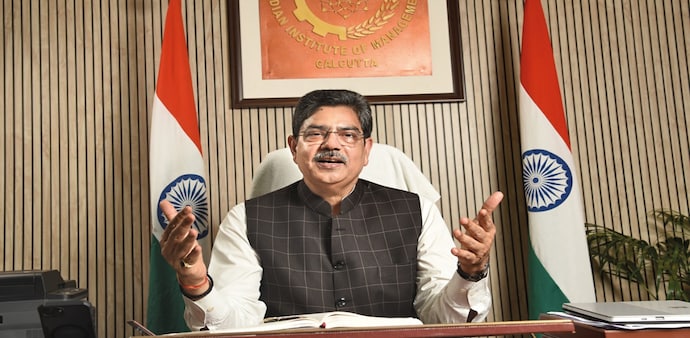
Alok Kumar Rai, Director, IIM Calcutta, on why there will be an increase in one-year management programmes in the future.
- Oct 6, 2026,
- Updated Oct 6, 2026 8:02 PM IST
The Indian Institute of Management (IIM) Calcutta has once again strengthened its position among India’s leading management institutes, securing the second spot in Business Today India’s Best B-schools 2026-27 ranking.
Over the years, the institute has continued to evolve with changing business needs while staying focused on developing future leaders. Alok Kumar Rai, who took charge as Director of IIM Calcutta in July 2025, has extensive experience in higher education leadership, having earlier served as vice-chancellor of the University of Lucknow.
At a time when management education is being redefined—from the relevance of the MBA to the skills required in a changing workplace—Rai, in this conversation with Business Today, discusses the future of business education, shifting employer expectations, new learning models, and why conceptual thinking, adaptability and leadership capabilities will remain central to developing tomorrow’s leaders. Edited excerpts:
Q: IIM Calcutta has consistently set benchmarks in management education. What has enabled the institute to maintain this position year after year?
It is a legacy that we have to uphold through consistent and persistent efforts.
The biggest driver at IIM Calcutta has always been keeping students first. Whatever we do at the institute level — whether it is policy decisions, curriculum changes, placements or infrastructure development — the student remains at the centre.
Students are the focus of all our initiatives. I believe this has been IIM Calcutta’s legacy, and we are trying to carry it forward.
Q: How closely is the MBA degree keeping pace with the changing nature of work, particularly in the corporate sector?
This is a slightly tricky question because many leading business leaders globally have started questioning the relevance of management education and the MBA degree.
However, I believe any career path has a ceiling, even after postgraduate studies.
For example, engineering education has traditionally been among the most sought-after qualifications. However, engineering graduates increasingly move towards specific skill sets demanded by employers. Yet, when it comes to higher-level decision-making, organisations need more than specialised domain knowledge.
That is what led to the creation of management education, not only in India but across the world.
At the same time, the business environment has changed significantly. One of the biggest challenges we see today is attracting students for a traditional two-year full-time MBA programme.
This will lead to greater growth of one-year management programmes. Some institutions in India already offer one-year management education, beginning with the classic programme introduced by ISB, and now several IIMs have also moved in this direction.
I see this as the next major development in management education.
A one-year programme offers two important benefits. First, it compresses the duration of education from two years to one year. Interestingly, in our executive management programme, while the duration is shorter, the academic intensity remains high.
The second advantage is for professionals who already have work experience. At IIM Calcutta, our MBAEx programme requires a minimum of five years of work experience, but this year the average work experience of the batch was 8.5 years.
Professionals benefit because they save one year and gain an additional year of career progression.
I also believe hybrid education will become a major trend. Management education is practice-oriented, and hybrid models allow professionals to continue working while pursuing advanced learning.
Q: How are employer expectations changing? Which management skills are becoming more important today?
This question needs to be understood in its entirety. There are different categories of students pursuing management education and different categories of institutions offering these programmes.
When we talk about specific skill sets, they are important, particularly at the entry and mid-level. However, when organisations hire people with the intention of preparing them for larger leadership roles, they look beyond specific skills.
For example, we offer artificial intelligence (AI)-based learning to our students. This is an important skill set that can help managers make better business decisions in a changing environment. But AI itself is not the core objective of management education. It is a capability that can be acquired and applied.
Today, it may be AI. Tomorrow, it would be quantum computing, and the day after that would be another emerging technology. The important capability is the ability to understand future changes, anticipate them, and build organisations where people continuously upgrade their skills.
That is what enables effective decision-making and leadership in large organisations.
I do not deny the importance of specific domain knowledge. These skills are important, but changing technologies will continue to influence business.
Q: Looking ahead five to ten years, what will distinguish an exceptional management education degree?
Institutions like ours receive students who are expected to take up larger leadership roles in organisations, not just immediate job responsibilities.
Therefore, our responsibility is to prepare them for the future rather than only meet the immediate requirements of a job.
While specific skills required for current roles are important, management education must also develop conceptual understanding and decision-making capabilities required for leadership positions.
Q: What does AI mean for curriculum and pedagogy? How is IIM Calcutta maintaining academic depth while responding to changing industry requirements?
Educational institutions must accept reality and be ready to embrace change. This applies not only to curriculum but also to the way learning is delivered.
At IIM Calcutta, we have introduced AI as part of the curriculum and have undertaken several digital initiatives. We are building AI studios, AI labs and AI-based learning systems.
However, AI is only a tool that we need to embrace. It is not the destination.
Along with technology-focused learning, we are also expanding flexible learning models.We are planning to start an online MBA programme, aligned with the growing importance of hybrid education.
Q: What skills will the next generation of business leaders require, especially with data and machine intelligence shaping business decisions?
I believe data-related learning is largely domain-specific and useful at the entry level. However, the kind of students we prepare for leadership roles in large organisations requires a stronger conceptual framework.
They need not only the ability to interpret data but also the ability to understand what the data means and how it can be used for larger strategic decision-making with a long-term impact.
This conceptual strength is what gives longevity to management professionals. We are moving towards a world where specialised skills will continue to change rapidly. Therefore, the ability to think deeply, understand problems and create sustainable solutions will remain critical.
Q: One finding from the Business Today survey this year is the changing student mix — with the share of engineers declining and non-engineers increasing. What does this shift mean? We have also seen female participation decline after years of growth. Is this a temporary trend or does it indicate a larger change?
If the number of engineering students is declining across institutions, one possible reason could be the volatility in the job market. Today, many technology professionals are uncertain about future roles and opportunities and therefore may prefer to continue in their existing jobs rather than pursue further education immediately.
The changing technology environment, including AI, is also influencing career decisions.
However, at institutions like IIM Calcutta, diversity has always been a priority. We give additional weightage to non-engineering backgrounds because we do not want the institution to be dominated by a single academic discipline.
This has been a conscious effort, and many leading IIMs follow a similar approach.
On female participation, the data for IIM Calcutta does not indicate a decline. In our MBA programme, female participation was 28% in 2025-26, and it has increased to 36% this year.
Q: On the job market situation you mentioned, can relatively muted pre-placement offers be seen as a sign of a broader slowdown in fresh hiring?
We cannot comment on what is happening at other institutions, but in our case, we have not seen a decline.
Our regular MBA programme has around 480 students. During internships, the number of pre placement offers stood at around 155 last year, which is over 30%. The number of opportunities has increased.
The conversion of these offers into pre-placement offers has also been better compared to previous years.
Q: Looking ahead, given all the changes taking place, what do you see as the future role, relevance and value of the management degree?
When we talk about management education, we need to recognise that students pursuing these programmes broadly fall into two categories.
The first category includes those who are preparing to meet the immediate requirements of organisations — with knowledge, skills, discipline and professional capabilities.
The second category includes those who are being groomed for larger leadership roles in organisations, and that is where the responsibility of institutes like IIM Calcutta becomes more important.
Our role is to develop individuals who can eventually take larger leadership responsibilities — not only for organisations but also for the country’s development.
@szarabi
The Indian Institute of Management (IIM) Calcutta has once again strengthened its position among India’s leading management institutes, securing the second spot in Business Today India’s Best B-schools 2026-27 ranking.
Over the years, the institute has continued to evolve with changing business needs while staying focused on developing future leaders. Alok Kumar Rai, who took charge as Director of IIM Calcutta in July 2025, has extensive experience in higher education leadership, having earlier served as vice-chancellor of the University of Lucknow.
At a time when management education is being redefined—from the relevance of the MBA to the skills required in a changing workplace—Rai, in this conversation with Business Today, discusses the future of business education, shifting employer expectations, new learning models, and why conceptual thinking, adaptability and leadership capabilities will remain central to developing tomorrow’s leaders. Edited excerpts:
Q: IIM Calcutta has consistently set benchmarks in management education. What has enabled the institute to maintain this position year after year?
It is a legacy that we have to uphold through consistent and persistent efforts.
The biggest driver at IIM Calcutta has always been keeping students first. Whatever we do at the institute level — whether it is policy decisions, curriculum changes, placements or infrastructure development — the student remains at the centre.
Students are the focus of all our initiatives. I believe this has been IIM Calcutta’s legacy, and we are trying to carry it forward.
Q: How closely is the MBA degree keeping pace with the changing nature of work, particularly in the corporate sector?
This is a slightly tricky question because many leading business leaders globally have started questioning the relevance of management education and the MBA degree.
However, I believe any career path has a ceiling, even after postgraduate studies.
For example, engineering education has traditionally been among the most sought-after qualifications. However, engineering graduates increasingly move towards specific skill sets demanded by employers. Yet, when it comes to higher-level decision-making, organisations need more than specialised domain knowledge.
That is what led to the creation of management education, not only in India but across the world.
At the same time, the business environment has changed significantly. One of the biggest challenges we see today is attracting students for a traditional two-year full-time MBA programme.
This will lead to greater growth of one-year management programmes. Some institutions in India already offer one-year management education, beginning with the classic programme introduced by ISB, and now several IIMs have also moved in this direction.
I see this as the next major development in management education.
A one-year programme offers two important benefits. First, it compresses the duration of education from two years to one year. Interestingly, in our executive management programme, while the duration is shorter, the academic intensity remains high.
The second advantage is for professionals who already have work experience. At IIM Calcutta, our MBAEx programme requires a minimum of five years of work experience, but this year the average work experience of the batch was 8.5 years.
Professionals benefit because they save one year and gain an additional year of career progression.
I also believe hybrid education will become a major trend. Management education is practice-oriented, and hybrid models allow professionals to continue working while pursuing advanced learning.
Q: How are employer expectations changing? Which management skills are becoming more important today?
This question needs to be understood in its entirety. There are different categories of students pursuing management education and different categories of institutions offering these programmes.
When we talk about specific skill sets, they are important, particularly at the entry and mid-level. However, when organisations hire people with the intention of preparing them for larger leadership roles, they look beyond specific skills.
For example, we offer artificial intelligence (AI)-based learning to our students. This is an important skill set that can help managers make better business decisions in a changing environment. But AI itself is not the core objective of management education. It is a capability that can be acquired and applied.
Today, it may be AI. Tomorrow, it would be quantum computing, and the day after that would be another emerging technology. The important capability is the ability to understand future changes, anticipate them, and build organisations where people continuously upgrade their skills.
That is what enables effective decision-making and leadership in large organisations.
I do not deny the importance of specific domain knowledge. These skills are important, but changing technologies will continue to influence business.
Q: Looking ahead five to ten years, what will distinguish an exceptional management education degree?
Institutions like ours receive students who are expected to take up larger leadership roles in organisations, not just immediate job responsibilities.
Therefore, our responsibility is to prepare them for the future rather than only meet the immediate requirements of a job.
While specific skills required for current roles are important, management education must also develop conceptual understanding and decision-making capabilities required for leadership positions.
Q: What does AI mean for curriculum and pedagogy? How is IIM Calcutta maintaining academic depth while responding to changing industry requirements?
Educational institutions must accept reality and be ready to embrace change. This applies not only to curriculum but also to the way learning is delivered.
At IIM Calcutta, we have introduced AI as part of the curriculum and have undertaken several digital initiatives. We are building AI studios, AI labs and AI-based learning systems.
However, AI is only a tool that we need to embrace. It is not the destination.
Along with technology-focused learning, we are also expanding flexible learning models.We are planning to start an online MBA programme, aligned with the growing importance of hybrid education.
Q: What skills will the next generation of business leaders require, especially with data and machine intelligence shaping business decisions?
I believe data-related learning is largely domain-specific and useful at the entry level. However, the kind of students we prepare for leadership roles in large organisations requires a stronger conceptual framework.
They need not only the ability to interpret data but also the ability to understand what the data means and how it can be used for larger strategic decision-making with a long-term impact.
This conceptual strength is what gives longevity to management professionals. We are moving towards a world where specialised skills will continue to change rapidly. Therefore, the ability to think deeply, understand problems and create sustainable solutions will remain critical.
Q: One finding from the Business Today survey this year is the changing student mix — with the share of engineers declining and non-engineers increasing. What does this shift mean? We have also seen female participation decline after years of growth. Is this a temporary trend or does it indicate a larger change?
If the number of engineering students is declining across institutions, one possible reason could be the volatility in the job market. Today, many technology professionals are uncertain about future roles and opportunities and therefore may prefer to continue in their existing jobs rather than pursue further education immediately.
The changing technology environment, including AI, is also influencing career decisions.
However, at institutions like IIM Calcutta, diversity has always been a priority. We give additional weightage to non-engineering backgrounds because we do not want the institution to be dominated by a single academic discipline.
This has been a conscious effort, and many leading IIMs follow a similar approach.
On female participation, the data for IIM Calcutta does not indicate a decline. In our MBA programme, female participation was 28% in 2025-26, and it has increased to 36% this year.
Q: On the job market situation you mentioned, can relatively muted pre-placement offers be seen as a sign of a broader slowdown in fresh hiring?
We cannot comment on what is happening at other institutions, but in our case, we have not seen a decline.
Our regular MBA programme has around 480 students. During internships, the number of pre placement offers stood at around 155 last year, which is over 30%. The number of opportunities has increased.
The conversion of these offers into pre-placement offers has also been better compared to previous years.
Q: Looking ahead, given all the changes taking place, what do you see as the future role, relevance and value of the management degree?
When we talk about management education, we need to recognise that students pursuing these programmes broadly fall into two categories.
The first category includes those who are preparing to meet the immediate requirements of organisations — with knowledge, skills, discipline and professional capabilities.
The second category includes those who are being groomed for larger leadership roles in organisations, and that is where the responsibility of institutes like IIM Calcutta becomes more important.
Our role is to develop individuals who can eventually take larger leadership responsibilities — not only for organisations but also for the country’s development.
@szarabi