
Q-commerce will become ‘much bigger’, says Amazon India VP and Country Manager Samir Kumar
Amazon India’s Samir Kumar on how technology can be used to ease challenges hindering the scaling of quick commerce in India.
- Sep 15, 2026,
- Updated Sep 15, 2026 2:57 PM IST
Amazon’s quick-commerce push has made the global e-commerce giant a late entrant to a market where Blinkit has already established a clear lead, while Zepto and Instamart have emerged as prominent players. Its core e-commerce rival, Flipkart Minutes, also entered the segment earlier.
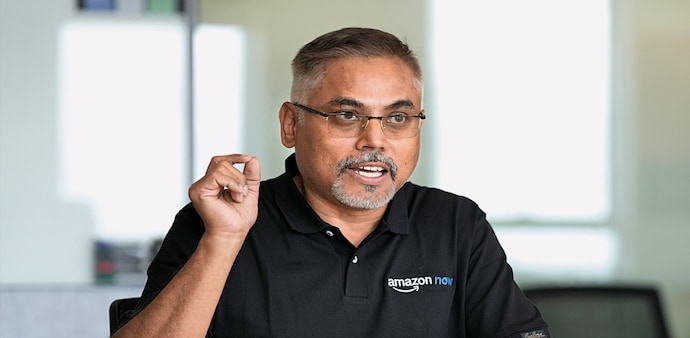
Amazon’s decision to enter the fray and seize a share of the market is a bold move as it continues to scale its presence in Indian e-commerce. In a conversation with Business Today, Samir Kumar, Vice President and Country Manager, India, Amazon, discusses the company’s ambitions and strategy—not just to enter India’s increasingly competitive quick-commerce market, but to emerge as one of its winners. Edited excerpts:
Q: Amazon has been in India for over a decade. As quick commerce moves beyond 10-minute delivery, what will define its next phase?
Quick commerce and e-commerce together are going to be a big part of the overall Indian market in the coming years. E-commerce penetration is still at a very nascent stage, so we have a lot to do because customers value price, selection, and convenience.
Small buildings can only carry so much inventory. So, whoever can manage the supply chain well eventually is going to be one of the contenders.
Our game is never about convenience. It is about the value and selection we offer. We already offer the largest selection to Indian consumers across every speed point. We offer close to 4.5 million items that can be delivered in a day. You can take a subset of that and deliver it in hours. Minutes, hours, and days help us win on price, selection and convenience.
Our selection across home, kitchen, and softlines such as apparel and shoes will also be important, along with serving the everyday needs of customers.
Q: Amazon has a strong one-day delivery network and is expanding quick commerce. Can you use your supply-chain advantage to offer a wider assortment through faster delivery and deepen your presence beyond metros?
For us to deliver in 10, 15 or even 30 minutes or an hour, that assortment has to be located close to the customer. But not every inventory item moves as fast. The challenge is placing the right inventory in the right locations, and carrying the largest assortment at the smallest possible depth in a sustainable way. That is where the technology and tools we have developed over the years will come into play.
We started with 10,000-15,000 SKUs or ASINs, as we call them at Amazon, but we are rapidly expanding that because we have 4.5 million items sitting in our warehouses. We know, based on customer frequency and where customers live, what the demand is in each area.
We are setting up our first set of dark stores, or micro-fulfilment centres, focused on everyday essentials. In every city where we operate, we are also setting up urban fulfilment centres that will carry the next set of assortments. They may not offer 10-minute delivery but could deliver in 25-30 minutes and carry a larger assortment.
Many players have figured out how to serve 10,000 items in 10 minutes. But as you increase the assortment, serving it sustainably requires the strength of the supply chain. The next phase will be about leveraging our existing scale and technology to bring as many of those 4.5 million SKUs closer to customers as possible. Speed is a game we want to win over time—we want to have the fastest speed for the largest assortment and give it for free to our Prime customers.
And when we say 300 cities and 3,000 stores, you cannot achieve that by focusing only on metros. You have to get into Tier-II, -III and -IV cities. We launched Tirupati just a few weeks ago and have seen 5x growth in the last 14 days. In September, we are expanding into 50-plus Tier-II and -III cities, moving towards the 300-city target.
Q: So, will Amazon eventually be able to serve not just high-demand products but also items that customers may need once every two or three months?
Once we have scale, we could carry many products that a customer may buy once every four months, but if there are enough customers in that neighbourhood, collectively they may generate demand for two or three units a day. That is the selection we need to figure out how to carry.
And then there is the question of large-size items. Micro-fulfilment and urban fulfilment centres are also constrained by space. So how do you carry that selection in that space? That is where the technology and tools come into play.
As we go from where we are today to 300 cities and more than 3,000 stores in the coming months and years, there will be investment in these facilities. But the payback is there because we are seeing frequency increase. It is an investment in the future because we already have a set of Prime customers, we have invested in India, and we are here to build a long-term sustainable business.
Q: The quick-commerce sector is seeing a lot of capital being deployed, but investors are increasingly demanding profitability. What is Amazon's focus—market capture or profitability? What is the roadmap over the next two years?
If you look at any decision we make at Amazon, we ask a few questions. First, is what we are building differentiated and something customers really value? It checks the box. Customers are going to value it.
The next question is whether it [quick commerce] is going to be big. It is already big, and given the way it is growing, it is going to be much bigger. So, it checks that box as well.
@Palakagrwal64
Amazon’s quick-commerce push has made the global e-commerce giant a late entrant to a market where Blinkit has already established a clear lead, while Zepto and Instamart have emerged as prominent players. Its core e-commerce rival, Flipkart Minutes, also entered the segment earlier.
Amazon’s decision to enter the fray and seize a share of the market is a bold move as it continues to scale its presence in Indian e-commerce. In a conversation with Business Today, Samir Kumar, Vice President and Country Manager, India, Amazon, discusses the company’s ambitions and strategy—not just to enter India’s increasingly competitive quick-commerce market, but to emerge as one of its winners. Edited excerpts:
Q: Amazon has been in India for over a decade. As quick commerce moves beyond 10-minute delivery, what will define its next phase?
Quick commerce and e-commerce together are going to be a big part of the overall Indian market in the coming years. E-commerce penetration is still at a very nascent stage, so we have a lot to do because customers value price, selection, and convenience.
Small buildings can only carry so much inventory. So, whoever can manage the supply chain well eventually is going to be one of the contenders.
Our game is never about convenience. It is about the value and selection we offer. We already offer the largest selection to Indian consumers across every speed point. We offer close to 4.5 million items that can be delivered in a day. You can take a subset of that and deliver it in hours. Minutes, hours, and days help us win on price, selection and convenience.
Our selection across home, kitchen, and softlines such as apparel and shoes will also be important, along with serving the everyday needs of customers.
Q: Amazon has a strong one-day delivery network and is expanding quick commerce. Can you use your supply-chain advantage to offer a wider assortment through faster delivery and deepen your presence beyond metros?
For us to deliver in 10, 15 or even 30 minutes or an hour, that assortment has to be located close to the customer. But not every inventory item moves as fast. The challenge is placing the right inventory in the right locations, and carrying the largest assortment at the smallest possible depth in a sustainable way. That is where the technology and tools we have developed over the years will come into play.
We started with 10,000-15,000 SKUs or ASINs, as we call them at Amazon, but we are rapidly expanding that because we have 4.5 million items sitting in our warehouses. We know, based on customer frequency and where customers live, what the demand is in each area.
We are setting up our first set of dark stores, or micro-fulfilment centres, focused on everyday essentials. In every city where we operate, we are also setting up urban fulfilment centres that will carry the next set of assortments. They may not offer 10-minute delivery but could deliver in 25-30 minutes and carry a larger assortment.
Many players have figured out how to serve 10,000 items in 10 minutes. But as you increase the assortment, serving it sustainably requires the strength of the supply chain. The next phase will be about leveraging our existing scale and technology to bring as many of those 4.5 million SKUs closer to customers as possible. Speed is a game we want to win over time—we want to have the fastest speed for the largest assortment and give it for free to our Prime customers.
And when we say 300 cities and 3,000 stores, you cannot achieve that by focusing only on metros. You have to get into Tier-II, -III and -IV cities. We launched Tirupati just a few weeks ago and have seen 5x growth in the last 14 days. In September, we are expanding into 50-plus Tier-II and -III cities, moving towards the 300-city target.
Q: So, will Amazon eventually be able to serve not just high-demand products but also items that customers may need once every two or three months?
Once we have scale, we could carry many products that a customer may buy once every four months, but if there are enough customers in that neighbourhood, collectively they may generate demand for two or three units a day. That is the selection we need to figure out how to carry.
And then there is the question of large-size items. Micro-fulfilment and urban fulfilment centres are also constrained by space. So how do you carry that selection in that space? That is where the technology and tools come into play.
As we go from where we are today to 300 cities and more than 3,000 stores in the coming months and years, there will be investment in these facilities. But the payback is there because we are seeing frequency increase. It is an investment in the future because we already have a set of Prime customers, we have invested in India, and we are here to build a long-term sustainable business.
Q: The quick-commerce sector is seeing a lot of capital being deployed, but investors are increasingly demanding profitability. What is Amazon's focus—market capture or profitability? What is the roadmap over the next two years?
If you look at any decision we make at Amazon, we ask a few questions. First, is what we are building differentiated and something customers really value? It checks the box. Customers are going to value it.
The next question is whether it [quick commerce] is going to be big. It is already big, and given the way it is growing, it is going to be much bigger. So, it checks that box as well.
@Palakagrwal64