
Uttarakhand Chief Minister Pushkar Singh Dhami on the state’s economic journey
Uttarakhand Chief Minister Pushkar Singh Dhami on industrial expansion, investor confidence, jobs, reverse migration and aspirations of the new generation.
- Sep 15, 2026,
- Updated Sep 15, 2026 1:54 PM IST
Long associated with pilgrimage, tourism and the Himalayas, Uttarakhand is building a broader economic identity. Business Today research places it at the forefront of manufacturing growth among India’s 11 hill states, with Gross State Value Addition rising 143% over the past decade.
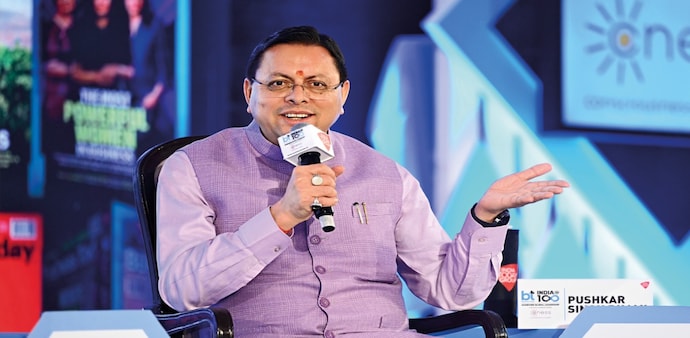
Chief Minister Pushkar Singh Dhami, 50, is leading the next phase of development as the state seeks to expand beyond its traditional strengths and emerge as a destination for investment, innovation and enterprise. A law graduate with a postgraduate degree in human resource management and industrial relations, Dhami represents Champawat in the Uttarakhand Legislative Assembly. Now in his second tenure as Chief Minister, he oversees key portfolios, including home, finance, planning, industry and personnel, bringing together legislative experience and executive responsibility at a crucial moment in the state’s economic journey. Edited excerpts:
Q: BT’s research shows Uttarakhand recorded the fastest manufacturing growth among 11 hill states. Has the state changed?
A: Uttarakhand has changed greatly. In 2023, we held a Global Investors Summit under the guidance of Prime Minister Narendra Modi. People from more than 50 countries participated. MoUs (memorandum of understanding) were signed, and investments worth lakhs of crores of rupees has come. There is a perception that investor summits see MoUs but without implementation on the ground. In our case, there was significant implementation. We prepared in advance to make policies that attract investors and made it easier for them to set up industries. We simplified wherever needed.
Our connectivity is good. The state is close to the greater national capital region. Last April, the prime minister launched the Delhi-Dehradun Economic Corridor. Delhi no longer feels far as the journey from Delhi to Dehradun can now be completed in two to two-and-a-half hours. Air services from Dehradun connect 50 cities, including Delhi, Mumbai, Ahmedabad, Bengaluru and Chennai, with more than 50 daily flights.
We also have a large industrial area in Haridwar. It is the abode of Mother Ganga. The environment is good and so is the law and order. In our state, good manpower is readily available and industrial strikes and disturbances are not common.
The state, however, is not only about the plain areas. It has varied geographical conditions. Two-three districts are entirely in the plains while nine are entirely in the hills. We want industry to reach districts such as Pauri, Chamoli and Almora as well. We are working to build industrial parks there. There are several small entrepreneurs and people who want to start enterprises. The ‘Our One District-Two Products’ scheme is already running.
Q: Every state is competing for land and skilled manpower. Does Uttarakhand have enough land for investors and industry?
A: Uttarakhand’s situation is very different from other states. We do not have very large land banks, but what we have is adequate for industrial requirements. Land is available in Haridwar and Dehradun. And we have a substantial land bank in Udham Singh Nagar. Whoever wants to set up industry or invest will be provided land as well as other facilities.
Q: What is your message to the younger generation about their role in India’s development?
A: When we talk about youth, and especially Gen Z, I call them the Indian Generation. At one point, we both were Gen Z. Those who fought for India’s independence—freedom fighters like Chandrashekhar Azad, Bhagat Singh, Rajguru and Ram Prasad Bismil—were all Gen Z. Today’s generation is aware, wise and connected to the world. The most important thing is the connectivity we have built—call it the communication revolution or the IT revolution. Young people observe the changing environment across the world. Naturally, they feel these changes should happen here too. They have expectations and we must listen to them. Just as the world has moved forward, we must also move forward. That is what our young people want.
The Prime Minister rightly said that these children are ours and the government belongs to them too. We are doing our part accordingly. In Uttarakhand, youth and water are our greatest priorities. They should serve the state.
One major issue was paper leaks and cheating. I started work as chief minister on July 4, 2021, and from the very first day resolved that if there was any wrongdoing or irregularity in an examination or recruitment process, or if the selection process was not transparent, we would not hide it.
Some cases were continuing from before. We acted on them, and 100 people from cheating mafias had to go to jail during our government’s tenure.
In these five years, we have made 34,000 new recruitments. Not a single case of corruption has come up in any of them. Our selections are conducted in a completely transparent manner.
A number of candidates and their parents have met and thanked us. They told us their sons and daughters had been working hard and writing examinations earlier too but were not being selected. In these years, some of those same candidates were selected in four-five examinations. Many came from humble families.
You may think 34,000 is a small figure, but for our state, it is very large. Ever since Uttarakhand was formed by the then Prime Minister Atal Behari Vajpayee, the total number of appointments are 50,000. Of these, 16,000 were made in 21 years, while in just five years, we recruited 34,000. The hiring is still ongoing.
We have also built a start-up ecosystem. When I came to power, there were 700 start-ups in the state. Today, we have nearly 2,000. Many people are opening homestays and small hotels, working
In agriculture and horticulture, and establishing small enterprises.
Q: How are you balancing industrialisation with agriculture and rural entrepreneurship?
A: We want farmers to become entrepreneurs of the rural economy. Through various missions—for fruits like apples and kiwis to millets, natural farming, dairy production, fisheries, beekeeping and medicinal plants—we are connecting mountain agriculture with the new economy.
Our focus is not only on production but on the entire value chain—processing, packaging, branding and marketing—so that farmers receive greater returns. Women’s participation is equally important. We are working to empower women through various steps, including the Lakhpati Didi initiative.
Q: How do you balance development with environmental concerns in a Himalayan state?
A: For a Himalayan state like Uttarakhand, development must be accompanied by resilience. We firmly believe that development and environment are not adversaries. They must be partners in progress. Around 70% of our geographical area is covered by forests. We view this natural wealth not merely as heritage but also a source of opportunities through circular economy, carbon credits and emerging sectors.
Uttarakhand is also moving rapidly in clean and renewable energy. The state should not remain only a consumer of energy but become an important contributor to India’s green energy security.
Through the Vibrant Villages Programme, border villages are being developed, not as the last villages of the country but as the first villages. Development of roads, electricity, communication, tourism and livelihood opportunities in these areas is improving lives while strengthening national security.
Q: The industrial policies of the BJP government in the state have been in place for some time now. Are they showing results on the ground?
A: The numbers tell the story. The state is moving in the right direction. Our GSDP has recorded growth of 7.23%, and per capita income has increased significantly. The state, which began its development journey with a relatively small budget, has crossed the historic milestone of Rs 1 lakh crore annual budget.
Uttarakhand has secured first place in NITI Aayog’s Sustainable Development Goals Index. The state has also been placed in the Achievers category in Ease of Doing Business and the Leaders category in Startup Ranking. But for us, real success will come when a young person from the mountains is no longer forced to leave his or her village in search of employment.
@szarabi
Long associated with pilgrimage, tourism and the Himalayas, Uttarakhand is building a broader economic identity. Business Today research places it at the forefront of manufacturing growth among India’s 11 hill states, with Gross State Value Addition rising 143% over the past decade.
Chief Minister Pushkar Singh Dhami, 50, is leading the next phase of development as the state seeks to expand beyond its traditional strengths and emerge as a destination for investment, innovation and enterprise. A law graduate with a postgraduate degree in human resource management and industrial relations, Dhami represents Champawat in the Uttarakhand Legislative Assembly. Now in his second tenure as Chief Minister, he oversees key portfolios, including home, finance, planning, industry and personnel, bringing together legislative experience and executive responsibility at a crucial moment in the state’s economic journey. Edited excerpts:
Q: BT’s research shows Uttarakhand recorded the fastest manufacturing growth among 11 hill states. Has the state changed?
A: Uttarakhand has changed greatly. In 2023, we held a Global Investors Summit under the guidance of Prime Minister Narendra Modi. People from more than 50 countries participated. MoUs (memorandum of understanding) were signed, and investments worth lakhs of crores of rupees has come. There is a perception that investor summits see MoUs but without implementation on the ground. In our case, there was significant implementation. We prepared in advance to make policies that attract investors and made it easier for them to set up industries. We simplified wherever needed.
Our connectivity is good. The state is close to the greater national capital region. Last April, the prime minister launched the Delhi-Dehradun Economic Corridor. Delhi no longer feels far as the journey from Delhi to Dehradun can now be completed in two to two-and-a-half hours. Air services from Dehradun connect 50 cities, including Delhi, Mumbai, Ahmedabad, Bengaluru and Chennai, with more than 50 daily flights.
We also have a large industrial area in Haridwar. It is the abode of Mother Ganga. The environment is good and so is the law and order. In our state, good manpower is readily available and industrial strikes and disturbances are not common.
The state, however, is not only about the plain areas. It has varied geographical conditions. Two-three districts are entirely in the plains while nine are entirely in the hills. We want industry to reach districts such as Pauri, Chamoli and Almora as well. We are working to build industrial parks there. There are several small entrepreneurs and people who want to start enterprises. The ‘Our One District-Two Products’ scheme is already running.
Q: Every state is competing for land and skilled manpower. Does Uttarakhand have enough land for investors and industry?
A: Uttarakhand’s situation is very different from other states. We do not have very large land banks, but what we have is adequate for industrial requirements. Land is available in Haridwar and Dehradun. And we have a substantial land bank in Udham Singh Nagar. Whoever wants to set up industry or invest will be provided land as well as other facilities.
Q: What is your message to the younger generation about their role in India’s development?
A: When we talk about youth, and especially Gen Z, I call them the Indian Generation. At one point, we both were Gen Z. Those who fought for India’s independence—freedom fighters like Chandrashekhar Azad, Bhagat Singh, Rajguru and Ram Prasad Bismil—were all Gen Z. Today’s generation is aware, wise and connected to the world. The most important thing is the connectivity we have built—call it the communication revolution or the IT revolution. Young people observe the changing environment across the world. Naturally, they feel these changes should happen here too. They have expectations and we must listen to them. Just as the world has moved forward, we must also move forward. That is what our young people want.
The Prime Minister rightly said that these children are ours and the government belongs to them too. We are doing our part accordingly. In Uttarakhand, youth and water are our greatest priorities. They should serve the state.
One major issue was paper leaks and cheating. I started work as chief minister on July 4, 2021, and from the very first day resolved that if there was any wrongdoing or irregularity in an examination or recruitment process, or if the selection process was not transparent, we would not hide it.
Some cases were continuing from before. We acted on them, and 100 people from cheating mafias had to go to jail during our government’s tenure.
In these five years, we have made 34,000 new recruitments. Not a single case of corruption has come up in any of them. Our selections are conducted in a completely transparent manner.
A number of candidates and their parents have met and thanked us. They told us their sons and daughters had been working hard and writing examinations earlier too but were not being selected. In these years, some of those same candidates were selected in four-five examinations. Many came from humble families.
You may think 34,000 is a small figure, but for our state, it is very large. Ever since Uttarakhand was formed by the then Prime Minister Atal Behari Vajpayee, the total number of appointments are 50,000. Of these, 16,000 were made in 21 years, while in just five years, we recruited 34,000. The hiring is still ongoing.
We have also built a start-up ecosystem. When I came to power, there were 700 start-ups in the state. Today, we have nearly 2,000. Many people are opening homestays and small hotels, working
In agriculture and horticulture, and establishing small enterprises.
Q: How are you balancing industrialisation with agriculture and rural entrepreneurship?
A: We want farmers to become entrepreneurs of the rural economy. Through various missions—for fruits like apples and kiwis to millets, natural farming, dairy production, fisheries, beekeeping and medicinal plants—we are connecting mountain agriculture with the new economy.
Our focus is not only on production but on the entire value chain—processing, packaging, branding and marketing—so that farmers receive greater returns. Women’s participation is equally important. We are working to empower women through various steps, including the Lakhpati Didi initiative.
Q: How do you balance development with environmental concerns in a Himalayan state?
A: For a Himalayan state like Uttarakhand, development must be accompanied by resilience. We firmly believe that development and environment are not adversaries. They must be partners in progress. Around 70% of our geographical area is covered by forests. We view this natural wealth not merely as heritage but also a source of opportunities through circular economy, carbon credits and emerging sectors.
Uttarakhand is also moving rapidly in clean and renewable energy. The state should not remain only a consumer of energy but become an important contributor to India’s green energy security.
Through the Vibrant Villages Programme, border villages are being developed, not as the last villages of the country but as the first villages. Development of roads, electricity, communication, tourism and livelihood opportunities in these areas is improving lives while strengthening national security.
Q: The industrial policies of the BJP government in the state have been in place for some time now. Are they showing results on the ground?
A: The numbers tell the story. The state is moving in the right direction. Our GSDP has recorded growth of 7.23%, and per capita income has increased significantly. The state, which began its development journey with a relatively small budget, has crossed the historic milestone of Rs 1 lakh crore annual budget.
Uttarakhand has secured first place in NITI Aayog’s Sustainable Development Goals Index. The state has also been placed in the Achievers category in Ease of Doing Business and the Leaders category in Startup Ranking. But for us, real success will come when a young person from the mountains is no longer forced to leave his or her village in search of employment.
@szarabi