
Will double inventory in India in 3-5 years: Haitham Mattar, MD, IHG Hotels & Resorts
Will double inventory in India in 3-5 years: Haitham Mattar, MD, IHG Hotels & Resorts
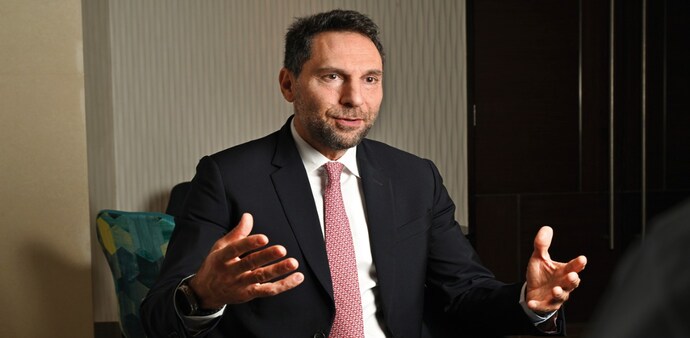
Haitham Mattar, MD, MEA & Southwest Asia, IHG Hotels; Resorts, on why he is focusing on domestic tourism, and what lies ahead for the hospitality industry.
Krishna Gopalan
- May 5, 2025,
- Updated May 5, 2025 4:12 PM IST
The InterContinental Hotels Group (IHG) is known for iconic brands Crowne Plaza, Holiday Inn, Six Senses, and, of course, InterContinental. It has a strong presence across the world, though India has emerged as a key market of late. In a freewheeling chat, Haitham Mattar, Managing Director, MEA & Southwest Asia, IHG Hotels & Resorts, tells Business Today’s Krishna Gopalan how he chooses which brand is ready for which market, the opportunities in India, and a lot more. Edited excerpts:
Hey!
Already a subscriber? Sign In
THIS IS A PREMIUM STORY FROM BUSINESS TODAY.
Subscribe to Business Today Digital and continue enjoying India's premier business offering uninterrupted
only FOR
₹999 / Year
Unlimited Digital Access + Ad Lite Experience
Cancel Anytime
-
 Unlimited access to Business Today website
 -
 Exclusive insights on Corporate India's working, every quarter
 -
 Access to our special editions, features, and priceless archives
 -
 Get front-seat access to events such as BT Best Banks, Best CEOs and Mindrush
The InterContinental Hotels Group (IHG) is known for iconic brands Crowne Plaza, Holiday Inn, Six Senses, and, of course, InterContinental. It has a strong presence across the world, though India has emerged as a key market of late. In a freewheeling chat, Haitham Mattar, Managing Director, MEA & Southwest Asia, IHG Hotels & Resorts, tells Business Today’s Krishna Gopalan how he chooses which brand is ready for which market, the opportunities in India, and a lot more. Edited excerpts:
Advertisement
Q: Which market does India remind you of and at what point in time? What makes it unique?
A: There’s a lot of cultural cross-exposure between India and the Middle East. After all, it is one of the oldest countries from where some of the oldest religions have come. A country that is highly spiritual resonates with the Gulf region. These are the things that come to my mind when I travel to India or the Middle East or the rest of the world.
Then, you look at China and India, not necessarily in terms of culture and food, but size. The critical mass that you see in both the countries makes you realise that you are in a consumption society that gives you opportunities for growth. India has a massive captive market. You’ve just got to find the right segment, the right product, create a need, and you are in business.
Advertisement
Q: Where does India stand in the overall global strategy of IHG?
A: We have grown tremendously in India from 16 hotels in 2013 to 46 today. The goal is to double our inventory over the next three to five years. Our global CEO Elie Maalouf has four-five focus countries, including India.
Q: You have a large portfolio of brands. How do you balance them in positioning and product offering?
A: We have 19 brands, but they are unique in their own way. There is no cross-contamination. They all have their own swimming lanes and remain very different—Holiday Inn and Holiday Express have a clear difference in terms of room size, experience, food and beverage options. Plus, they target different segments of the market. Brand affinity comes from how it resonates with the consumer. People may not be loyal to IHG per se but will be loyal to InterContinental or Holiday Inn or Crowne Plaza.
Advertisement
Q: You have seen many markets globally. How do you decide when a market is ready for any of your brands?
A: We do a lot of research on customer trends to understand what’s changing and what people are looking for. This is important since we must cater to the new generation, which is always looking for something different. Our brands must be true to themselves. Take InterContinental. You have to keep the brand’s hallmarks even as it is renovated and renewed. Research helps us understand which markets need which brand.
All our brands exist in the US. We have a brand called Even Hotels, which is focused on wellness. We realised from the tourism strategy of Saudi Arabia that there was a large domestic market with a young population. About 70% are under the age of 35 and looking for wellness. So, Even sounded like a good brand for that market. We put up a paper for our board’s approval on these facts and why this brand will work in Saudi Arabia.
Advertisement
We have to make sure that everything is well-researched before we launch an offering. We then identify like-minded partners to help develop that brand. Nine out of ten times, investors, owners and developers know which of our brands they want. The critical part is making sure that you’re offering these investors a return on investment. We are not just in the business of generating fees. It’s about building partnerships and relationships.
Q: How critical are considerations of heterogeneity across markets for brand positioning?
A: A lot of local and cultural opportunities drive hotel design and experience. This means an InterContinental can be different in terms of architectural design or food experience to reflect the local culture. So, arrival experience, reception, team members will change. Take Six Senses, where the spa experience changes across locations, because it has to be specific to the environment.
But the basic values remain the same and what we deliver by way of brand promise and quality standards is always intact. So is the way the team is selected. Or the quality of bedding and linen. The aura around the hotel experience has to be the same because you have to feel like you are staying in an InterContinental property regardless of the location. It is that heritage that you feel throughout. The touch points for each guest have to always remind them that they are at an InterContinental—whether it’s the scent, the linen or the material they touch. The people who work in hospitality are like ambassadors and travel around the world. It’s almost like an exchange programme for students.
Advertisement
The look and feel changes—that could be the colours or the artwork—to reflect the location, but brand hallmarks remain. Sleeping on the bed is a good example, because regardless of where I am, that experience is absolutely the same.
Q: Do you want to pick up one or two examples of markets where the industry’s evolution took place much sooner than anticipated?
A: Most of my experiences come from Gulf region countries and countries that feed these markets. That has given me a good understanding of the eastern European market as it is a big outbound market, especially for Dubai and the Middle East.
Even if you look at smaller countries such as Jordan, there is a wealth of natural assets. It also has historical and religious sites. Its tourism has relied heavily on the US market. In the past, more specifically around 15 years ago, anything that happened in the US or the Middle East led to slowing down (of tourism). At that point, the average American looked at the Middle East as one country and not 28 countries. A lot has changed, and more Americans now want to travel to Dubai or Delhi or Agra.
Advertisement
I must mention the way Dubai has transformed and led the way for tourism in the Middle East. It started with small areas of beach hotels, followed by a realisation that they need to do more. But 60% of their coastline is taken by the port and that led them to extend the coastline as much as possible. They then tried to do retail, or shopping tourism, with the biggest mall in the world and then the second-biggest mall in the world. A lot of fashion is based in Europe, and you’ve got to import that to Dubai.
Soon after, Dubai looked at its own natural assets to go beyond being just a shopping destination. Then, it started promoting outdoor adventure. Plus, it built a big convention centre and that gave it a way to do more events. Dubai is also an attractive destination for Indian weddings. That is a big market today. There is a lot to be learnt from what Dubai has done over time: when something did not work, it quickly thought of a new idea. The key was diversity. Today you find a bit of Vegas in Dubai or a bit of Miami or a bit of Singapore.
I think the focus on creating high quality airport infrastructure [through Emirates] also helped Dubai in terms of ensuring connectivity across the world.That diversity is bringing in different segments of the market. When they focused only on one segment, they realised it’s just not enough, it’s too seasonal.
Q: What do you have to say about Indians going abroad for vacations? How are you going to convince Indians to spend more time here and spend more money in the hotel?
A: Our data shows that the domestic market is the largest and accounts for about 70% tourists. There are perhaps 200 million Indians who are high-end customers and can afford to travel outside. But there is a very large base wanting to travel across the country for spiritual tourism, staycations or business. The hotels that we are building and the brands we are bringing in are more focused on the domestic market. Across the world, the domestic market is huge, be it Egypt, Saudi Arabia, India or China. 
@krishnagopalan
Read more!