
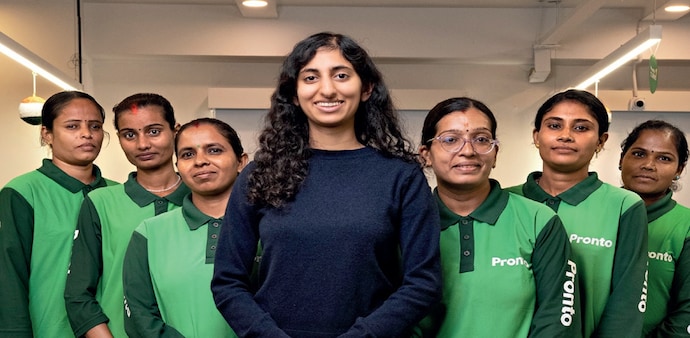
Founder & CEO of Pronto, Anjali Sardana, has the outsider’s advantage
Despite lacking local market experience, operational expertise, and even fluency in an Indian language, Anjali Sardana chose India for her first major entrepreneurial bet
Palak Agarwal
- Oct 28, 2026,
- Updated Oct 28, 2026 5:32 PM IST
Anjali Sardana did not know the Indian market. The US-raised entrepreneur did not speak an Indian language, had no experience running an operations-heavy business and, by her own admission, was not prepared to build a company in India. Today, about 60% of on-demand home services start-up Pronto’s business comes from Delhi-NCR.
Advertisement
That is the paradox at the heart of Sardana’s story. The idea behind Pronto emerged from a broader frustration with labour markets. Home services became the starting point. But the ambition was to structure informal labour across warehouses, factories, retail, and manufacturing.
The irony of building in India as an outsider is not lost on Sardana. “If you were prepared, you probably wouldn’t do it,” she says.
Her outsider status, she argues, allowed her to question assumptions others may have taken for granted. And the competition did not change her conviction. By the time Pronto formally launched in 2025, Urban Company was already a listed incumbent, and Snabbit had entered the market.
Advertisement
But Sardana says she would have built Pronto regardless. She describes the conviction behind the company in unusually personal terms: “I became so obsessed that I couldn’t sleep or eat because I felt I was wasting time not starting.”
For her, Pronto is ultimately less about cleaning homes than about what happens when technology meets a fragmented labour market. She sees India’s blue-collar workforce as a potential beneficiary of AI and robotics, not merely as a source of cheap labour or data.
The founder who arrived in India without knowing its market is now betting that the country’s informal workforce can become the foundation for a much bigger global business.
@PalakAgarwal64
Read more!