
BTTV Exclusive| Gaja IPO: CEO explains valuation, AIF growth, business model and plans after listing
Gaja Alternative Asset Management IPO: MD and CEO Gopal Jain explains the company’s business model, growth outlook, valuation and plans to scale its AIF platform.
- Aug 18, 2026,
- Updated Aug 18, 2026 3:49 PM IST
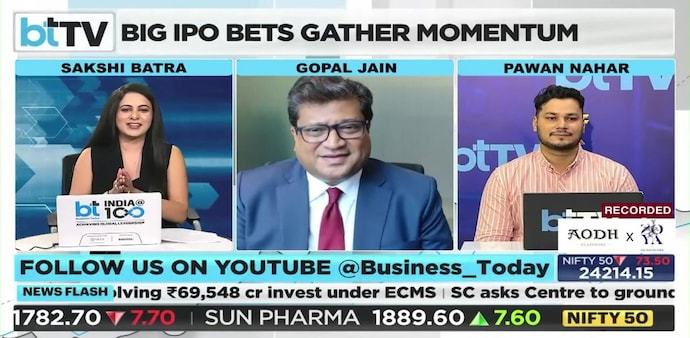
Gaja Alternative Asset Management is positioning its initial public offering (IPO) as what Gopal Jain, its Managing Director and CEO, described in an interview with Business Today TV as a first-of-its-kind listing in India that could give public market investors exposure to an alternative asset management business. Jain said the company is effectively taking its fund management business public after 22 years of managing alternative investment funds and offshore funds.
He said the primary capital raised through the IPO will be used to build a broader asset management platform, scale Gaja’s flagship strategy and add new strategies. “This is, arguably, the first of its kind IPO in India,” Jain said, adding that the listing would mark the debut of listed alternatives, particularly listed equity alternatives, as an asset class in India.
IPO pricing and valuation Jain said Gaja is going public at the upper end of its IPO price band at Rs 160 per share, compared with Rs 144 per share in a pre-IPO transaction carried out about a year ago. He said the company’s pre-money valuation has risen from Rs 1,500 crore at the time of that transaction to Rs 1,800 crore now, while historical profit has increased from Rs 62 crore to Rs 82 crore.
According to Jain, Gaja’s profit has grown 33 per cent, while the current valuation implies about three times its book value. He said the company’s net worth stood at a little over Rs 600 crore as of March 31. On the price-to-earnings metric, Jain said Gaja’s historical P/E is about 23 times, compared with a range of 29 to 91 times for the peer set presented by the company. He added that investors should assess the sustainability of future profit growth rather than view the multiple in isolation.
Industry growth and revenue model Jain said the growth potential of India’s alternative investment industry is a key driver for Gaja. He said the sector has grown at a compounded annual rate of about 29 per cent historically, while CRISIL expects it to grow at around 26 per cent annually going forward. “We can ride the coattails of the industry’s growth as we have in the last two decades,” he said.
He added that Gaja has a relatively mature business model, multiple revenue streams and a long operating history, which he believes makes its earnings more predictable and easier for investors to model. Gaja’s asset management business generates two broad types of fees: management fees and performance fees. While management fees are capped, performance fees are linked to fund performance and do not have a fixed cap, Jain said.
Access to alternatives and private equity exposure The company also earns carried interest, or a share of profits generated by its funds. Jain said it takes time for alternative asset managers to generate meaningful carried interest, but Gaja’s 22-year operating history means it has already built multiple income streams, including management fees, carried interest and sponsor gains.
Jain said the company’s long track record and transparency around its underlying funds should help institutional, HNI and retail investors better understand and model its future earnings. He also said a listed alternative asset manager could widen access to the asset class, as AIF products are largely accessible only to institutional and high-net-worth investors who meet applicable investment requirements.
“Anybody can buy into an alternative AMC,” he said, while clarifying that owning shares of the AMC is not the same as investing directly in its funds. He added that Gaja’s funds invest in unlisted companies, which can offer some insulation from daily public market volatility, and said performance fees are standard globally and broadly in line with global averages. Overall, Jain said Gaja offers exposure to a 22-year-old alternative asset management business as well as the structural growth of India’s private markets and AIF industry.
Watch the entire video:
Gaja Alternative Asset Management is positioning its initial public offering (IPO) as what Gopal Jain, its Managing Director and CEO, described in an interview with Business Today TV as a first-of-its-kind listing in India that could give public market investors exposure to an alternative asset management business. Jain said the company is effectively taking its fund management business public after 22 years of managing alternative investment funds and offshore funds.
He said the primary capital raised through the IPO will be used to build a broader asset management platform, scale Gaja’s flagship strategy and add new strategies. “This is, arguably, the first of its kind IPO in India,” Jain said, adding that the listing would mark the debut of listed alternatives, particularly listed equity alternatives, as an asset class in India.
IPO pricing and valuation Jain said Gaja is going public at the upper end of its IPO price band at Rs 160 per share, compared with Rs 144 per share in a pre-IPO transaction carried out about a year ago. He said the company’s pre-money valuation has risen from Rs 1,500 crore at the time of that transaction to Rs 1,800 crore now, while historical profit has increased from Rs 62 crore to Rs 82 crore.
According to Jain, Gaja’s profit has grown 33 per cent, while the current valuation implies about three times its book value. He said the company’s net worth stood at a little over Rs 600 crore as of March 31. On the price-to-earnings metric, Jain said Gaja’s historical P/E is about 23 times, compared with a range of 29 to 91 times for the peer set presented by the company. He added that investors should assess the sustainability of future profit growth rather than view the multiple in isolation.
Industry growth and revenue model Jain said the growth potential of India’s alternative investment industry is a key driver for Gaja. He said the sector has grown at a compounded annual rate of about 29 per cent historically, while CRISIL expects it to grow at around 26 per cent annually going forward. “We can ride the coattails of the industry’s growth as we have in the last two decades,” he said.
He added that Gaja has a relatively mature business model, multiple revenue streams and a long operating history, which he believes makes its earnings more predictable and easier for investors to model. Gaja’s asset management business generates two broad types of fees: management fees and performance fees. While management fees are capped, performance fees are linked to fund performance and do not have a fixed cap, Jain said.
Access to alternatives and private equity exposure The company also earns carried interest, or a share of profits generated by its funds. Jain said it takes time for alternative asset managers to generate meaningful carried interest, but Gaja’s 22-year operating history means it has already built multiple income streams, including management fees, carried interest and sponsor gains.
Jain said the company’s long track record and transparency around its underlying funds should help institutional, HNI and retail investors better understand and model its future earnings. He also said a listed alternative asset manager could widen access to the asset class, as AIF products are largely accessible only to institutional and high-net-worth investors who meet applicable investment requirements.
“Anybody can buy into an alternative AMC,” he said, while clarifying that owning shares of the AMC is not the same as investing directly in its funds. He added that Gaja’s funds invest in unlisted companies, which can offer some insulation from daily public market volatility, and said performance fees are standard globally and broadly in line with global averages. Overall, Jain said Gaja offers exposure to a 22-year-old alternative asset management business as well as the structural growth of India’s private markets and AIF industry.
Watch the entire video: