
Hindustan Coca-Cola IPO: Jefferies on Coke India bottler's biggest moat & key risks
Hindustan Coca-Cola Holdings is preparing for an IPO with positive free cash flow and a strong bottling network. Check its business profile, financials, market position and OFS details.
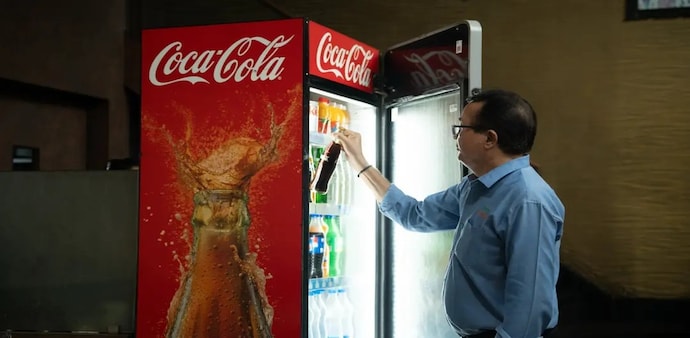
- Nov 26, 2026,
- Updated Nov 26, 2026 1:28 PM IST
Hindustan Coca-Cola Holdings (HCCH), Coca-Cola’s largest bottler in India, has a net-cash balance sheet and reported positive free cash flow in FY26 as it prepares for an initial public offering (IPO), according to Jefferies. Its EBITDA margins have risen because of cost controls, operating leverage, backward integration and fiscal incentives.
The IPO of Hindustan Coca-Cola Holdings is entirely an offer-for-sale (OFS) of up to 99,74,61,465 equity shares by its promoter, Hindustan Coca-Cola Overseas Holdings Pte. The company will not receive any proceeds from the issue. Its shares will be listed on the National Stock Exchange (NSE) and BSE.
Kotak Mahindra Capital Company, Citigroup Global Markets India, JP Morgan India, Morgan Stanley India, Axis Capital, Goldman Sachs (India) Securities and IIFL Capital Services are the book-running lead managers for the IPO, while KFin Technologies is the registrar.
Market opportunity and business profile Citing the DRHP, Jefferies said India’s non-alcoholic ready-to-drink market was worth about $15 billion in FY26 and could grow at a compound annual growth rate of around 14 per cent through 2031. Growth is expected to be supported by low per-capita consumption, rising incomes, urbanisation and broader consumption occasions.
HCCH operates across 10 states and four Union Territories, mainly in southern and western India, reaching 1.7 million outlets. These regions account for about 45 per cent of India’s non-alcoholic ready-to-drink market and benefit from warmer weather and relatively year-round consumption.
HCCH accounts for 38.5 per cent of Coca-Cola concentrate sales in India. Its share exceeds 60 per cent in carbonated soft drinks and 42 per cent in still beverages in its territories, where Coca-Cola brands have more than three times the share of the nearest competitor. HCCH handles manufacturing, bottling, distribution, sales and local execution, while The Coca-Cola Company controls brands, formulations, concentrate, packaging and certain pricing decisions.
HCCH offers 41 beverages across sparkling drinks, hydration and still beverages, contributing about 67%, 23% and 10% of volumes, respectively. Its brands include Thums Up, Coca-Cola, Sprite, Fanta, Maaza, Kinley, Limca, Minute Maid and Monster. General trade contributes over 80 per cent of its business, while about 573,000 outlets have visi-coolers.
Jubilant Beverages acquired a 40 per cent stake in HCCH in July 2025, becoming a promoter alongside The Coca-Cola Company. The partnership brought local presence, listed-company promoter experience and professional leadership.
Capacity and expansion plans HCCH operates 14 owned plants, eight co-packing units and 90 bottling lines. Its installed capacity is about 1.3 billion cases, with utilisation at 67 per cent in FY26.
The company plans to add ASSP lines and establish a dedicated route-to-market for products priced at Rs 10-20. The technology uses one-third less plastic than standard 250 ml PET bottles and extends shelf life by more than four months.
Financial performance and competition Jefferies said rival Varun Beverages Ltd, which handles over 90 per cent of PepsiCo India’s volumes and also operates overseas, covers more than four million outlets and has over 1.15 million visi-coolers. It recorded better volume growth in most quarters, higher realisations and stronger EBITDA margins, although HCCH led growth in the June quarter. Seasonality was broadly similar.
Varun Beverages Ltd reported June-quarter revenue of about Rs 6,000 crore and EBITDA of Rs 1,880 crore, compared with HCCH’s Rs 4,300 crore and Rs 740 crore, respectively.
HCCH’s FY24-FY26 reported figures are not directly comparable because of refranchising. Its retained units recorded FY26 revenue of Rs 11,440 crore and EBITDA of Rs 1,300 crore, with realisations and margins improving in the first quarter of FY27.
Jefferies said HCCH’s working capital improved by March 2026, while capital expenditure moderated and free cash flow turned positive in FY26 after remaining negative in FY24 and FY25.
Key risks Based on the DRHP, Jefferies has flagged dependence on The Coca Cola Company, dependence on its supplies for concentrate, limited controls over brands, territorial restrictions, geographic concentration, change of seasons and weather, changing consumer preference, competition, regulatory concerns as major risks for the company.