
Strong economy, weak markets: 5 reasons why markets are ignoring 8.2% GDP growth
Strong economy, weak markets: 5 reasons why markets are ignoring 8.2% GDP growth
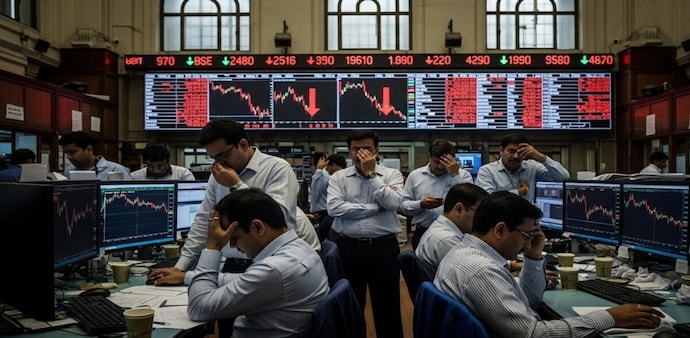
With consumers maxed out on debt, corporate lending stagnant, and mid/small-caps down 18-23%, India is in a relative bear market.
Ashutosh Verma
- Dec 3, 2025,
- Updated Dec 3, 2025 11:54 AM IST
India reported a dazzling 8.2% real GDP growth for Q2 FY25 -- one of the fastest rates in the world. The Nifty and Bank Nifty touched fresh all-time highs on the news. Yet within hours the indices gave up all gains, mid-caps and small-caps continued to get hammered, and most retail portfolios are nursing deep losses for the third straight quarter. Market Veteran and GQuant founder Shankar Sharma explained exactly why the market refuses to celebrate: the headline number is mathematically misleading and the market has already priced in the truth.
Advertisement
1. The GDP math that nobody believes
The official numbers show nominal GDP growing at around 8.7% while real GDP grew 8.2%. That implies an inflation adjustment (GDP deflator) of just 0.5-0.7%. India has never recorded this in modern data series. Sharma says that a realistic deflator of 4-4.5% (aligned with actual CPI, bond yields and inflation expectations) and true real growth collapses to only 4-4.5%.
“The market is not stupid. It sees through the deflator trick,” he said. “That’s the real cause for concern.”
2. The proof is in the market breadth
Since the last GDP print three months ago, Nifty is barely up 2% in rupees terms and it's down 6% in dollar terms. Similarly, Nifty Midcap 100 down 18%, Nifty Smallcap 100 down 23%. MSCI India has underperformed MSCI Emerging Markets by roughly 32% year-to-date. Sharma calls this a “classic relative bear market”. In dollar terms and versus peers, India is down 30-50%.
Advertisement
3. The Indian consumer is tapped out
For five years, private banks fueled their entire loan book growth through retail lending -- personal loans, credit cards, vehicles, and consumer durables. But, corporate lending almost stagnated during this time. Household debt-to-GDP has shot up from 33% in 2019 to around 42%. Retail loans growing at a 23% five-year CAGR versus just 6% for non-food corporate credit. Personal-loan and credit-card NPAs are now the fastest-rising stress segment, according to the RBI’s 2025 Financial Stability Reports. “Consumers are saturated,” Sharma said. “How much more debt can they take to buy the next iPhone or washing machine?”
4. GST cuts worked, but only for cars
The September 2024 GST reductions delivered ₹2-4 lakh absolute savings on cars, pushing passenger-vehicle sales to record monthly highs. White goods and air-conditioners sales actually fell 8-12% year-on-year despite a scorching summer. Lower-ticket items simply don’t create the same behavioral push.
Advertisement
5. Global money has already left the building
Eighteen months ago, Sharma predicted that India and the US would be the two worst-performing major markets. The call has played out perfectly.
Sharma’s own global portfolio is roughly 40% China, heavily weighted to Taiwan and Korea, with the rest in Europe and Latin America -- up 21% year-to-date despite the recent correction. He said that the bottom-line for the Indian investors is to expect index-level returns to struggle to beat fixed-deposit rates for the next few years. The current IPO frenzy is merely the latest “circus” that will pass, just like the SME and 2021-24 small-cap bubbles.
Real alpha, Sharma insists, will come only from painful, bottom-up stock-picking in quality small-caps –- not from hugging large-cap indices. “Small-caps will eventually save the Indian market and take it higher. Not large-caps,” he concluded. Until consumer leverage eases, corporate capex revives, and GDP accounting becomes credible again, the market’s message is unambiguous: celebrate the 8.2% headline at your own peril.
Advertisement
Disclaimer: Business Today provides stock market news for informational purposes only and should not be construed as investment advice. Readers are encouraged to consult with a qualified financial advisor before making any investment decisions.
India reported a dazzling 8.2% real GDP growth for Q2 FY25 -- one of the fastest rates in the world. The Nifty and Bank Nifty touched fresh all-time highs on the news. Yet within hours the indices gave up all gains, mid-caps and small-caps continued to get hammered, and most retail portfolios are nursing deep losses for the third straight quarter. Market Veteran and GQuant founder Shankar Sharma explained exactly why the market refuses to celebrate: the headline number is mathematically misleading and the market has already priced in the truth.
Advertisement
1. The GDP math that nobody believes
The official numbers show nominal GDP growing at around 8.7% while real GDP grew 8.2%. That implies an inflation adjustment (GDP deflator) of just 0.5-0.7%. India has never recorded this in modern data series. Sharma says that a realistic deflator of 4-4.5% (aligned with actual CPI, bond yields and inflation expectations) and true real growth collapses to only 4-4.5%.
“The market is not stupid. It sees through the deflator trick,” he said. “That’s the real cause for concern.”
2. The proof is in the market breadth
Since the last GDP print three months ago, Nifty is barely up 2% in rupees terms and it's down 6% in dollar terms. Similarly, Nifty Midcap 100 down 18%, Nifty Smallcap 100 down 23%. MSCI India has underperformed MSCI Emerging Markets by roughly 32% year-to-date. Sharma calls this a “classic relative bear market”. In dollar terms and versus peers, India is down 30-50%.
Advertisement
3. The Indian consumer is tapped out
For five years, private banks fueled their entire loan book growth through retail lending -- personal loans, credit cards, vehicles, and consumer durables. But, corporate lending almost stagnated during this time. Household debt-to-GDP has shot up from 33% in 2019 to around 42%. Retail loans growing at a 23% five-year CAGR versus just 6% for non-food corporate credit. Personal-loan and credit-card NPAs are now the fastest-rising stress segment, according to the RBI’s 2025 Financial Stability Reports. “Consumers are saturated,” Sharma said. “How much more debt can they take to buy the next iPhone or washing machine?”
4. GST cuts worked, but only for cars
The September 2024 GST reductions delivered ₹2-4 lakh absolute savings on cars, pushing passenger-vehicle sales to record monthly highs. White goods and air-conditioners sales actually fell 8-12% year-on-year despite a scorching summer. Lower-ticket items simply don’t create the same behavioral push.
Advertisement
5. Global money has already left the building
Eighteen months ago, Sharma predicted that India and the US would be the two worst-performing major markets. The call has played out perfectly.
Sharma’s own global portfolio is roughly 40% China, heavily weighted to Taiwan and Korea, with the rest in Europe and Latin America -- up 21% year-to-date despite the recent correction. He said that the bottom-line for the Indian investors is to expect index-level returns to struggle to beat fixed-deposit rates for the next few years. The current IPO frenzy is merely the latest “circus” that will pass, just like the SME and 2021-24 small-cap bubbles.
Real alpha, Sharma insists, will come only from painful, bottom-up stock-picking in quality small-caps –- not from hugging large-cap indices. “Small-caps will eventually save the Indian market and take it higher. Not large-caps,” he concluded. Until consumer leverage eases, corporate capex revives, and GDP accounting becomes credible again, the market’s message is unambiguous: celebrate the 8.2% headline at your own peril.
Advertisement
Disclaimer: Business Today provides stock market news for informational purposes only and should not be construed as investment advice. Readers are encouraged to consult with a qualified financial advisor before making any investment decisions.
Read more!