
BJP seats win, stock market: Short-term volatility likely; NDA fall may trigger correction
Exit polls of seven polling agencies indicate a comfortable majority for the incumbent NDA (BJP + JDU + LJP) in the Bihar assembly election.
- Nov 12, 2025,
- Updated Nov 12, 2025 1:09 PM IST
After the Bihar Assembly Elections, exit polls are hinting at the return of NDA alliance to the power, led by BJP and NDA. But select analysts believe that if these polls turn false on November 14, the counting, Indian stock market may witness a sharp correction in the short-term. Markets may price a short-term 'coalition discount,' with Nifty correcting 5-7 per cent on news of NDA’s downfall before stabilising on fiscal policy clarity.
InCred Equities has analysed the potential impact on Indian equity markets should the NDA lose the Bihar elections, with further implications stretching to a possible INDI alliance coalition government at the Centre. Drawing on recent history, it is noted that "when dominant-party stability gives way to coalition ambiguity—as in the 2024 post-poll reaction, when Nifty-50 index fell 6% in a single day—investors immediately price in concerns over policy continuity, fiscal prudence, and reform momentum."
According to InCred Equities, such a political shift is likely to trigger a sharp, short-term risk-off phase. The firm expects increased near-term volatility across indices, pronounced foreign investor outflows, and a temporary adjustment of India's perceived stability premium. Sectors including defence, infrastructure, and PSU themes could lose momentum, while consumption, regional, and SME-linked equities might benefit as fiscal approaches become more decentralised.
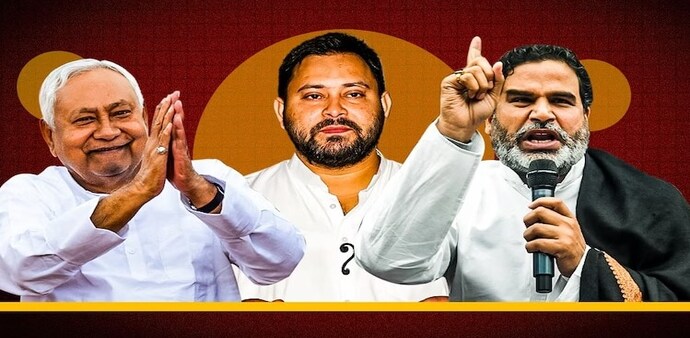
Exit polls of seven polling agencies indicate a comfortable majority for the incumbent NDA (BJP + JDU + LJP) in the Bihar assembly election. NDA is expected to gain 146 seats out of the 243 seat assembly. The opposition alliance Mahagathbandhan (RJD + Congress + Left) is restricted to 90 seats while the Jan Suraaj party is gaining 2 seats on average.
Youth unemployment has been the major theme in this election along with other issues like corruption and infrastructure development, said JM Financial. "High voter turnout has been the key highlight in the two phases of the election, which may be a result of the review exercise of the voter list carried out before the election," it said.
Market data from previous coalition transitions indicate that bond yields may rise modestly, reflecting a heightened fiscal-risk premium, and the rupee could experience mild pressure until the new government’s policy stance is clarified. InCred Equities points out that disciplined investors may find cyclical accumulation opportunities during these volatile periods, given that markets historically rebound once governance visibility improves.
InCred Equities underscores that the medium-term market trajectory is expected to depend less on who governs and more on the coalition's ability to maintain infrastructure spending, macro-economic stability, and credible fiscal management. The implications for the broader market and stakeholders hinge on the new government’s commitment to reform continuity and fiscal discipline, rather than its political make-up.
After the Bihar Assembly Elections, exit polls are hinting at the return of NDA alliance to the power, led by BJP and NDA. But select analysts believe that if these polls turn false on November 14, the counting, Indian stock market may witness a sharp correction in the short-term. Markets may price a short-term 'coalition discount,' with Nifty correcting 5-7 per cent on news of NDA’s downfall before stabilising on fiscal policy clarity.
InCred Equities has analysed the potential impact on Indian equity markets should the NDA lose the Bihar elections, with further implications stretching to a possible INDI alliance coalition government at the Centre. Drawing on recent history, it is noted that "when dominant-party stability gives way to coalition ambiguity—as in the 2024 post-poll reaction, when Nifty-50 index fell 6% in a single day—investors immediately price in concerns over policy continuity, fiscal prudence, and reform momentum."
According to InCred Equities, such a political shift is likely to trigger a sharp, short-term risk-off phase. The firm expects increased near-term volatility across indices, pronounced foreign investor outflows, and a temporary adjustment of India's perceived stability premium. Sectors including defence, infrastructure, and PSU themes could lose momentum, while consumption, regional, and SME-linked equities might benefit as fiscal approaches become more decentralised.
Exit polls of seven polling agencies indicate a comfortable majority for the incumbent NDA (BJP + JDU + LJP) in the Bihar assembly election. NDA is expected to gain 146 seats out of the 243 seat assembly. The opposition alliance Mahagathbandhan (RJD + Congress + Left) is restricted to 90 seats while the Jan Suraaj party is gaining 2 seats on average.
Youth unemployment has been the major theme in this election along with other issues like corruption and infrastructure development, said JM Financial. "High voter turnout has been the key highlight in the two phases of the election, which may be a result of the review exercise of the voter list carried out before the election," it said.
Market data from previous coalition transitions indicate that bond yields may rise modestly, reflecting a heightened fiscal-risk premium, and the rupee could experience mild pressure until the new government’s policy stance is clarified. InCred Equities points out that disciplined investors may find cyclical accumulation opportunities during these volatile periods, given that markets historically rebound once governance visibility improves.
InCred Equities underscores that the medium-term market trajectory is expected to depend less on who governs and more on the coalition's ability to maintain infrastructure spending, macro-economic stability, and credible fiscal management. The implications for the broader market and stakeholders hinge on the new government’s commitment to reform continuity and fiscal discipline, rather than its political make-up.