
BT Explainer: Why no Indian stock in top 10 MSCI EM Index - First time in 26 years
BT Explainer: Why no Indian stock in top 10 MSCI EM Index - First time in 26 years
Ask Investment Managers in note said delivery across key AI-linked companies remains healthy, suggesting that the fundamental cycle is still intact despite concerns around crowded positioning.
Amit Mudgill
- Jun 9, 2026,
- Updated Jun 9, 2026 12:32 PM IST
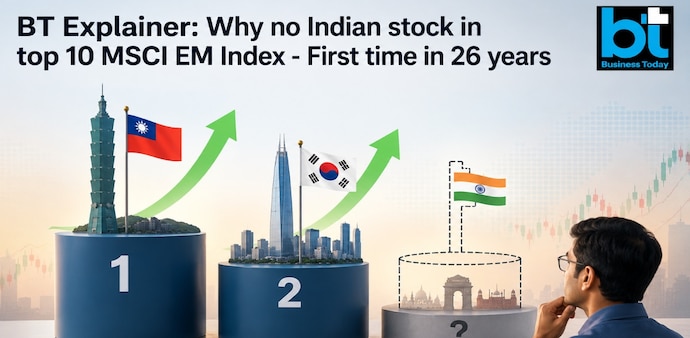
No Indian stock is among the top 10 constituents of the MSCI Emerging Markets Index by weight for the first time in 26 years, as the artificial intelligence (AI) boom reshaped the emerging-market landscape and left India on the sidelines. Taiwan and South Korea are the new poster boys, catering to surge in demand for AI chips, even racing ahead of China. India, a non-AI play, has gone off foreign investor radar, with 2026 alone seeing Rs 2,76,178 crore worth FPI outflows, in addition to Rs 1,66,286 crore outflows in 2025. This is reflecting in the MSCI EM index weighting.
Advertisement
Earnings growth forecast for Indian equities, say for Nifty universe, is 16-17 per cent for FY27 that appears aggressive, analysts noted. On the flip side, Taiwan and Korea are enjoying a secular and visible growth trend, which is expected to continue amid solid AI chip demand. "No wonder capital is chasing the expanding earnings growth in AI and Big Tech plays," MOFSL said in a note.
Seven of the top 10 MSCI EM index constituents are technology companies benefiting from the AI trade, with a combined weight of 33.44 per cent, data compiled from the MSCI factsheet for May showed. Overall, 43.1 per cent of the MSCI EM index constituents are from the IT sector.
Advertisement
Taiwan Semiconductor Manufacturing Company (TSMC), the world's largest dedicated contract chipmaker, accounted for 14.46 per cent of the MSCI EM index weight. This company alone accounts for 90 per cent of advanced AI chips and nearly 70 per cent of overall chips, with MUFG in a straregy note calling it world's most important chip manufacturer.
On the other hand, HDFC Bank and Reliance Industries Ltd (RIL) have slipped to the 11th and 12th spots in the MSCI EM index that has 1,205 constituents valuing $12.80 trillion.
Ask Investment Managers said delivery across key AI-linked companies remains healthy, suggesting that the fundamental cycle is still intact despite concerns around crowded positioning. It noted that while the US-based Nvidia continued to lead the AI accelerator cycle, companies such as TSMC, Samsung and SK Hynix are benefiting from strong demand across custom chips, advanced-node manufacturing and HBM memory.
Advertisement
Samsung accounted for 7.78 per cent of the MSCI EM index weight while SK Hynix another 6.60 per cent.
MOFSL noted that 2024 and 2025 were the years of a global AI and semiconductor boom, with market cap and profits recording 34 per cent and 32 per cent CAGR, respectively.
"This does not appear to ring alarm bells given the strong earnings trajectory of global AI and chip/ semiconductor manufacturing companies. Earnings are expected to clock 46 per centr CAGR over the next two years, underscoring the durability of the underlying growth cycle. While multiple pockets within the category do appear stretched, overall, valuations look moderate on a forward basis, nearly half of the current levels," MOFSL said.
Ask Investment Managers said the AI earnings momentum is secular but warned it is more crowded and vulnerable to periodic profit booking now. Taiwan's Mediatek, Delta Electronics and Hon Hai Precision are among MSCI EM index's key constituents.
Overall, Taiwan and South Korea, driven largely by chipmakers, account for 26.41 per cent and 23.06 per cent of the index, respectively, together making up nearly half of the benchmark. China ranks third with a 20.36 per cent weight, almost double of India's 10.87 per cent. India, whose benchmarks stand where they were in May 2024, is at distant fourth.
Advertisement
Morgan Stanley in a June 2 report noted that AI demand is rising across High Bandwidth Memory (HBM), Dynamic Random-Access Memory (DRAM) and enterprise Solid-State Drives (SSDs), pushing memory prices up six-fold in the past year.
New supply, the foreign brokerage noted, takes years to build, qualify and ramp. "That makes this cycle look less like a normal semiconductor upturn and more like a durable supply-demand reset," it said.
Three companies Samsung, SK Hynix and US-based Micron control 90 per cent of DRAM output worldwide.
The MSCI Emerging Markets Index, which captures large and mid cap representation across emerging markets countries and covers approximately 85 per cent of the free float-adjusted market capitalisation in each country, has delivered a solid 25.61 per cent in the first five months of 2026, in addition to a 33.57 per cent return in 2025.
"Since India’s market peak in Sep’24, valuations across India and several EMs have moderated meaningfully. While India’s valuation correction has largely been driven by price and time corrections, several AI-led markets have been supported by strong earnings upgrades over the past year," MOFSL said.
Disclaimer: Business Today provides stock market news for informational purposes only and should not be construed as investment advice. Readers are encouraged to consult with a qualified financial advisor before making any investment decisions.
No Indian stock is among the top 10 constituents of the MSCI Emerging Markets Index by weight for the first time in 26 years, as the artificial intelligence (AI) boom reshaped the emerging-market landscape and left India on the sidelines. Taiwan and South Korea are the new poster boys, catering to surge in demand for AI chips, even racing ahead of China. India, a non-AI play, has gone off foreign investor radar, with 2026 alone seeing Rs 2,76,178 crore worth FPI outflows, in addition to Rs 1,66,286 crore outflows in 2025. This is reflecting in the MSCI EM index weighting.
Advertisement
Earnings growth forecast for Indian equities, say for Nifty universe, is 16-17 per cent for FY27 that appears aggressive, analysts noted. On the flip side, Taiwan and Korea are enjoying a secular and visible growth trend, which is expected to continue amid solid AI chip demand. "No wonder capital is chasing the expanding earnings growth in AI and Big Tech plays," MOFSL said in a note.
Seven of the top 10 MSCI EM index constituents are technology companies benefiting from the AI trade, with a combined weight of 33.44 per cent, data compiled from the MSCI factsheet for May showed. Overall, 43.1 per cent of the MSCI EM index constituents are from the IT sector.
Advertisement
Taiwan Semiconductor Manufacturing Company (TSMC), the world's largest dedicated contract chipmaker, accounted for 14.46 per cent of the MSCI EM index weight. This company alone accounts for 90 per cent of advanced AI chips and nearly 70 per cent of overall chips, with MUFG in a straregy note calling it world's most important chip manufacturer.
On the other hand, HDFC Bank and Reliance Industries Ltd (RIL) have slipped to the 11th and 12th spots in the MSCI EM index that has 1,205 constituents valuing $12.80 trillion.
Ask Investment Managers said delivery across key AI-linked companies remains healthy, suggesting that the fundamental cycle is still intact despite concerns around crowded positioning. It noted that while the US-based Nvidia continued to lead the AI accelerator cycle, companies such as TSMC, Samsung and SK Hynix are benefiting from strong demand across custom chips, advanced-node manufacturing and HBM memory.
Advertisement
Samsung accounted for 7.78 per cent of the MSCI EM index weight while SK Hynix another 6.60 per cent.
MOFSL noted that 2024 and 2025 were the years of a global AI and semiconductor boom, with market cap and profits recording 34 per cent and 32 per cent CAGR, respectively.
"This does not appear to ring alarm bells given the strong earnings trajectory of global AI and chip/ semiconductor manufacturing companies. Earnings are expected to clock 46 per centr CAGR over the next two years, underscoring the durability of the underlying growth cycle. While multiple pockets within the category do appear stretched, overall, valuations look moderate on a forward basis, nearly half of the current levels," MOFSL said.
Ask Investment Managers said the AI earnings momentum is secular but warned it is more crowded and vulnerable to periodic profit booking now. Taiwan's Mediatek, Delta Electronics and Hon Hai Precision are among MSCI EM index's key constituents.
Overall, Taiwan and South Korea, driven largely by chipmakers, account for 26.41 per cent and 23.06 per cent of the index, respectively, together making up nearly half of the benchmark. China ranks third with a 20.36 per cent weight, almost double of India's 10.87 per cent. India, whose benchmarks stand where they were in May 2024, is at distant fourth.
Advertisement
Morgan Stanley in a June 2 report noted that AI demand is rising across High Bandwidth Memory (HBM), Dynamic Random-Access Memory (DRAM) and enterprise Solid-State Drives (SSDs), pushing memory prices up six-fold in the past year.
New supply, the foreign brokerage noted, takes years to build, qualify and ramp. "That makes this cycle look less like a normal semiconductor upturn and more like a durable supply-demand reset," it said.
Three companies Samsung, SK Hynix and US-based Micron control 90 per cent of DRAM output worldwide.
The MSCI Emerging Markets Index, which captures large and mid cap representation across emerging markets countries and covers approximately 85 per cent of the free float-adjusted market capitalisation in each country, has delivered a solid 25.61 per cent in the first five months of 2026, in addition to a 33.57 per cent return in 2025.
"Since India’s market peak in Sep’24, valuations across India and several EMs have moderated meaningfully. While India’s valuation correction has largely been driven by price and time corrections, several AI-led markets have been supported by strong earnings upgrades over the past year," MOFSL said.
Disclaimer: Business Today provides stock market news for informational purposes only and should not be construed as investment advice. Readers are encouraged to consult with a qualified financial advisor before making any investment decisions.
Read more!