
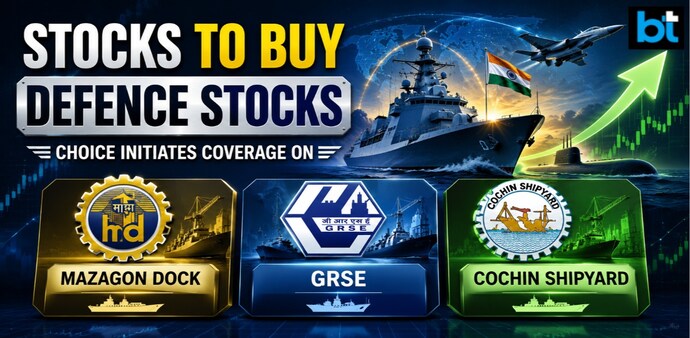
Defence stocks: Choice initiates coverage on Mazagon Dock, GRSE, Cochin Shipyard — Targets
Choice Institutional Equities has initiated coverage on defence shipping including Mazagon Dock, GRSE and Cochin Shipyard. Check rating, price targets & more..
- Jun 9, 2026,
- Updated Jun 9, 2026 1:26 PM IST
Indian Ocean has become the world’s most critical strategic corridor, carrying about 50 per cent of global container traffic, about 70 per cent of Asia’s oil flows and about 40 per cent of global seaborne crude through chokepoints such as Hormuz, Bab-el-Mandeb and Malacca, said Choice Institutional Broking.
More than 120,000 commercial vessels transit these waters every year, while for India, about 90 per cent of trade by volume and about 85 per cent of crude imports move through them. Choice said rising piracy, vessel harassment and grey-zone naval activity have turned maritime security into an economic safeguard, with the Indian Navy now carrying out continuous anti-piracy patrols, merchant vessel escorts and rapid-response deployments.
It said that China’s naval expansion under the ‘String of Pearls’ strategy and India’s ‘Diamond Necklace’ response are creating a structural opportunity for naval expansion and modernisation. It said the domestic naval industry has an order pipeline of about Rs 2.35 trillion through 2035, with Mazagon Dock Shipbuilders, Cochin Shipyard and Garden Reach Shipbuilders & Engineers among the main beneficiaries.
According to Choice, with China and Pakistan fielding more than 1,100 naval platforms against India’s 297, closing even 40 per cent of the 876-platform gap would require more than 300 new platforms over 20 years, implying a capex opportunity of $75-100 billion.
On Mazagon Dock Shipbuilders, Choice said the company is entering a structural upcycle and sees a pathway to a Rs 1 trillion order book by FY27E from a current base of about Rs 205 billion. It said the backlog could grow through likely awards such as the P-75I submarine programme of about Rs 700 billion, along with Project 17B frigates and next-generation destroyers.
Choice also pointed to diversification through ONGC orders and early export opportunities. It said the company is in a capacity-led phase with capex of about Rs 65-70 billion over three to five years and about Rs 200 billion in the long term, covering deadweight capacity expansion, the 37-acre Nhava Yard, Mumbai yard upgrades for P-75I and AIP submarines, and the greenfield Tuticorin yard for VLCC-class shipbuilding.
Choice said India’s participation in global commercial shipbuilding remains misaligned with its trade footprint, with less than 1 per cent of global cargo vessel ownership despite handling about 95 per cent of merchandise trade by volume and having a coastline of about 7,500 km. It estimated that if India’s share rises to 3-10 per cent, Mazagon could see incremental revenue opportunities of about Rs 120 billion, Rs 200 billion and Rs 450 billion, respectively.
Choice initiated coverage on Mazagon with a ‘buy’ rating and a target price of Rs 3,100. It expects revenue, EBITDA and PAT CAGR of 16 per cent, 18.6 per cent and 17.7 per cent over FY26-29E. The key risk, it said, is heavy reliance on large programmes and Ministry of Defence ordering cycles.
On Cochin Shipyard, Choice said lifecycle economics remain underappreciated in defence shipbuilding, with initial construction accounting for only 15-25 per cent of a naval platform’s lifetime cost, while maintenance, dockings, refits, upgrades and life-extension work make up the rest over 30-40 years.
It said mid-life refits alone can equal 70-100 per cent of original build value, implying cumulative monetisation of four to six times the initial contract value. Choice said Cochin commands about 45 per cent of India’s ship repair market and is the only yard capable of aircraft carrier repairs, making such work effectively yard-locked to the original builder.
Choice said Cochin has an order book of about Rs 19,000 crore, with 65-70 per cent linked to defence, and 75 vessels at various stages of execution, giving three to four years of visibility. It added that a medium-term sector pipeline of about Rs 2.85 lakh crore is supported by Maritime India Vision 2030 and Maritime Amrit Kaal Vision 2047.
Choice also said global shipbuilding is entering a regulation-led replacement cycle, with nearly half the global order book now comprising alternative-fuel or fuel-ready vessels. It noted that Cochin has already built India’s first hydrogen fuel cell vessel, is building a fully electric autonomous ferry for ASCO in Norway, and is executing 14 vessels for Norwegian clients and 22 for the Indian market through subsidiaries
Choice initiated coverage with an ‘add’ rating and a target price of Rs 1,550It sees revenue, Ebitda and PAT CAGR of 19.8 per cent, 24.7 per cent and 26.4 per cent over FY26-29E. The key risk is timely conversion of defence opportunities and exposure to ship repair cyclicality.
On GRSE, Choice said the company had an order book of about Rs 15,300 crore as of May 2026, equivalent to about 2.2 times FY26 revenue and around two years of execution visibility. It said the expected Next-Generation Corvette contract of about Rs 33,000 crore could lift the order book beyond Rs 50,000 crore by early FY27, giving eight to 10 years of revenue visibility.
Choice said GRSE delivered five warships in eight months, with revenue split between 83 per cent defence and 17 per cent commercial, while the near-term defence opportunity pipeline is about Rs 1.6 lakh crore, including P-17 Bravo frigates, Mine Counter-Measure Vessels and Platform Docks.
Choice also said GRSE is positioned to benefit from India’s green maritime transition, estimating a near-term opportunity of Rs 5,500-11,500 crore that could rise to Rs 13,000-29,000 croreby 2035, including defence and export potential. It added that green vessels can generate about 1.3-1.6 times the initial contract value over 25-30 years through battery replacements, refits and maintenance.
Choice expects a structural margin reset, with 150-250 basis points of EBITDA expansion over FY27-FY29E as GRSE moves to repeated execution of more complex platforms. It initiated coverage with a ‘buy’ rating and a target price of Rs 3,500, and expects revenue, EBITDA and PAT CAGR of 21.6 per cent, 23 per cent and 23 per cent over FY26-29E.
Choice said its coverage reflects a broader view that India’s naval and shipbuilding ecosystem is entering a high-growth phase, supported by strategic demand, long-term order pipelines and capacity creation, while company-specific execution, order timing and programme conversion will remain central to earnings visibility.
Indian Ocean has become the world’s most critical strategic corridor, carrying about 50 per cent of global container traffic, about 70 per cent of Asia’s oil flows and about 40 per cent of global seaborne crude through chokepoints such as Hormuz, Bab-el-Mandeb and Malacca, said Choice Institutional Broking.
More than 120,000 commercial vessels transit these waters every year, while for India, about 90 per cent of trade by volume and about 85 per cent of crude imports move through them. Choice said rising piracy, vessel harassment and grey-zone naval activity have turned maritime security into an economic safeguard, with the Indian Navy now carrying out continuous anti-piracy patrols, merchant vessel escorts and rapid-response deployments.
It said that China’s naval expansion under the ‘String of Pearls’ strategy and India’s ‘Diamond Necklace’ response are creating a structural opportunity for naval expansion and modernisation. It said the domestic naval industry has an order pipeline of about Rs 2.35 trillion through 2035, with Mazagon Dock Shipbuilders, Cochin Shipyard and Garden Reach Shipbuilders & Engineers among the main beneficiaries.
According to Choice, with China and Pakistan fielding more than 1,100 naval platforms against India’s 297, closing even 40 per cent of the 876-platform gap would require more than 300 new platforms over 20 years, implying a capex opportunity of $75-100 billion.
On Mazagon Dock Shipbuilders, Choice said the company is entering a structural upcycle and sees a pathway to a Rs 1 trillion order book by FY27E from a current base of about Rs 205 billion. It said the backlog could grow through likely awards such as the P-75I submarine programme of about Rs 700 billion, along with Project 17B frigates and next-generation destroyers.
Choice also pointed to diversification through ONGC orders and early export opportunities. It said the company is in a capacity-led phase with capex of about Rs 65-70 billion over three to five years and about Rs 200 billion in the long term, covering deadweight capacity expansion, the 37-acre Nhava Yard, Mumbai yard upgrades for P-75I and AIP submarines, and the greenfield Tuticorin yard for VLCC-class shipbuilding.
Choice said India’s participation in global commercial shipbuilding remains misaligned with its trade footprint, with less than 1 per cent of global cargo vessel ownership despite handling about 95 per cent of merchandise trade by volume and having a coastline of about 7,500 km. It estimated that if India’s share rises to 3-10 per cent, Mazagon could see incremental revenue opportunities of about Rs 120 billion, Rs 200 billion and Rs 450 billion, respectively.
Choice initiated coverage on Mazagon with a ‘buy’ rating and a target price of Rs 3,100. It expects revenue, EBITDA and PAT CAGR of 16 per cent, 18.6 per cent and 17.7 per cent over FY26-29E. The key risk, it said, is heavy reliance on large programmes and Ministry of Defence ordering cycles.
On Cochin Shipyard, Choice said lifecycle economics remain underappreciated in defence shipbuilding, with initial construction accounting for only 15-25 per cent of a naval platform’s lifetime cost, while maintenance, dockings, refits, upgrades and life-extension work make up the rest over 30-40 years.
It said mid-life refits alone can equal 70-100 per cent of original build value, implying cumulative monetisation of four to six times the initial contract value. Choice said Cochin commands about 45 per cent of India’s ship repair market and is the only yard capable of aircraft carrier repairs, making such work effectively yard-locked to the original builder.
Choice said Cochin has an order book of about Rs 19,000 crore, with 65-70 per cent linked to defence, and 75 vessels at various stages of execution, giving three to four years of visibility. It added that a medium-term sector pipeline of about Rs 2.85 lakh crore is supported by Maritime India Vision 2030 and Maritime Amrit Kaal Vision 2047.
Choice also said global shipbuilding is entering a regulation-led replacement cycle, with nearly half the global order book now comprising alternative-fuel or fuel-ready vessels. It noted that Cochin has already built India’s first hydrogen fuel cell vessel, is building a fully electric autonomous ferry for ASCO in Norway, and is executing 14 vessels for Norwegian clients and 22 for the Indian market through subsidiaries
Choice initiated coverage with an ‘add’ rating and a target price of Rs 1,550It sees revenue, Ebitda and PAT CAGR of 19.8 per cent, 24.7 per cent and 26.4 per cent over FY26-29E. The key risk is timely conversion of defence opportunities and exposure to ship repair cyclicality.
On GRSE, Choice said the company had an order book of about Rs 15,300 crore as of May 2026, equivalent to about 2.2 times FY26 revenue and around two years of execution visibility. It said the expected Next-Generation Corvette contract of about Rs 33,000 crore could lift the order book beyond Rs 50,000 crore by early FY27, giving eight to 10 years of revenue visibility.
Choice said GRSE delivered five warships in eight months, with revenue split between 83 per cent defence and 17 per cent commercial, while the near-term defence opportunity pipeline is about Rs 1.6 lakh crore, including P-17 Bravo frigates, Mine Counter-Measure Vessels and Platform Docks.
Choice also said GRSE is positioned to benefit from India’s green maritime transition, estimating a near-term opportunity of Rs 5,500-11,500 crore that could rise to Rs 13,000-29,000 croreby 2035, including defence and export potential. It added that green vessels can generate about 1.3-1.6 times the initial contract value over 25-30 years through battery replacements, refits and maintenance.
Choice expects a structural margin reset, with 150-250 basis points of EBITDA expansion over FY27-FY29E as GRSE moves to repeated execution of more complex platforms. It initiated coverage with a ‘buy’ rating and a target price of Rs 3,500, and expects revenue, EBITDA and PAT CAGR of 21.6 per cent, 23 per cent and 23 per cent over FY26-29E.
Choice said its coverage reflects a broader view that India’s naval and shipbuilding ecosystem is entering a high-growth phase, supported by strategic demand, long-term order pipelines and capacity creation, while company-specific execution, order timing and programme conversion will remain central to earnings visibility.