
Explainer: Why stock market is jittery over AI and what it means for Infosys, TCS, others
Generative and agentic AI are driving a structural shift in IT services, delivering immediate productivity gains of 20-40 per cent across core tasks such as coding, testing, support, maintenance and BPO.
- Feb 16, 2026,
- Updated Feb 16, 2026 3:20 PM IST
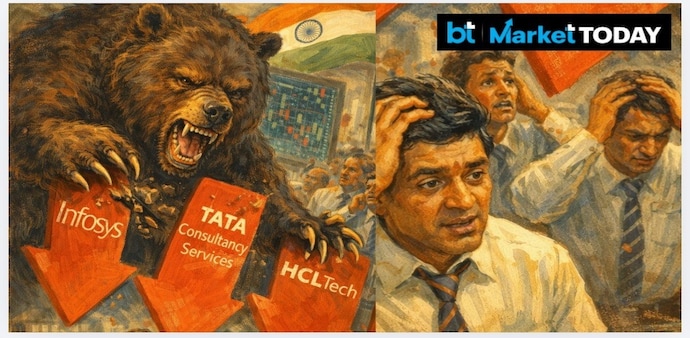
Large IT firms such as Infosys Ltd, Tata Consultancy Services Ltd (TCS), Wipro Ltd, HCL Technologies Ltd (HCL Tech) and Tech Mahindra Ltd (TechM) have witnessed sharp declines in their share prices recently, largely due to concerns over artificial intelligence-led disruptions. There are fears that AI may collapse entire layers of the software value chain, triggering selling across SaaS, consulting and data analytics stocks. However, analysts do not expect AI platforms to fully replace IT service providers, though they believe these platforms could weaken their bargaining power and relevance within the modern technology value chain.
These developments have sharpened the debate on how quickly and to what extent AI-led deflation may materialise, as against the potential for incremental revenue growth driven by AI adoption.
Why IT stocks are falling
The recent fall in IT services stocks was driven by a narrative that marked down terminal growth rate assumptions for IT players. Anthropic recently launched plug-ins for its Claude Cowork agent aimed at automating tasks across legal, sales, marketing and data analysis functions. The plug-ins tailor Claude to specific job functions such as sales, legal and financial analysis. Meanwhile, US-based Palantir, in its earnings call, highlighted how it is upending pay-per-seat software as well as third-party software with its AI offerings. The company cited examples of clients eliminating third-party software. Palantir also said its AI platform is powering complex SAP migration work, compressing implementation timelines from years to weeks.
What it means for Infosys, TCS and others
Generative and agentic AI are driving a structural shift in IT services, delivering immediate productivity gains of 20-40 per cent across core tasks such as coding, testing, support, maintenance and BPO. This efficiency, ICICI Securities said, is eroding IT services’ share in global technology spending.
"Based on our analysis of Gartner’s global technology spends, IT services’ wallet share is projected to contract by 8 percentage points between CY23-26, as capital incrementally flows toward AI infrastructure, including semiconductors and data centres, and platforms," it said.
The brokerage noted that pure-play AI leaders are scaling at an unprecedented rate. OpenAI and Anthropic have reached annual revenue run-rates of $20 billion and $14 billion, respectively, backed by 10 lakh and 3 lakh enterprise customers.
"While we believe that these platforms do not replace IT service providers, they are essentially weakening their bargaining power and relevance within the modern tech value chain," ICICI Securities said.
Should investors write off domestic IT firms?
Analysts noted that new AI tools have accelerated productivity gains but cannot entirely replace the need for IT services. This is due to the unavailability of ‘AI-ready’ data required to implement AI platforms at enterprise scale, and the need for data and process governance and accountability.
They said clients are unlikely to overhaul smoothly running enterprise-grade core IT systems with probabilistic agentic AI platforms due to concerns around the accuracy of generative outputs.
As per ISG, 65 per cent of IT leaders said managing existing data complexity hinders their AI progress more than a lack of actual innovation. IT services providers are seeing growth in demand for building ‘AI-ready’ data architecture, analysts said.
What IT firms are doing on the AI front
IT services companies have stepped up partnerships with AI-native companies and are likely to benefit from implementation and customisation of these AI platforms for enterprise clients.
For instance, Accenture and Cognizant have announced partnerships with Palantir, while Infosys is partnering with Cursor. Infosys and Cognizant are also partnering with Cognition.
"All major IT services players are strengthening partnership with OpenAI and Anthropic. We note that despite a 10-20 per cent deflationary impact on revenue during renewals, IT service providers are reporting overall revenue growth as new AI-driven workloads offset these losses," ICICI Securities said.
Management commentaries
MOFSL in a note said TCS is confident about a good 2026, based on client conversations and strong momentum in AI. The company continued to win several large deals, including one mega deal in North America. BFSI is expected to return to sustained growth, the brokerage said.
Infosys, MOFSL said, noted that strong AI adoption is being witnessed among large financial services clients, including partnerships with Cognition. Discretionary spending has increased across banking, payments, mortgages, and asset and wealth management, it said.
While global macro uncertainty continues to weigh on overall IT spending, structural demand for technology-led business transformation remains intact, MOFSL cited HCL Tech as saying. Wipro sees no major change in the demand environment yet, especially for discretionary spending despite uncertainty. TechM continued to target growth ahead of the peer average by FY27.
AI adoption remains gradual
Investec noted that enterprises are slow to adopt AI for a reason. Enterprise systems are highly complex and run virtually every aspect of operations. Companies typically prefer a gradual approach, achieving speed without disrupting existing systems.
"Adoption of new tech and driving a higher cadence of innovation is easy for startups as they start with a clean slate. SaaS allows large incumbent enterprises the ability to move up the tech ladder without breaking existing systems. Not to forget that SaaS offerings are sold to multiple customers and tested across multiple environments. Pronouncing SaaS dead therefore looks misplaced to us," Investec said.
Against this backdrop, it sees IT services firms as enablers, using their domain and legacy-system knowledge to integrate SaaS into the existing landscape.
What to watch To determine whether AI-led deflation or incremental AI volume is winning the tug-of-war, ICICI Securities said it is monitoring three critical KPIs. The first is growth in profitability per employee. The second is changing billing models with increase in outcome based or fixed price contracts. The third is increase in net new deal TCV. Acceleration in these metrics would signal a positive growth spin, it said.
Investec said IT services firms should benefit from legacy code modernization, migration of legacy SaaS applications, building AI foundation layers for enterprises and physical AI among other opportunities. AI should drive higher business velocity over time, and the increasing hype puts pressure on enterprises to deliver on the AI promise as fast as possible, it said.
Large IT firms such as Infosys Ltd, Tata Consultancy Services Ltd (TCS), Wipro Ltd, HCL Technologies Ltd (HCL Tech) and Tech Mahindra Ltd (TechM) have witnessed sharp declines in their share prices recently, largely due to concerns over artificial intelligence-led disruptions. There are fears that AI may collapse entire layers of the software value chain, triggering selling across SaaS, consulting and data analytics stocks. However, analysts do not expect AI platforms to fully replace IT service providers, though they believe these platforms could weaken their bargaining power and relevance within the modern technology value chain.
These developments have sharpened the debate on how quickly and to what extent AI-led deflation may materialise, as against the potential for incremental revenue growth driven by AI adoption.
Why IT stocks are falling
The recent fall in IT services stocks was driven by a narrative that marked down terminal growth rate assumptions for IT players. Anthropic recently launched plug-ins for its Claude Cowork agent aimed at automating tasks across legal, sales, marketing and data analysis functions. The plug-ins tailor Claude to specific job functions such as sales, legal and financial analysis. Meanwhile, US-based Palantir, in its earnings call, highlighted how it is upending pay-per-seat software as well as third-party software with its AI offerings. The company cited examples of clients eliminating third-party software. Palantir also said its AI platform is powering complex SAP migration work, compressing implementation timelines from years to weeks.
What it means for Infosys, TCS and others
Generative and agentic AI are driving a structural shift in IT services, delivering immediate productivity gains of 20-40 per cent across core tasks such as coding, testing, support, maintenance and BPO. This efficiency, ICICI Securities said, is eroding IT services’ share in global technology spending.
"Based on our analysis of Gartner’s global technology spends, IT services’ wallet share is projected to contract by 8 percentage points between CY23-26, as capital incrementally flows toward AI infrastructure, including semiconductors and data centres, and platforms," it said.
The brokerage noted that pure-play AI leaders are scaling at an unprecedented rate. OpenAI and Anthropic have reached annual revenue run-rates of $20 billion and $14 billion, respectively, backed by 10 lakh and 3 lakh enterprise customers.
"While we believe that these platforms do not replace IT service providers, they are essentially weakening their bargaining power and relevance within the modern tech value chain," ICICI Securities said.
Should investors write off domestic IT firms?
Analysts noted that new AI tools have accelerated productivity gains but cannot entirely replace the need for IT services. This is due to the unavailability of ‘AI-ready’ data required to implement AI platforms at enterprise scale, and the need for data and process governance and accountability.
They said clients are unlikely to overhaul smoothly running enterprise-grade core IT systems with probabilistic agentic AI platforms due to concerns around the accuracy of generative outputs.
As per ISG, 65 per cent of IT leaders said managing existing data complexity hinders their AI progress more than a lack of actual innovation. IT services providers are seeing growth in demand for building ‘AI-ready’ data architecture, analysts said.
What IT firms are doing on the AI front
IT services companies have stepped up partnerships with AI-native companies and are likely to benefit from implementation and customisation of these AI platforms for enterprise clients.
For instance, Accenture and Cognizant have announced partnerships with Palantir, while Infosys is partnering with Cursor. Infosys and Cognizant are also partnering with Cognition.
"All major IT services players are strengthening partnership with OpenAI and Anthropic. We note that despite a 10-20 per cent deflationary impact on revenue during renewals, IT service providers are reporting overall revenue growth as new AI-driven workloads offset these losses," ICICI Securities said.
Management commentaries
MOFSL in a note said TCS is confident about a good 2026, based on client conversations and strong momentum in AI. The company continued to win several large deals, including one mega deal in North America. BFSI is expected to return to sustained growth, the brokerage said.
Infosys, MOFSL said, noted that strong AI adoption is being witnessed among large financial services clients, including partnerships with Cognition. Discretionary spending has increased across banking, payments, mortgages, and asset and wealth management, it said.
While global macro uncertainty continues to weigh on overall IT spending, structural demand for technology-led business transformation remains intact, MOFSL cited HCL Tech as saying. Wipro sees no major change in the demand environment yet, especially for discretionary spending despite uncertainty. TechM continued to target growth ahead of the peer average by FY27.
AI adoption remains gradual
Investec noted that enterprises are slow to adopt AI for a reason. Enterprise systems are highly complex and run virtually every aspect of operations. Companies typically prefer a gradual approach, achieving speed without disrupting existing systems.
"Adoption of new tech and driving a higher cadence of innovation is easy for startups as they start with a clean slate. SaaS allows large incumbent enterprises the ability to move up the tech ladder without breaking existing systems. Not to forget that SaaS offerings are sold to multiple customers and tested across multiple environments. Pronouncing SaaS dead therefore looks misplaced to us," Investec said.
Against this backdrop, it sees IT services firms as enablers, using their domain and legacy-system knowledge to integrate SaaS into the existing landscape.
What to watch To determine whether AI-led deflation or incremental AI volume is winning the tug-of-war, ICICI Securities said it is monitoring three critical KPIs. The first is growth in profitability per employee. The second is changing billing models with increase in outcome based or fixed price contracts. The third is increase in net new deal TCV. Acceleration in these metrics would signal a positive growth spin, it said.
Investec said IT services firms should benefit from legacy code modernization, migration of legacy SaaS applications, building AI foundation layers for enterprises and physical AI among other opportunities. AI should drive higher business velocity over time, and the increasing hype puts pressure on enterprises to deliver on the AI promise as fast as possible, it said.