
India–EU trade deal: Abhishek Basumallick on stock market expectations, key gainer & loser
In an interview to Business Today, Basumallick said US is India's largest export partner and it is not easy that EU would replace it completely.
- Jan 27, 2026,
- Updated Jan 27, 2026 12:48 PM IST
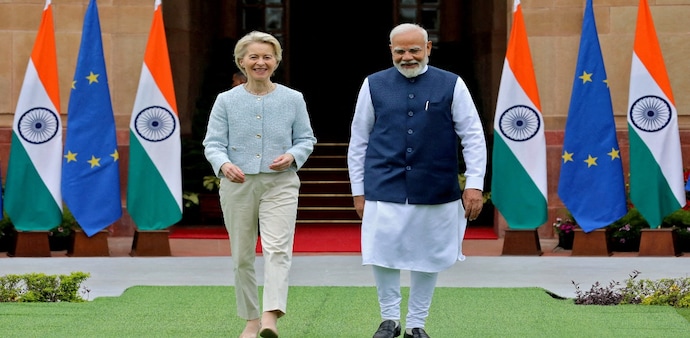
Dubbed the “mother of all deals”, the India–EU trade agreement has been signed, triggering a recovery in equity benchmarks Sensex and Nifty. After falling to a low of 81,088.59, the Sensex turned positive and was trading at 81,540 at 12.46 pm. The Nifty was trading at 25,084.55, up 40 points.
Abhishek Basumallick, Co-founder & Fund Manager at Shree Rama Managers said having a free trade agreement with the EU is going to be beneficial, but stock market investors may need to temper down expectations simply because EU as an economic bloc is nowhere compared to the US.
In an interview to Business Today, Basumallick said US is India's largest export partner and it is not easy that EU would replace it completely.
"Obviously, any small improvement is better than having nothing," he said.
Basumallick said until and unless one really knows the contours of the India-US deal, including the tariffs that are getting reduced, it is very difficult to comment, saying it is not as if that India is not exporting products to the EU.
"It is already doing so and the differential is going to be dependent on the new tariffs that will come in or the new, you know, reduced rates that will come in vis-a-vis the competition," Basumallick said.
Basumallick said if the EU has trade deals with China and Vietnam, which are competing with India, the India deal is probably going to negate the benefit that one is thinking of.
"But broadly, my sense is that, you know, there is going to be some benefit to all these exporting sectors," he said.
At present, Indian textile exports to the EU attract 10-14 per cent tariffs to up to 16 per cent tariffs, which makes India less competitive to other markets like Bangladesh and Vietnam, that enjoy preferential access under the EU trade agreements.
EU imports about $125 billion dollars worth of textiles and apparel annually from across the world and India's right now has just about a 5-6 per cent share within that.
China exports about 30 per cent of this entire market of textile imports to the EU, 20 per cent share goes to Bangladesh and to Pakistan and crucially. The latter two countries already benefit from zero tariffs in the EU.
In the case of electronics goods, the second largest exports category for India in the EU, India's exports stood at $11.3 billion in FY25.
Refined petroleum products, India's largest export to the EU, stood at $15 billion in FY25.
The luxury car segment that is being seen as a major beneficiary. It is expected that duties could reduce from 110 per cent to 40 per cent and then eventually to 10 per cent. That makes a case for luxury car segments.
Basumallick, said auto segment if duty cuts actually goes through, is probably going to see a serious disruption. He said the entry level cars for some of these luxury brands is somewhere between Rs 50 to Rs 60 lakhs.
"Now if that comes down to say Rs 30-35 lakhs, that would cannibalise the more expensive Indian SUVs that are getting sold primarily. Mahindra is doing a fairly good job. You have Kia. Maruti may not be present in that segment all that much, but other players, the Korean players, could be impacted definitely because a lot of people will then shift from the top end SUVs," Basumallick said.
Basumallick said once India has a lot more a Mercedes or BMW etc on the Indian roads, the possibilities of those companies setting up their own supply chains, their own manufacturing base here would rise in the long-term.
"So this is not going to be a very short-term play, but 5 years, 7 years later, you can see positive impact of giving market access to some of these larger luxury car players," he said.
Basumallick said defence could be a key beneficiary. That is where the EU is going to be spending the most, he said.
India he said is the natural ally in terms of producing and supplying defence products.
Dubbed the “mother of all deals”, the India–EU trade agreement has been signed, triggering a recovery in equity benchmarks Sensex and Nifty. After falling to a low of 81,088.59, the Sensex turned positive and was trading at 81,540 at 12.46 pm. The Nifty was trading at 25,084.55, up 40 points.
Abhishek Basumallick, Co-founder & Fund Manager at Shree Rama Managers said having a free trade agreement with the EU is going to be beneficial, but stock market investors may need to temper down expectations simply because EU as an economic bloc is nowhere compared to the US.
In an interview to Business Today, Basumallick said US is India's largest export partner and it is not easy that EU would replace it completely.
"Obviously, any small improvement is better than having nothing," he said.
Basumallick said until and unless one really knows the contours of the India-US deal, including the tariffs that are getting reduced, it is very difficult to comment, saying it is not as if that India is not exporting products to the EU.
"It is already doing so and the differential is going to be dependent on the new tariffs that will come in or the new, you know, reduced rates that will come in vis-a-vis the competition," Basumallick said.
Basumallick said if the EU has trade deals with China and Vietnam, which are competing with India, the India deal is probably going to negate the benefit that one is thinking of.
"But broadly, my sense is that, you know, there is going to be some benefit to all these exporting sectors," he said.
At present, Indian textile exports to the EU attract 10-14 per cent tariffs to up to 16 per cent tariffs, which makes India less competitive to other markets like Bangladesh and Vietnam, that enjoy preferential access under the EU trade agreements.
EU imports about $125 billion dollars worth of textiles and apparel annually from across the world and India's right now has just about a 5-6 per cent share within that.
China exports about 30 per cent of this entire market of textile imports to the EU, 20 per cent share goes to Bangladesh and to Pakistan and crucially. The latter two countries already benefit from zero tariffs in the EU.
In the case of electronics goods, the second largest exports category for India in the EU, India's exports stood at $11.3 billion in FY25.
Refined petroleum products, India's largest export to the EU, stood at $15 billion in FY25.
The luxury car segment that is being seen as a major beneficiary. It is expected that duties could reduce from 110 per cent to 40 per cent and then eventually to 10 per cent. That makes a case for luxury car segments.
Basumallick, said auto segment if duty cuts actually goes through, is probably going to see a serious disruption. He said the entry level cars for some of these luxury brands is somewhere between Rs 50 to Rs 60 lakhs.
"Now if that comes down to say Rs 30-35 lakhs, that would cannibalise the more expensive Indian SUVs that are getting sold primarily. Mahindra is doing a fairly good job. You have Kia. Maruti may not be present in that segment all that much, but other players, the Korean players, could be impacted definitely because a lot of people will then shift from the top end SUVs," Basumallick said.
Basumallick said once India has a lot more a Mercedes or BMW etc on the Indian roads, the possibilities of those companies setting up their own supply chains, their own manufacturing base here would rise in the long-term.
"So this is not going to be a very short-term play, but 5 years, 7 years later, you can see positive impact of giving market access to some of these larger luxury car players," he said.
Basumallick said defence could be a key beneficiary. That is where the EU is going to be spending the most, he said.
India he said is the natural ally in terms of producing and supplying defence products.