
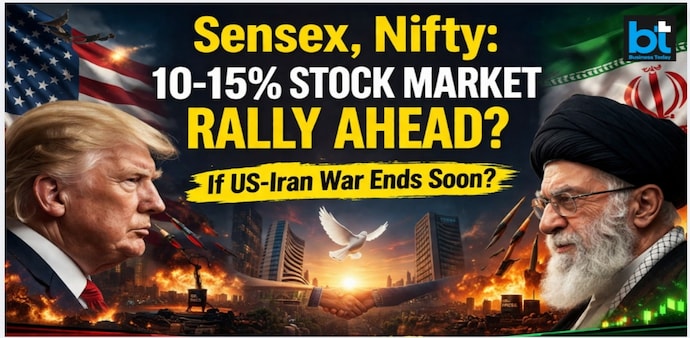
Sensex, Nifty: 10-15% stock market rally ahead if US-Iran war ends soon?
Saurabh Jain, Head of Fundamental Research at SMC Global Securities, said if the US–Iran war de-escalates, a market upside of around 10–15 per cent is possible, as easing tensions would likely push crude oil prices lower.
- Apr 17, 2026,
- Updated Apr 17, 2026 4:17 PM IST
The US President Donald Trump has the world on edge. But a long-lasting US-Iran peace plan could be in the offing, with reports suggesting the second round of talks with Iran could take place as soon as this weekend. A few analysts believe the stock market could see 10-15 per cent rally in case the war is over. Others advice investors to start accumulating good quality stocks.
Jefferies, in its latest GREED & Fear note, said the recent US polling data reinforced the impression that Trump is looking for a face-saving way out of the Iran situation, with Pakistan Army chief Asim Munir emerging as a key enabler.
It cited a CNN poll conducted between March 26 and March 30 that found that 66 per cent disapproved of the US decision to take military action in Iran, up from 59 per cent in the previous poll conducted between February 28 and March 1. Other polls conducted over the past week show 55-60 per cent disapprove of the military action in Iran.
Saurabh Jain, Head of Fundamental Research at SMC Global Securities said if the US–Iran war de-escalates, a market upside of around 10–15 per cent is possible, as easing tensions would likely push crude oil prices lower. Since India imports nearly 85 per cent of its oil, a decline in crude prices would help reduce inflation, improve corporate margins, and strengthen overall macro stability, he said.
"Overall, a post-war decline in crude prices would be significantly positive for the Indian market, particularly for consumption-oriented and cost-sensitive sectors," Jain said.
Thomas V Abraham, Research Analyst at Mirae Asset Sharekhan said market valuations may ease slightly from earlier peaks due to prior crude spikes and CAD pressures.
"FY27 EPS growth, previously eyed at 14 per cent, could trim to around 12 per cent. Positively, the war's easing implies the worst is behind, paving way for trade clarity and crude stability. Realistic FY27 Nifty targets is in the range of 27,000, based on 19-20 times forward P/E amid 12-14% EPS growth post-recovery," Abraham said. The target suggests 11 per cent potential upside on Nifty over Friday's intra-day level of 24,283.10.
Ankur Punj, MD & Business Head at Equirus Wealth said even as investors await the second round of peace talks to resume, the receding crude oil prices is keeping the mood upbeat. If the talks translates into some positive developments, one may see extended uptick in markets with a cautious biasl he said.
Kotak Institutional Equities in a strategy note said it doubts if Iran or the US has much to gain from a prolonged conflict. A prolonged war may further deepen the distrust between Iran and the US, potentially drive Iran to pursue nuclear deterrence as a ‘safety’ guarantee, it said,
A prolong war may increase economic hardships for US households through higher inflation and interest rates, reduce the appetite among other countries for US assets and debt and further erode public support for the war in the US, with political ramifications in the mid-term polls in November 2026," it said.
"We can hope for economic and political considerations (domestic and external) for the two protagonists and other parties forcing some sort of a compromise in the next few weeks," it said.
Utsav Verma, Head of Research at Choice Institutional Equities said it believes the broader markets will remain range-bound amid crude headwinds. A two-week ceasefire is now in place, with the Strait of Hormuz likely to reopen, and the probability of an immediate return to peak escalation has receded materially, he noted.
"With the tail risk of Brent averaging above $115 per barrel for a sustained period now substantially diminished, the case for maintaining maximum portfolio hedges weakens decisively. Investors who remained defensive in taking long positions through the conflict period should begin a calibrated reduction in hedge ratios, redirecting capital toward equity positions with strong earnings visibility — precisely the kind that can generate alpha," he said.
"Verma said he is of the view that equity investments should be calibrated in staggered manner, as the opportunity lies in selectivity.
The US President Donald Trump has the world on edge. But a long-lasting US-Iran peace plan could be in the offing, with reports suggesting the second round of talks with Iran could take place as soon as this weekend. A few analysts believe the stock market could see 10-15 per cent rally in case the war is over. Others advice investors to start accumulating good quality stocks.
Jefferies, in its latest GREED & Fear note, said the recent US polling data reinforced the impression that Trump is looking for a face-saving way out of the Iran situation, with Pakistan Army chief Asim Munir emerging as a key enabler.
It cited a CNN poll conducted between March 26 and March 30 that found that 66 per cent disapproved of the US decision to take military action in Iran, up from 59 per cent in the previous poll conducted between February 28 and March 1. Other polls conducted over the past week show 55-60 per cent disapprove of the military action in Iran.
Saurabh Jain, Head of Fundamental Research at SMC Global Securities said if the US–Iran war de-escalates, a market upside of around 10–15 per cent is possible, as easing tensions would likely push crude oil prices lower. Since India imports nearly 85 per cent of its oil, a decline in crude prices would help reduce inflation, improve corporate margins, and strengthen overall macro stability, he said.
"Overall, a post-war decline in crude prices would be significantly positive for the Indian market, particularly for consumption-oriented and cost-sensitive sectors," Jain said.
Thomas V Abraham, Research Analyst at Mirae Asset Sharekhan said market valuations may ease slightly from earlier peaks due to prior crude spikes and CAD pressures.
"FY27 EPS growth, previously eyed at 14 per cent, could trim to around 12 per cent. Positively, the war's easing implies the worst is behind, paving way for trade clarity and crude stability. Realistic FY27 Nifty targets is in the range of 27,000, based on 19-20 times forward P/E amid 12-14% EPS growth post-recovery," Abraham said. The target suggests 11 per cent potential upside on Nifty over Friday's intra-day level of 24,283.10.
Ankur Punj, MD & Business Head at Equirus Wealth said even as investors await the second round of peace talks to resume, the receding crude oil prices is keeping the mood upbeat. If the talks translates into some positive developments, one may see extended uptick in markets with a cautious biasl he said.
Kotak Institutional Equities in a strategy note said it doubts if Iran or the US has much to gain from a prolonged conflict. A prolonged war may further deepen the distrust between Iran and the US, potentially drive Iran to pursue nuclear deterrence as a ‘safety’ guarantee, it said,
A prolong war may increase economic hardships for US households through higher inflation and interest rates, reduce the appetite among other countries for US assets and debt and further erode public support for the war in the US, with political ramifications in the mid-term polls in November 2026," it said.
"We can hope for economic and political considerations (domestic and external) for the two protagonists and other parties forcing some sort of a compromise in the next few weeks," it said.
Utsav Verma, Head of Research at Choice Institutional Equities said it believes the broader markets will remain range-bound amid crude headwinds. A two-week ceasefire is now in place, with the Strait of Hormuz likely to reopen, and the probability of an immediate return to peak escalation has receded materially, he noted.
"With the tail risk of Brent averaging above $115 per barrel for a sustained period now substantially diminished, the case for maintaining maximum portfolio hedges weakens decisively. Investors who remained defensive in taking long positions through the conflict period should begin a calibrated reduction in hedge ratios, redirecting capital toward equity positions with strong earnings visibility — precisely the kind that can generate alpha," he said.
"Verma said he is of the view that equity investments should be calibrated in staggered manner, as the opportunity lies in selectivity.