
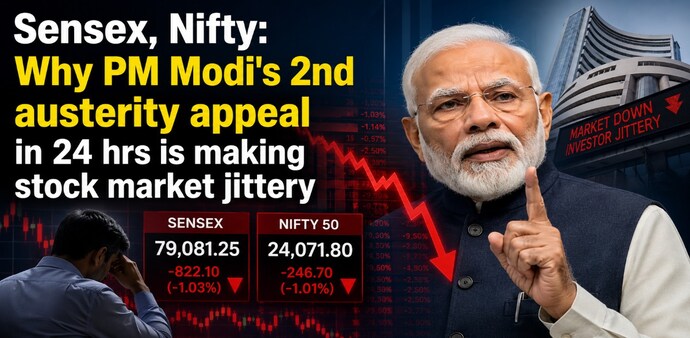
Sensex, Nifty: Why PM Modi's 2nd austerity appeal in 24 hrs is making stock market jittery
The BSE Sensex hit a low of 75,276.30 and was later trading at 75,301.44, down 713.84 points or 0.94 per cent. The NSE Nifty stood at 23,633.30, down 184.30 points or 0.77 per cent.
- May 12, 2026,
- Updated May 12, 2026 11:41 AM IST
Prime Minister Narendra Modi's second appeal for austerity measures in less than 24 hours has made stock market nervous. Stock analysts believe they are a precursor to actual austerity measures in the coming weeks, making market participants jittery. PM Modi's appeals are seen, as reduced policy appetite for further worsening of twin deficits. This, in the backdrop of an intensifying West Asia crisis, is seen as a signal that crude oil prices may stay higher for a longer period than initially anticipated by the market, weighing on investor sentiment. Already, a section of the market was anticipating rise in petrol and diesel prices post assembly elections, which the government has refrained from doing so, till now.
Comparing the prevailing tensions in West Asia with Covid pandemic, PM Modi on May 11 said: "If the COVID pandemic was the biggest crisis of this century, then the circumstances created by the war in West Asia are one of the major crises of this decade.”
PM Modi’s comments signal that the pressure on government fiscal finances is reaching a tipping point, there is less appetite for further rupee depreciation and the burden of adjustment may be incrementally shared with consumers, Nomura India said.
Rupee hit a record low of 95.63 a dollar earlier today. The weakness in domestic currency has partly triggered Rs 2,07,581 crore foreign equity outflows from India in 2026 so far.
On Tuesday, the BSE Sensex hit a low of 75,276.30 and was later trading at 75,301.44, down 713.84 points or 0.94 per cent. The NSE Nifty stood at 23,633.30, down 184.30 points or 0.77 per cent.
Addressing the inauguration of the Sardardham Hostel in Gujarat’s Vadodara, PM urged both government and private organisations to reduce fuel consumption by promoting remote work and virtual communication.
JM Financial said no end to the Iran conflict is in sight and, thus, investors should brace for austerity measures. Several Asian economies, including Indonesia, Vietnam, Myanmar and South Korea have already urged citizens to curb fuel consumption or announced strict measures to reduce fuel usage.
Nomura said the government may disincentivise non-essential imports like gold, and may include a potential hike to the customs duty on gold imports. It, however, noted that gold shipments have been stuck at customs since March, owing to administrative delays.
Besides, it said tighter rules under the Liberalized Remittance Scheme (LRS) could be announced. Under the LRS, residents are allowed to freely remit up to $250,000 abroad annually for the purpose of foreign education, travel etc.
JM Financial said a section of the market was already anticipating fuel price hikes immediately after the election results were out, but the government does not seem to be in panic mode.
"Only prices of bulk diesel (25 per cent to Rs 109.8/litre) and commercial LPG (up 78 per cent to Rs 3,024/cylinder) were hiked. We expect the government to follow a gradual approach; hence, fuel price may be increased in tranches, LRS limits may be reduced temporarily, and duty on gold imports may be hiked as the lean wedding season approaches," it said.
Prime Minister Narendra Modi's second appeal for austerity measures in less than 24 hours has made stock market nervous. Stock analysts believe they are a precursor to actual austerity measures in the coming weeks, making market participants jittery. PM Modi's appeals are seen, as reduced policy appetite for further worsening of twin deficits. This, in the backdrop of an intensifying West Asia crisis, is seen as a signal that crude oil prices may stay higher for a longer period than initially anticipated by the market, weighing on investor sentiment. Already, a section of the market was anticipating rise in petrol and diesel prices post assembly elections, which the government has refrained from doing so, till now.
Comparing the prevailing tensions in West Asia with Covid pandemic, PM Modi on May 11 said: "If the COVID pandemic was the biggest crisis of this century, then the circumstances created by the war in West Asia are one of the major crises of this decade.”
PM Modi’s comments signal that the pressure on government fiscal finances is reaching a tipping point, there is less appetite for further rupee depreciation and the burden of adjustment may be incrementally shared with consumers, Nomura India said.
Rupee hit a record low of 95.63 a dollar earlier today. The weakness in domestic currency has partly triggered Rs 2,07,581 crore foreign equity outflows from India in 2026 so far.
On Tuesday, the BSE Sensex hit a low of 75,276.30 and was later trading at 75,301.44, down 713.84 points or 0.94 per cent. The NSE Nifty stood at 23,633.30, down 184.30 points or 0.77 per cent.
Addressing the inauguration of the Sardardham Hostel in Gujarat’s Vadodara, PM urged both government and private organisations to reduce fuel consumption by promoting remote work and virtual communication.
JM Financial said no end to the Iran conflict is in sight and, thus, investors should brace for austerity measures. Several Asian economies, including Indonesia, Vietnam, Myanmar and South Korea have already urged citizens to curb fuel consumption or announced strict measures to reduce fuel usage.
Nomura said the government may disincentivise non-essential imports like gold, and may include a potential hike to the customs duty on gold imports. It, however, noted that gold shipments have been stuck at customs since March, owing to administrative delays.
Besides, it said tighter rules under the Liberalized Remittance Scheme (LRS) could be announced. Under the LRS, residents are allowed to freely remit up to $250,000 abroad annually for the purpose of foreign education, travel etc.
JM Financial said a section of the market was already anticipating fuel price hikes immediately after the election results were out, but the government does not seem to be in panic mode.
"Only prices of bulk diesel (25 per cent to Rs 109.8/litre) and commercial LPG (up 78 per cent to Rs 3,024/cylinder) were hiked. We expect the government to follow a gradual approach; hence, fuel price may be increased in tranches, LRS limits may be reduced temporarily, and duty on gold imports may be hiked as the lean wedding season approaches," it said.