
Stock market crash: Five biggest reasons behind Sensex, Nifty's 2% slump today
The sharp decline wiped out nearly Rs 8.96 lakh crore in investor wealth, with BSE market capitalisation (m-cap) falling to Rs 471.23 lakh crore from Rs 480.20 lakh crore in the previous session.
- Jul 8, 2026,
- Updated Jul 8, 2026 4:41 PM IST
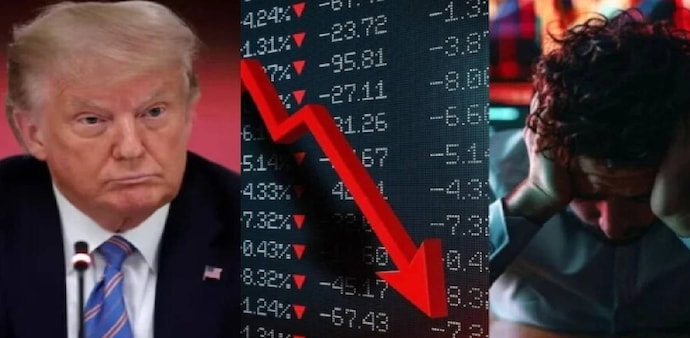
Indian equity benchmarks came under intense selling pressure on Wednesday after US President Donald Trump said the ceasefire understanding with Iran was "over", as investors reacted to renewed geopolitical concerns in West Asia.
The 30-share BSE Sensex pack slumped 1,677.12 points or 2.15 per cent to settle at 76,503.60, while the NSE Nifty50 index declined 516.65 points or 2.12 per cent to close at 23,882.05.
The sharp decline wiped out nearly Rs 8.96 lakh crore in investor wealth, with BSE market capitalisation (m-cap) falling to Rs 471.23 lakh crore from Rs 480.20 lakh crore in the previous session. Heavyweight stocks such as HDFC Bank Ltd, ICICI Bank Ltd, Reliance Industries Ltd (RIL), Larsen & Toubro (L&T), Bharti Airtel Ltd, Bajaj Finance, Axis Bank, Kotak Mahindra Bank and State Bank of India (SBI) were among the biggest contributors to the fall in the benchmark indices.
Here are the five biggest factors behind Wednesday's market crash:
1. Crude oil prices surge
Crude oil prices climbed sharply after Trump's remarks reignited concerns over geopolitical tensions in West Asia. Brent crude futures were last trading 6.16 per cent higher at $78.73 per barrel, while US West Texas Intermediate (WTI) crude advanced $6.25 to $74.84 per barrel.
"Sentiment on the domestic bourses turned decisively negative this session, wiping out the recent gains as renewed flare-ups in West Asia sent crude oil prices climbing," said Vinod Nair, Head of Research at Geojit Investments.
"Inflationary worries resurfaced as well, pushing bond yields higher both at home and in the U.S. Volatility remained elevated, with a sharp spike in India VIX as every sector traded in the red, reflecting a macro-driven flight from risk compounded by pre-earnings anxiety over muted Q1 forecasts. While the upcoming earnings results may not, by themselves, prove to be a major market-moving catalyst, investors will closely monitor management commentaries and forward guidance to assess whether earnings weakness persists into Q2, delaying FY27 domestic earnings recovery and market performance," Nair added.
2. Rupee weakens
The Indian rupee fell around 0.71 per cent to 95.50 against the US dollar, pressured by higher crude oil prices and a risk-off mood.
"The Indian rupee fell the most among the Asian currencies, weighed down by a sharp rise in crude oil prices and risk-off sentiment after Trump's remarks about ending the ceasefire with Iran. Geopolitical concerns have lifted the risk premium amid heightened volatility. In the near term, USD-INR is expected to face resistance at 95.80 and support at 94.95, with the bias now favouring dollar bulls," said Dilip Parmar, Research Analyst at HDFC Securities.
3. Selling across sectors
Selling pressure was visible across the board, with all NSE sectoral indices ending in the red. Nifty FMCG and Nifty Bank, including private and PSU banks, emerged as the biggest laggards during the session.
4. Mid- and small-cap stocks tumble
The broader market also witnessed heavy selling pressure. The Nifty Midcap 100 index declined 1.55 per cent, while the Nifty Smallcap 100 cracked 2.24 per cent, indicating heightened risk aversion among investors.
5. India VIX spikes 26%
India VIX, widely known as the market's fear gauge, jumped 26.03 per cent to 14.68, according to NSE data. The index measures the market's expectation of volatility over the next 30 days based on Nifty50 options. A rise in the VIX typically signals heightened uncertainty and growing risk aversion among investors.
Going ahead, Rupak De, Senior Technical Analyst at LKP Securities, noted, "It will be crucial to watch whether Nifty50 manages to hold 23,800 support level. A decisive break below 23,800 could extend the ongoing corrective phase, while sustained trading above this level may pave the way for a meaningful recovery in the near term."
Indian equity benchmarks came under intense selling pressure on Wednesday after US President Donald Trump said the ceasefire understanding with Iran was "over", as investors reacted to renewed geopolitical concerns in West Asia.
The 30-share BSE Sensex pack slumped 1,677.12 points or 2.15 per cent to settle at 76,503.60, while the NSE Nifty50 index declined 516.65 points or 2.12 per cent to close at 23,882.05.
The sharp decline wiped out nearly Rs 8.96 lakh crore in investor wealth, with BSE market capitalisation (m-cap) falling to Rs 471.23 lakh crore from Rs 480.20 lakh crore in the previous session. Heavyweight stocks such as HDFC Bank Ltd, ICICI Bank Ltd, Reliance Industries Ltd (RIL), Larsen & Toubro (L&T), Bharti Airtel Ltd, Bajaj Finance, Axis Bank, Kotak Mahindra Bank and State Bank of India (SBI) were among the biggest contributors to the fall in the benchmark indices.
Here are the five biggest factors behind Wednesday's market crash:
1. Crude oil prices surge
Crude oil prices climbed sharply after Trump's remarks reignited concerns over geopolitical tensions in West Asia. Brent crude futures were last trading 6.16 per cent higher at $78.73 per barrel, while US West Texas Intermediate (WTI) crude advanced $6.25 to $74.84 per barrel.
"Sentiment on the domestic bourses turned decisively negative this session, wiping out the recent gains as renewed flare-ups in West Asia sent crude oil prices climbing," said Vinod Nair, Head of Research at Geojit Investments.
"Inflationary worries resurfaced as well, pushing bond yields higher both at home and in the U.S. Volatility remained elevated, with a sharp spike in India VIX as every sector traded in the red, reflecting a macro-driven flight from risk compounded by pre-earnings anxiety over muted Q1 forecasts. While the upcoming earnings results may not, by themselves, prove to be a major market-moving catalyst, investors will closely monitor management commentaries and forward guidance to assess whether earnings weakness persists into Q2, delaying FY27 domestic earnings recovery and market performance," Nair added.
2. Rupee weakens
The Indian rupee fell around 0.71 per cent to 95.50 against the US dollar, pressured by higher crude oil prices and a risk-off mood.
"The Indian rupee fell the most among the Asian currencies, weighed down by a sharp rise in crude oil prices and risk-off sentiment after Trump's remarks about ending the ceasefire with Iran. Geopolitical concerns have lifted the risk premium amid heightened volatility. In the near term, USD-INR is expected to face resistance at 95.80 and support at 94.95, with the bias now favouring dollar bulls," said Dilip Parmar, Research Analyst at HDFC Securities.
3. Selling across sectors
Selling pressure was visible across the board, with all NSE sectoral indices ending in the red. Nifty FMCG and Nifty Bank, including private and PSU banks, emerged as the biggest laggards during the session.
4. Mid- and small-cap stocks tumble
The broader market also witnessed heavy selling pressure. The Nifty Midcap 100 index declined 1.55 per cent, while the Nifty Smallcap 100 cracked 2.24 per cent, indicating heightened risk aversion among investors.
5. India VIX spikes 26%
India VIX, widely known as the market's fear gauge, jumped 26.03 per cent to 14.68, according to NSE data. The index measures the market's expectation of volatility over the next 30 days based on Nifty50 options. A rise in the VIX typically signals heightened uncertainty and growing risk aversion among investors.
Going ahead, Rupak De, Senior Technical Analyst at LKP Securities, noted, "It will be crucial to watch whether Nifty50 manages to hold 23,800 support level. A decisive break below 23,800 could extend the ongoing corrective phase, while sustained trading above this level may pave the way for a meaningful recovery in the near term."