
Stock market: Impact of 50% US tariffs & why share analysts remain optimistic
On Thursday, the BSE Sensex was trading at 80,120.15, down 666.39 points, or 0.82 per cent. The NSE Nifty declined 194.15 points, or 0.79 per cent, to 24,517.90.
- Aug 28, 2025,
- Updated Aug 28, 2025 11:50 AM IST
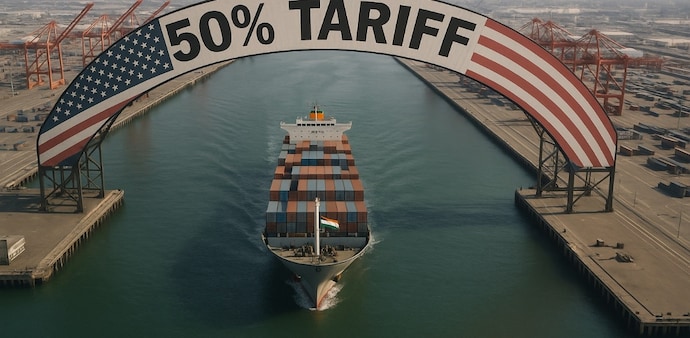
With the US imposing an additional 25 per cent tariff on Indian imports, economists estimate a potential 50–80 basis point drag on India’s growth. While foreign equity inflows may come under pressure, stock analysts expect the broader market impact to be limited, with textiles being the most vulnerable sector. Still, many on Dalal Street remain optimistic, viewing the tariff move as a short-term setback.
On Thursday, the BSE Sensex was trading at 80,120.15, down 666.39 points, or 0.82 per cent. The NSE Nifty declined 194.15 points, or 0.79 per cent, to 24,517.90.
India has refrained from retaliatory action yet far, with the intention of leaving the door open for further negotiations, said DBS Bank's economist Radhika Rao.
Rao noted that key segments such as pharma, semiconductors, electronics and other sectors under Section 232 are outside the tariff umbrella for now. Few others face differentiated rates, such as 50 per cent on steel and aluminium and 25 per cent on auto and parts, taking the total effective rate to 33-35 per cent range.
Sectors such as textiles and gems & jewellery face the risk of regional competition, which was relatively manageable at the 25 per cent tariff but become untenable at 50 per cent, Rao said.
"With the substitution effect of textiles being higher than gems & jewellery (given higher skill-based work), the former faces more risk of impact," she said.
Nomura said its base case assumes that the reciprocal tariffs will stay at 25 per cent through FY26, but the 25 per cent penalty will be removed after November.
"We recently lowered our FY26 GDP growth to 6 per cent YoY from 6.2 per cent, due to weaker exports, spillovers to the labour market and investments, which we expect will more than offset any GST boost. We retain our FY26 CPI inflation forecast of 2.7 per cent YoY, though we see downside risks, amid likely disinflation due to GST changes and weaker demand," it said.
Impact on stock market
"We believe that the equity markets may remain under pressure as FPI equity inflows into India may be impacted as the US accounts for 40 per cent of the country's FPI asset under custody. However, domestic mutual fund equity flows remain robust helped by sustained SIP flows," Antique Stock Broking said.
VK Vijayakumar, Chief Investment Strategist at Geojit Investments said the 50 per cent tariff imposed on India will weigh on market sentiment in the near-term. But the market is unlikely to panic since the market will view this high tariffs as a short-term aberration that will be resolved soon, he said.
The US treasury secretary Scott Bessant’s comment that “ at the end of the day India and US will come together” indicates the likely outcome, Vijayakumar said adding that the market will discount this outcome without panicking.
Vijayakumar said the real challenge before the market is the high valuations and the tepid earnings growth. The strong pillar of support to the market is the aggressive buying by DIIs flush with funds.
"In the near-term, with the export sectors facing headwinds, smart money will be chasing fairly valued domestic consumption themes. Investors can consider moving money from over-valued smallcaps to the safety of fairly valued largecaps with focus on domestic consumption," he said.
Antique's interaction with policy experts at Antique's 11th flagship conference suggest that the penal tariff of 25 per cent may be withdrawn in the near term and the impact during the initial 3-6 months may be limited due to supply chain constraints and paper work.
"Within our coverage, textile companies are the only ones that could likely to be impacted," the brokerage said.
https://youtube.com/live/bz5M_uUTlnM
Sensex, Nifty outlook Vaishali Parekh, Vice President - Technical Research, PL Capital said Nifty formed a bearish candle formation on the daily chart to slip below the important 50EMA at the 24,850 zone to weaken the bias. Traders, she said are awaiting further developments and global cues with respect to tariff rates, which shall shape the future directional move of the indices.
"As mentioned earlier, technically, the index would have the crucial and major support zone near the 24,500 level, which needs to be sustained to keep the overall trend intact, and on the upside, a decisive move above the 25000 zone is needed to revive the overall sentiment," Parekh said.
On Sensex, Parekh said the index has succumbed to selling pressure and was near the crucial support zone of the 100-EMA level of 80,826.
"The 30-pack index is currently precariously placed, and if it sustains below the 80,300 zone, then there can be a further slide expected with the 79700 zone as the next mportant zone to be watched for. On the upside, we continue to maintain our view; only a decisive move past the near-term hurdle of the 81,500 zone shall confirm an improvement in bias and expect a further rise," she said.
With the US imposing an additional 25 per cent tariff on Indian imports, economists estimate a potential 50–80 basis point drag on India’s growth. While foreign equity inflows may come under pressure, stock analysts expect the broader market impact to be limited, with textiles being the most vulnerable sector. Still, many on Dalal Street remain optimistic, viewing the tariff move as a short-term setback.
On Thursday, the BSE Sensex was trading at 80,120.15, down 666.39 points, or 0.82 per cent. The NSE Nifty declined 194.15 points, or 0.79 per cent, to 24,517.90.
India has refrained from retaliatory action yet far, with the intention of leaving the door open for further negotiations, said DBS Bank's economist Radhika Rao.
Rao noted that key segments such as pharma, semiconductors, electronics and other sectors under Section 232 are outside the tariff umbrella for now. Few others face differentiated rates, such as 50 per cent on steel and aluminium and 25 per cent on auto and parts, taking the total effective rate to 33-35 per cent range.
Sectors such as textiles and gems & jewellery face the risk of regional competition, which was relatively manageable at the 25 per cent tariff but become untenable at 50 per cent, Rao said.
"With the substitution effect of textiles being higher than gems & jewellery (given higher skill-based work), the former faces more risk of impact," she said.
Nomura said its base case assumes that the reciprocal tariffs will stay at 25 per cent through FY26, but the 25 per cent penalty will be removed after November.
"We recently lowered our FY26 GDP growth to 6 per cent YoY from 6.2 per cent, due to weaker exports, spillovers to the labour market and investments, which we expect will more than offset any GST boost. We retain our FY26 CPI inflation forecast of 2.7 per cent YoY, though we see downside risks, amid likely disinflation due to GST changes and weaker demand," it said.
Impact on stock market
"We believe that the equity markets may remain under pressure as FPI equity inflows into India may be impacted as the US accounts for 40 per cent of the country's FPI asset under custody. However, domestic mutual fund equity flows remain robust helped by sustained SIP flows," Antique Stock Broking said.
VK Vijayakumar, Chief Investment Strategist at Geojit Investments said the 50 per cent tariff imposed on India will weigh on market sentiment in the near-term. But the market is unlikely to panic since the market will view this high tariffs as a short-term aberration that will be resolved soon, he said.
The US treasury secretary Scott Bessant’s comment that “ at the end of the day India and US will come together” indicates the likely outcome, Vijayakumar said adding that the market will discount this outcome without panicking.
Vijayakumar said the real challenge before the market is the high valuations and the tepid earnings growth. The strong pillar of support to the market is the aggressive buying by DIIs flush with funds.
"In the near-term, with the export sectors facing headwinds, smart money will be chasing fairly valued domestic consumption themes. Investors can consider moving money from over-valued smallcaps to the safety of fairly valued largecaps with focus on domestic consumption," he said.
Antique's interaction with policy experts at Antique's 11th flagship conference suggest that the penal tariff of 25 per cent may be withdrawn in the near term and the impact during the initial 3-6 months may be limited due to supply chain constraints and paper work.
"Within our coverage, textile companies are the only ones that could likely to be impacted," the brokerage said.
https://youtube.com/live/bz5M_uUTlnM
Sensex, Nifty outlook Vaishali Parekh, Vice President - Technical Research, PL Capital said Nifty formed a bearish candle formation on the daily chart to slip below the important 50EMA at the 24,850 zone to weaken the bias. Traders, she said are awaiting further developments and global cues with respect to tariff rates, which shall shape the future directional move of the indices.
"As mentioned earlier, technically, the index would have the crucial and major support zone near the 24,500 level, which needs to be sustained to keep the overall trend intact, and on the upside, a decisive move above the 25000 zone is needed to revive the overall sentiment," Parekh said.
On Sensex, Parekh said the index has succumbed to selling pressure and was near the crucial support zone of the 100-EMA level of 80,826.
"The 30-pack index is currently precariously placed, and if it sustains below the 80,300 zone, then there can be a further slide expected with the 79700 zone as the next mportant zone to be watched for. On the upside, we continue to maintain our view; only a decisive move past the near-term hurdle of the 81,500 zone shall confirm an improvement in bias and expect a further rise," she said.