
Stock market: India edges past South Korea to become sixth most-valued market; here's how
Stock market: The US-Iran peace deal offered a three-fold macro benefit for India and a reason for EM investors to diversify holdings from the overcrowded AI trade.
- Jun 18, 2026,
- Updated Jun 18, 2026 12:34 PM IST
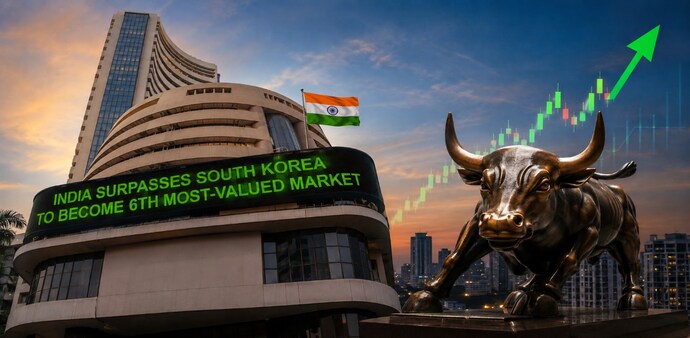
Indian stock market edged past South Korea to reclaim the sixth-largest market tag globally, topping $5 trillion in market capitalisation (m-cap) following the US-Iran peace deal. Data showed India's m-cap stood at Rs 4,76,48,719 crore in Thursday's trade, which was roughly $5.05 trillion in dollar terms. In comparison, South Korean market was just shy of $5 trillion mark.
The peace deal offered a three-fold macro benefit for India and a reason for EM investors to diversify holdings from the overcrowded AI trade.
A likely fall in Brent to $75-80 a barrel could bring proforma benefit of 64 per cent on the current account deficit (CAD), Emkay Global said in a strategy note. Second, it addresses supply chain bottlenecks and potential raw material shortage worries across multiple sectors and averts a potential inflation shock. Third, the relief on the external account translates to improved domestic liquidity, which should help interest rate transmission.
As Abhay Laijawala Managing Director, Chief Investment Officer — India at Lighthouse Canton noted, India had been penalised by global allocators for lacking "the most dangerously concentrated sector exposure" in the EM universe. That same absence — of semiconductor and memory risk — is now its most compelling structural attribute, he said in a note.
"India's position in the EM universe at this moment appears structurally unique. It is the only major emerging market that simultaneously offers zero concentration in the most crowded semiconductor and memory fabrication trade. More importantly, India also offers a deep, listed, and largely under-owned set of direct beneficiaries of AI infrastructure that global capital is now increasingly pivoting toward," Laijawala said in a note.
He said global capital is rapidly rotating beyond pureplay AI software and chips into the physical backbone powering the technology: energy, grid equipment, and data center infrastructure. As data center power constraints intensify globally, the market has realised that the ultimate bottleneck for artificial intelligence is not just computing code, but electricity, cooling and allied infrastructure, he said.
Data showed three companies, TSMC, Samsung Electronics, and SK Hynix, constituted approximately 28 per cent of the entire MSCI Emerging Markets. India carries a total country weight of 10.87 per cent in the index, a six-year low.
"Korea and Taiwan own the first trade. India is exceptionally well-positioned for the second, the AI plus infrastructure ex semiconductors and memory," Laijawala said.
Indian stock market edged past South Korea to reclaim the sixth-largest market tag globally, topping $5 trillion in market capitalisation (m-cap) following the US-Iran peace deal. Data showed India's m-cap stood at Rs 4,76,48,719 crore in Thursday's trade, which was roughly $5.05 trillion in dollar terms. In comparison, South Korean market was just shy of $5 trillion mark.
The peace deal offered a three-fold macro benefit for India and a reason for EM investors to diversify holdings from the overcrowded AI trade.
A likely fall in Brent to $75-80 a barrel could bring proforma benefit of 64 per cent on the current account deficit (CAD), Emkay Global said in a strategy note. Second, it addresses supply chain bottlenecks and potential raw material shortage worries across multiple sectors and averts a potential inflation shock. Third, the relief on the external account translates to improved domestic liquidity, which should help interest rate transmission.
As Abhay Laijawala Managing Director, Chief Investment Officer — India at Lighthouse Canton noted, India had been penalised by global allocators for lacking "the most dangerously concentrated sector exposure" in the EM universe. That same absence — of semiconductor and memory risk — is now its most compelling structural attribute, he said in a note.
"India's position in the EM universe at this moment appears structurally unique. It is the only major emerging market that simultaneously offers zero concentration in the most crowded semiconductor and memory fabrication trade. More importantly, India also offers a deep, listed, and largely under-owned set of direct beneficiaries of AI infrastructure that global capital is now increasingly pivoting toward," Laijawala said in a note.
He said global capital is rapidly rotating beyond pureplay AI software and chips into the physical backbone powering the technology: energy, grid equipment, and data center infrastructure. As data center power constraints intensify globally, the market has realised that the ultimate bottleneck for artificial intelligence is not just computing code, but electricity, cooling and allied infrastructure, he said.
Data showed three companies, TSMC, Samsung Electronics, and SK Hynix, constituted approximately 28 per cent of the entire MSCI Emerging Markets. India carries a total country weight of 10.87 per cent in the index, a six-year low.
"Korea and Taiwan own the first trade. India is exceptionally well-positioned for the second, the AI plus infrastructure ex semiconductors and memory," Laijawala said.