
What Buffett indicator, BEER ratio, EM peer comparison suggest for market direction
Market cap to GDP ratio could come under pressure in the upcoming quarters, with earnings outlook for upcoming quarters weakening due to war, Axis Securities said.
- Apr 2, 2026,
- Updated Apr 2, 2026 1:58 PM IST
Benchmark indices Nifty and Sensex are in correction mode, falling 11 per cent each in the past one month. Yet, investors are wondering whether they should invest or wait for the dust to settle. While a few market indicators suggest valuations are easing, analysts are mixed.
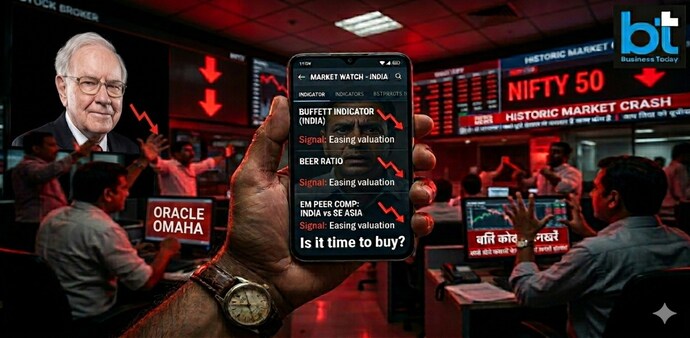
Buffett Indicator Market capitalisation (M-cap) to GDP ratio, commonly referred to as the Buffett indicator after legendary investor Warren Buffett, has eased to 114 per cent threshold from a high of 138 per cent in December 2025 and 125 per cent at the end of FY25. The ratio below 100 suggest the market is undervalued. But the gauge, on an annual basis, has stayed above 100 since FY21 (barring FY23's 97 per cent). Buffett has long cited the indicator as a broad gauge of equity market valuation. The recent ease indicates that market has now retraced from overvaluation towards fair valuation, Axis Securities said.
It, however, noted that m-cap to GDP ratio in the upcoming quarters could come under pressure with earnings outlook for upcoming quarters weakening due to war.
BEER ratio The relationship between bonds and equity is defined by the BEER ratio, or bond-earnings yield ratio, which is calculated by dividing the benchmark 10-year bond yield by the earnings yield of the benchmark index. A ratio of 1 means that both equity and bond market have equal level of perceived riskiness. A level over 1 means stocks are perceived risky. In India's case, it is just over 1.1 against the long-term average of 1.2.
"Indian bond yields have recently spiked to around 7 per cent, driven by escalating geopolitical tensions in the Middle East. Despite the RBI’s front-loaded interest rate cuts, yields have not eased, indicating that the market is factoring in persistently higher inflation expectations. BEER ratio suggests equities are less attractive relative to bonds unless supported by strong earning growth," Axis Securities said.
Nifty valuations, EM premium
India's contribution to the global market cap as a percentage at 3 per cent in March 2026 was its lowest in 36 months. MOFSL noted that Nifty is trading at 17.7 times, which is 15 per cent discount to its own long-period average of 20.9 times. Indian market’s valuation premium to emerging markets, which has been a bone of contention for EM investors, has shrunk sharply to 27 per cent against a 10-year average of 73 per cent and a peak premium of 145 per cent and closer to a decadal-low premium of 21 per cent.
"This relative valuation correction provides a strong entry point for Indian equities given that the structural case for India’s economy remains strong as ever," MOFSL said.
Axis Securities said the current valuations, although corrected, will re-rate depending on swift resolution of Iran War and earnings outlook. Style and sector rotation are keys to generating alpha, it said.
Benchmark indices Nifty and Sensex are in correction mode, falling 11 per cent each in the past one month. Yet, investors are wondering whether they should invest or wait for the dust to settle. While a few market indicators suggest valuations are easing, analysts are mixed.
Buffett Indicator Market capitalisation (M-cap) to GDP ratio, commonly referred to as the Buffett indicator after legendary investor Warren Buffett, has eased to 114 per cent threshold from a high of 138 per cent in December 2025 and 125 per cent at the end of FY25. The ratio below 100 suggest the market is undervalued. But the gauge, on an annual basis, has stayed above 100 since FY21 (barring FY23's 97 per cent). Buffett has long cited the indicator as a broad gauge of equity market valuation. The recent ease indicates that market has now retraced from overvaluation towards fair valuation, Axis Securities said.
It, however, noted that m-cap to GDP ratio in the upcoming quarters could come under pressure with earnings outlook for upcoming quarters weakening due to war.
BEER ratio The relationship between bonds and equity is defined by the BEER ratio, or bond-earnings yield ratio, which is calculated by dividing the benchmark 10-year bond yield by the earnings yield of the benchmark index. A ratio of 1 means that both equity and bond market have equal level of perceived riskiness. A level over 1 means stocks are perceived risky. In India's case, it is just over 1.1 against the long-term average of 1.2.
"Indian bond yields have recently spiked to around 7 per cent, driven by escalating geopolitical tensions in the Middle East. Despite the RBI’s front-loaded interest rate cuts, yields have not eased, indicating that the market is factoring in persistently higher inflation expectations. BEER ratio suggests equities are less attractive relative to bonds unless supported by strong earning growth," Axis Securities said.
Nifty valuations, EM premium
India's contribution to the global market cap as a percentage at 3 per cent in March 2026 was its lowest in 36 months. MOFSL noted that Nifty is trading at 17.7 times, which is 15 per cent discount to its own long-period average of 20.9 times. Indian market’s valuation premium to emerging markets, which has been a bone of contention for EM investors, has shrunk sharply to 27 per cent against a 10-year average of 73 per cent and a peak premium of 145 per cent and closer to a decadal-low premium of 21 per cent.
"This relative valuation correction provides a strong entry point for Indian equities given that the structural case for India’s economy remains strong as ever," MOFSL said.
Axis Securities said the current valuations, although corrected, will re-rate depending on swift resolution of Iran War and earnings outlook. Style and sector rotation are keys to generating alpha, it said.