
Why is market down today: Despite US-Iran positive cue, Sensex, Nifty are falling; key factors
While US President Donald Trump extended the deadline for reopening the Strait of Hormuz to April 6, the market reaction suggests limited confidence in the near-term resolution.
- Mar 27, 2026,
- Updated Mar 27, 2026 10:03 AM IST
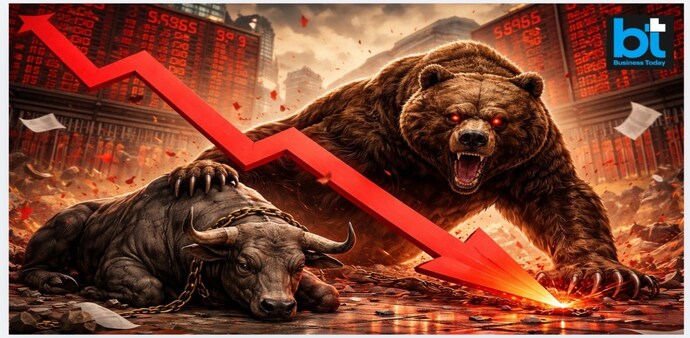
Stock market today: Benchmark indices Sensex and Nifty fell over 1 per cent each in Friday's trade, despite the US President Donald Trump extending deadline for Iran to open the Strait of Hormuz by 10 days to April 6. Investors were worried over rupee, which hit a record low. Even as Trump insisted Iranian negotiators were "begging us to make a deal," investors were unconvinced.
On the other hand, Brent futures for June delivery stayed above $100 a barrel mark, only easing 1 per cent today, after rising 4.76 per cent in the previous session. Wall Street indices settled lower overnight and Asian markets were largely mixed. Profit booking after a two-day rally also weighed on domestic indices.
Sensex, Nifty levels
On Wednesday, Sensex was trading at 74,272.68, down 1,000 points or 1.33 per cent. Nifty stood at 23,007.10, down 299.35 points or 1.28 per cent.
"While US President Donald Trump extended the deadline for reopening the Strait of Hormuz to April 6, citing ongoing discussions, the market reaction suggests limited confidence in the near-term resolution. This prolonged uncertainty continues to keep risk appetite under pressure," said Hariprasad K, a SEBI-registered Research Analyst and Founder at Livelong Wealth.
"Crude oil prices have once again moved above the $100 per barrel mark, reinforcing inflationary concerns globally. For India, this is particularly significant given its heavy reliance on crude imports. Elevated oil prices directly impact inflation, currency stability, and corporate margins, creating a layered risk environment for equities," he added.
US-Iran news
Trump in a social media post on Thursday said: "The Iranian negotiators are very different and “strange.” They are “begging” us to make a deal, which they should be doing since they have been militarily obliterated, with zero chance of a comeback, and yet they publicly state that they are only “looking at our proposal.” WRONG!!! They better get serious soon, before it is too late."
He later said Iran talks are ongoing and, despite erroneous statements to the contrary by the "Fake News Media", they are going very well.
Devarsh Vakil, Head of Prime Research at HDFC Securities said Indian rupee remains under pressure, reflectiong sustained foreign institutional outflows, which totalled nearly $11 billion in March alone, underscoring persistent macroeconomic anxiety.
Wall Street selloff
Vakil noted that US benchmark S&P500 fell 1.7 per cent overnight, its steepest single-session decline since the conflict's onset. Nasdaq Composite dropped 2.4 per cent, slipping into correction territory, he said.
"Losses deepened as investors grew increasingly concerned about the conflict's implications for inflation and growth," Vakil said.
Stock market fairly valued
VK Vijayakumar, Chief Investment Strategist at Geojit Investments Limited said the market correction since the war began has brought down Nifty valuations to fair levels.
"Nifty is now trading at about 19 times, which is lower than the last 10-year average of 22.4 times. But if India’s macros take a hit due to this energy crisis, valuations may again decline factoring-in the feared hit to earnings growth in FY27," he said.
Stock market today: Benchmark indices Sensex and Nifty fell over 1 per cent each in Friday's trade, despite the US President Donald Trump extending deadline for Iran to open the Strait of Hormuz by 10 days to April 6. Investors were worried over rupee, which hit a record low. Even as Trump insisted Iranian negotiators were "begging us to make a deal," investors were unconvinced.
On the other hand, Brent futures for June delivery stayed above $100 a barrel mark, only easing 1 per cent today, after rising 4.76 per cent in the previous session. Wall Street indices settled lower overnight and Asian markets were largely mixed. Profit booking after a two-day rally also weighed on domestic indices.
Sensex, Nifty levels
On Wednesday, Sensex was trading at 74,272.68, down 1,000 points or 1.33 per cent. Nifty stood at 23,007.10, down 299.35 points or 1.28 per cent.
"While US President Donald Trump extended the deadline for reopening the Strait of Hormuz to April 6, citing ongoing discussions, the market reaction suggests limited confidence in the near-term resolution. This prolonged uncertainty continues to keep risk appetite under pressure," said Hariprasad K, a SEBI-registered Research Analyst and Founder at Livelong Wealth.
"Crude oil prices have once again moved above the $100 per barrel mark, reinforcing inflationary concerns globally. For India, this is particularly significant given its heavy reliance on crude imports. Elevated oil prices directly impact inflation, currency stability, and corporate margins, creating a layered risk environment for equities," he added.
US-Iran news
Trump in a social media post on Thursday said: "The Iranian negotiators are very different and “strange.” They are “begging” us to make a deal, which they should be doing since they have been militarily obliterated, with zero chance of a comeback, and yet they publicly state that they are only “looking at our proposal.” WRONG!!! They better get serious soon, before it is too late."
He later said Iran talks are ongoing and, despite erroneous statements to the contrary by the "Fake News Media", they are going very well.
Devarsh Vakil, Head of Prime Research at HDFC Securities said Indian rupee remains under pressure, reflectiong sustained foreign institutional outflows, which totalled nearly $11 billion in March alone, underscoring persistent macroeconomic anxiety.
Wall Street selloff
Vakil noted that US benchmark S&P500 fell 1.7 per cent overnight, its steepest single-session decline since the conflict's onset. Nasdaq Composite dropped 2.4 per cent, slipping into correction territory, he said.
"Losses deepened as investors grew increasingly concerned about the conflict's implications for inflation and growth," Vakil said.
Stock market fairly valued
VK Vijayakumar, Chief Investment Strategist at Geojit Investments Limited said the market correction since the war began has brought down Nifty valuations to fair levels.
"Nifty is now trading at about 19 times, which is lower than the last 10-year average of 22.4 times. But if India’s macros take a hit due to this energy crisis, valuations may again decline factoring-in the feared hit to earnings growth in FY27," he said.