
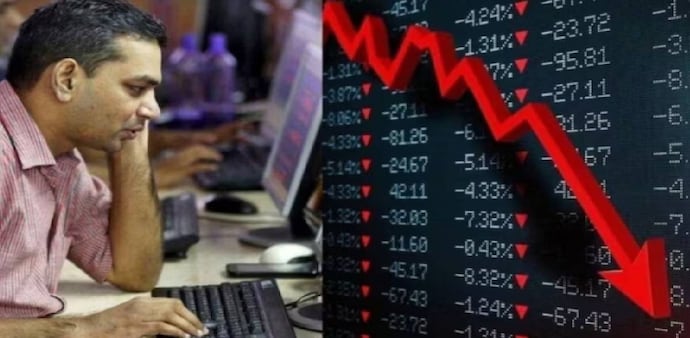
Why market fell today: Sensex tumbles 1,677 pts lower, Nifty ends below 23,900
The BSE SENSEX was trading at 76,467.78, down 1,712.94 points or 2.19 per cent. Nifty was trading at 23,896.85, down 501.85 points or 2.19 per cent.
- Jul 8, 2026,
- Updated Jul 8, 2026 4:04 PM IST
An 8 per cent surge in crude oil prices over two days, uncertainty over US-Iran peace talks following military strikes by both countries, the revocation of the US waiver on Iranian oil, weakness in the rupee, and fears of a reversal in recent foreign inflows dragged domestic equity benchmarks Sensex and Nifty lower on Wednesday.
Asian markets ended up to 5.39 per cent lower, led by South Korean stocks. European shares, too, fell as much as 2 per cent. US index futures, on the other hand, were hinting at a gap-down opening. Indian markets were no exception.
The BSE SENSEX eventually settled the day at 76,503.60, down 1,677.12 points or 2.15 per cent. Nifty ended the day at 23,882.05, down 516.65 points or 2.12 per cent.
Market selloff: Indices fall 2% each
Earlier in the day, the BSE SENSEX wfell to an intraday low of 76,259.03. Nifty also slipped to a low of 23,805.20, before recovering a bit. India VIX, which suggests a likely volatility in the market over the next 30 days, soared 26.03 per cent to 14.68, thanks to rise in crude's risk premium and uncertainty over the peace talks.
"In the near term, higher crude prices present a negative macroeconomic implication for India, as a sustained rise in oil prices could widen the oil import bill, put pressure on the current account deficit, add to inflationary pressures and keep the rupee under pressure," said Maulik Patel, Head of Research at Equirus Securities.
IndiGo, Maruti Suzuki lead losers
Thirty of 30 Sensex stocks fell. InterGlobe Aviation Ltd led the fall with a 5.02 per cent fall. The aviation stock closed at Rs 5125.55. Maruti Suzuki, Bajaj Finance, Hindustan Unilever Ltd, UltraTech Cement and Larsen & Toubro tanked up to 4 per cent.
Crude price spike: 8% in two days!
Crude prices jumped as fresh attacks on shipping in and around the Strait of Hormuz reintroduced a geopolitical risk premium into the energy market. The incidents challenged the stability of the recent US-Iran peace accord, with Iranian leadership indicating that geopolitical pressures could stall further negotiations.
On Wednesday, Brent crude for September delivery rose 4.69 per cent to $77.64 a barrel. This took the two-day rise in oil prices to 7.84 per cent.
Ankur Punj, MD & Business Head at Equirus Wealth said: “A global equity market selloff triggered a massive correction in domestic benchmarks as investors turned risk-averse following a fresh wave of conflict in West Asia. A strong upsurge in crude oil prices coupled with a sharp fall in the currency against the dollar dampened sentiment. Indications that a ceasefire between the US and Iran might fall apart also prompted investors to exit stocks.”
Renewed US-Iran tensions
"With the renewed US-Iran tensions and the consequent spike in Brent crude, the market is again back to uncertain territory. How long this would last and what would be its consequences are now in the realm of uncertainty. The market was slowly gaining strength on positive FII activity and improving macro fundamentals. The renewed US- Iran tensions have put a temporary question mark on this positive development. Therefore, investors have to wait and watch the developments," said VK Vijayakumar, Chief Investment Strategist, Geojit Investments.
Trump says it is over
Later, the US President Donald Trump said that his tentative ceasefire with Iran is done, raising the prospect of a renewed military conflict between the two countries, Bloomberg reported.
Broader indices such as Nifty500 and BSE500 fell 1.6 per cent each. A total of 61 per cent of stocks within Nifty 500 universe are still trading above their 50 days SMA compared with last week’s reading of 58 per cent.
Rupee takes hit against dollar
Rupee fell 20 paise against the dollar and there were fears that foreign flows trend may reverse.
"We believe the RBI's recent measures to encourage foreign currency inflows—including incentives for FCNR(B) deposits and easing of certain external borrowing norms—could potentially attract US$50–60 billion of additional inflows and stabilise the rupee," UBS said.
An 8 per cent surge in crude oil prices over two days, uncertainty over US-Iran peace talks following military strikes by both countries, the revocation of the US waiver on Iranian oil, weakness in the rupee, and fears of a reversal in recent foreign inflows dragged domestic equity benchmarks Sensex and Nifty lower on Wednesday.
Asian markets ended up to 5.39 per cent lower, led by South Korean stocks. European shares, too, fell as much as 2 per cent. US index futures, on the other hand, were hinting at a gap-down opening. Indian markets were no exception.
The BSE SENSEX eventually settled the day at 76,503.60, down 1,677.12 points or 2.15 per cent. Nifty ended the day at 23,882.05, down 516.65 points or 2.12 per cent.
Market selloff: Indices fall 2% each
Earlier in the day, the BSE SENSEX wfell to an intraday low of 76,259.03. Nifty also slipped to a low of 23,805.20, before recovering a bit. India VIX, which suggests a likely volatility in the market over the next 30 days, soared 26.03 per cent to 14.68, thanks to rise in crude's risk premium and uncertainty over the peace talks.
"In the near term, higher crude prices present a negative macroeconomic implication for India, as a sustained rise in oil prices could widen the oil import bill, put pressure on the current account deficit, add to inflationary pressures and keep the rupee under pressure," said Maulik Patel, Head of Research at Equirus Securities.
IndiGo, Maruti Suzuki lead losers
Thirty of 30 Sensex stocks fell. InterGlobe Aviation Ltd led the fall with a 5.02 per cent fall. The aviation stock closed at Rs 5125.55. Maruti Suzuki, Bajaj Finance, Hindustan Unilever Ltd, UltraTech Cement and Larsen & Toubro tanked up to 4 per cent.
Crude price spike: 8% in two days!
Crude prices jumped as fresh attacks on shipping in and around the Strait of Hormuz reintroduced a geopolitical risk premium into the energy market. The incidents challenged the stability of the recent US-Iran peace accord, with Iranian leadership indicating that geopolitical pressures could stall further negotiations.
On Wednesday, Brent crude for September delivery rose 4.69 per cent to $77.64 a barrel. This took the two-day rise in oil prices to 7.84 per cent.
Ankur Punj, MD & Business Head at Equirus Wealth said: “A global equity market selloff triggered a massive correction in domestic benchmarks as investors turned risk-averse following a fresh wave of conflict in West Asia. A strong upsurge in crude oil prices coupled with a sharp fall in the currency against the dollar dampened sentiment. Indications that a ceasefire between the US and Iran might fall apart also prompted investors to exit stocks.”
Renewed US-Iran tensions
"With the renewed US-Iran tensions and the consequent spike in Brent crude, the market is again back to uncertain territory. How long this would last and what would be its consequences are now in the realm of uncertainty. The market was slowly gaining strength on positive FII activity and improving macro fundamentals. The renewed US- Iran tensions have put a temporary question mark on this positive development. Therefore, investors have to wait and watch the developments," said VK Vijayakumar, Chief Investment Strategist, Geojit Investments.
Trump says it is over
Later, the US President Donald Trump said that his tentative ceasefire with Iran is done, raising the prospect of a renewed military conflict between the two countries, Bloomberg reported.
Broader indices such as Nifty500 and BSE500 fell 1.6 per cent each. A total of 61 per cent of stocks within Nifty 500 universe are still trading above their 50 days SMA compared with last week’s reading of 58 per cent.
Rupee takes hit against dollar
Rupee fell 20 paise against the dollar and there were fears that foreign flows trend may reverse.
"We believe the RBI's recent measures to encourage foreign currency inflows—including incentives for FCNR(B) deposits and easing of certain external borrowing norms—could potentially attract US$50–60 billion of additional inflows and stabilise the rupee," UBS said.