
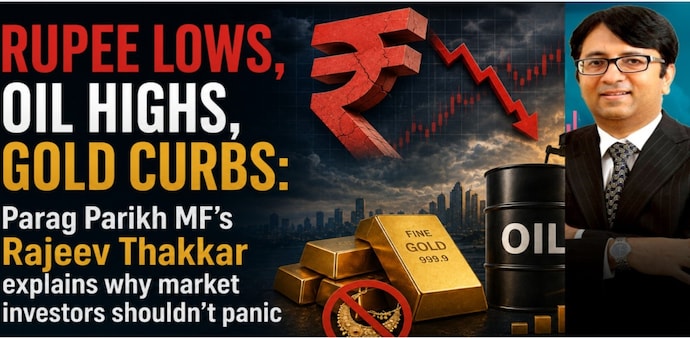
Rupee lows, oil highs, gold curbs: Parag Parikh MF's Rajeev Thakkar explains why market investors shouldn't panic | Exclusive
Parag Parikh Mutual Fund's Rajeev Thakkar on market turmoil: ‘This too shall pass; nothing specific to worry about’.
- May 19, 2026,
- Updated May 19, 2026 1:37 PM IST
Rajeev Thakkar, Chief Investment Officer (CIO) and Director at Parag Parikh Financial Advisory Services (PPFAS) Mutual Fund, in a exclusive conversation on Business Today Television (BTTV) in Market Masters show with Shailendra Bhatnagar, Chief Analyst & Editor, Markets, spoke on a range of topics - rupee at all time low, oil on the boil, gold austerity measures and more.
'India is a young country...' - Parag Parikh Mutual Fund's Rajeev Thakkar
When asked about the trying times, not only for the entire market but for investors as well as the rupee is at a record low, oil is back on the boil, and the government has put in a word saying please don't buy gold - hence how fund managers like him are navigating this space, Rajeev Thakkar said,"While in the immediate context things look very gloomy, like a depreciating currency, rising oil prices, and outflows from foreign investors, if we zoom out a bit and look at the longer context—and partly, India is a young country, so a lot of people would be investors in their mid-20s or 30s who may not have that long context."
On gold
"In the early '90s, when there was an oil crisis of something similar where Iraq had invaded Kuwait and there was this Gulf War, at that time we had to actually pledge our gold. We had to put our gold onto a plane, fly it to Western countries, and pledge it to raise some small amount of money to keep our imports going. The rupee had very steep declines at that point in time, and we had a similar situation," Rajeev Thakkar explained.
On oil prices
He added, "So today, while we are seeing prices increase—we have seen a roughly ₹3 increase in fuel prices at the pump level. This would be anywhere between 3% to 4% or 5% depending on whether one is looking at petrol or diesel. Even assuming that another ₹10 increase were to come, this will be a 10% kind of increase, which is steep. I'm not trying to minimize the impact on the common people, but if we look at the historical context, this is not the first time this is happening. In 2007, there was a steep oil price increase. Post the Russia-Ukraine war, there was a steep increase in global oil prices. So it is a fact of life today."
'Don't think here's anything specific to worry about...'
"Luckily for India and for the world, there are alternatives now where we have ethanol blending, which has taken place in a big way in India. We have alternatives in terms of electric vehicles, which will hopefully pick up in demand. So this too shall pass. I don't think there's anything specific to worry about in the current context," Thakkar said.
Is the current market (bear) scenario is here to stay?
When asked - is the current market scenario is here to stay, Rajeev Thakkar said, "So, it depends on what one's definition of long-term is. It may continue for 6 months, 12 months, or 18 months. But if it's a young person looking to invest to create wealth over decades, then this doesn't matter so much."
'Don't think it'll be as prolonged as a lot of people fear...'
"Within the Middle East, there's a lot of oil; it's just that the Strait of Hormuz is closed and ships are not able to pass through. Refining capacity, yes, it may take some time. But I don't think it'll be as prolonged as a lot of people fear," Thakkar said.
WATCH FULL CONVERSATION HERE:-
FAQs
- +−
What did Rajeev Thakkar say about the rupee fall, rising oil prices and current market worries?
Rajeev Thakkar said the present situation looks gloomy in the short term, with a weak rupee, higher oil prices and foreign investor outflows. However, he stressed that India has faced similar phases earlier and long-term investors should view such periods with patience and perspective.
- +−
Why does Rajeev Thakkar believe the impact of high oil prices may not last too long?
He said the current pressure is linked to disruptions such as the Strait of Hormuz issue, but added that it may not be as prolonged as many fear. He also pointed to alternatives like ethanol blending and electric vehicles, which can gradually reduce dependence on oil.
- +−
Should young investors worry about the current bear market scenario?
According to Thakkar, young investors creating wealth over decades should not worry too much about a market downturn lasting 6, 12 or even 18 months. His view is that short-term volatility is part of investing and matters less when the investment horizon is long.
Rajeev Thakkar, Chief Investment Officer (CIO) and Director at Parag Parikh Financial Advisory Services (PPFAS) Mutual Fund, in a exclusive conversation on Business Today Television (BTTV) in Market Masters show with Shailendra Bhatnagar, Chief Analyst & Editor, Markets, spoke on a range of topics - rupee at all time low, oil on the boil, gold austerity measures and more.
'India is a young country...' - Parag Parikh Mutual Fund's Rajeev Thakkar
When asked about the trying times, not only for the entire market but for investors as well as the rupee is at a record low, oil is back on the boil, and the government has put in a word saying please don't buy gold - hence how fund managers like him are navigating this space, Rajeev Thakkar said,"While in the immediate context things look very gloomy, like a depreciating currency, rising oil prices, and outflows from foreign investors, if we zoom out a bit and look at the longer context—and partly, India is a young country, so a lot of people would be investors in their mid-20s or 30s who may not have that long context."
On gold
"In the early '90s, when there was an oil crisis of something similar where Iraq had invaded Kuwait and there was this Gulf War, at that time we had to actually pledge our gold. We had to put our gold onto a plane, fly it to Western countries, and pledge it to raise some small amount of money to keep our imports going. The rupee had very steep declines at that point in time, and we had a similar situation," Rajeev Thakkar explained.
On oil prices
He added, "So today, while we are seeing prices increase—we have seen a roughly ₹3 increase in fuel prices at the pump level. This would be anywhere between 3% to 4% or 5% depending on whether one is looking at petrol or diesel. Even assuming that another ₹10 increase were to come, this will be a 10% kind of increase, which is steep. I'm not trying to minimize the impact on the common people, but if we look at the historical context, this is not the first time this is happening. In 2007, there was a steep oil price increase. Post the Russia-Ukraine war, there was a steep increase in global oil prices. So it is a fact of life today."
'Don't think here's anything specific to worry about...'
"Luckily for India and for the world, there are alternatives now where we have ethanol blending, which has taken place in a big way in India. We have alternatives in terms of electric vehicles, which will hopefully pick up in demand. So this too shall pass. I don't think there's anything specific to worry about in the current context," Thakkar said.
Is the current market (bear) scenario is here to stay?
When asked - is the current market scenario is here to stay, Rajeev Thakkar said, "So, it depends on what one's definition of long-term is. It may continue for 6 months, 12 months, or 18 months. But if it's a young person looking to invest to create wealth over decades, then this doesn't matter so much."
'Don't think it'll be as prolonged as a lot of people fear...'
"Within the Middle East, there's a lot of oil; it's just that the Strait of Hormuz is closed and ships are not able to pass through. Refining capacity, yes, it may take some time. But I don't think it'll be as prolonged as a lot of people fear," Thakkar said.
WATCH FULL CONVERSATION HERE:-