
Sea lanes are critical for strategic stability: Vice Admiral Krishna Swaminathan
India is critically dependent on the Gulf for its energy requirements, and energy security is closely linked to maritime security in the Indian Ocean region, said Vice Admiral Krishna Swaminathan, Flag Officer Commanding-in-Chief, Western Naval Command, Indian Navy.
- Mar 28, 2026,
- Updated Mar 28, 2026 5:58 PM IST
India is a maritime nation, heavily dependent on the seas for its economic well-being. Any disruption to sea lanes due to conflict can have significant spillover effects, Vice Admiral Krishna Swaminathan said.
India is critically dependent on the Gulf for its energy requirements, and energy security is closely linked to maritime security in the Indian Ocean region, said Vice Admiral Krishna Swaminathan, Flag Officer Commanding-in-Chief, Western Naval Command, Indian Navy.
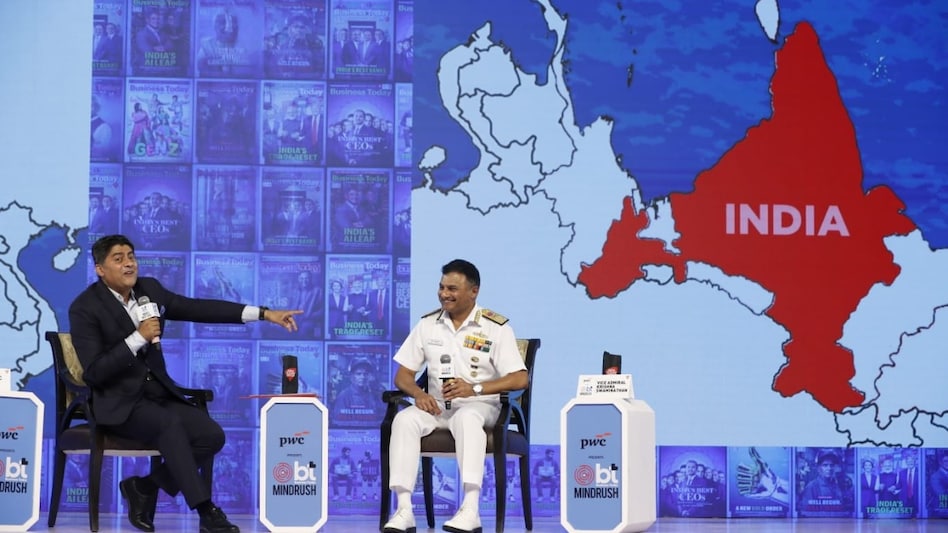
Speaking at BT MindRush, Swaminathan noted that in a globalised economy, commodities move across regions, and it is sea lanes and supply chains that enable these physical interconnections.
“Sea lanes are important for strategic stability. Safety and stability at sea cannot be taken for granted. If sea lanes are threatened by conflict, there will be spillover effects. For India, energy security equals maritime security equals national security—there is a direct thread of logic,” he said.
The naval officer explained that maritime trade remains the most cost-effective mode of transport, with transportation by sea being about 95% cheaper than road and 85% cheaper than rail per kilometre.
He added that the Indian Navy has adopted a mission-based deployment strategy to ensure the safety and security of sea lanes and uninterrupted trade flows.
“We are a maritime nation straddling the Indian Ocean, where major trade routes crisscross. Our connectivity to the north is constrained by hostile borders and mountain ranges, making sea routes critical for economic well-being,” he said.
Emphasising the need for deeper maritime engagement, Swaminathan said the Indian Navy is expanding its capabilities, with plans to grow from a 140-ship fleet to around 270 ships by 2047.
He also highlighted a structural shift in defence manufacturing. “The Indian armed forces have traditionally depended on public sector undertakings (PSUs) for defence production. This is now changing, with the government creating a level playing field for private industry and CPSEs,” he said.
“The push is towards greater participation of private players in defence. By 2047, the aim is to achieve near-total self-reliance, where imports are made by choice rather than compulsion,” he added.
India is a maritime nation, heavily dependent on the seas for its economic well-being. Any disruption to sea lanes due to conflict can have significant spillover effects, Vice Admiral Krishna Swaminathan said.
India is critically dependent on the Gulf for its energy requirements, and energy security is closely linked to maritime security in the Indian Ocean region, said Vice Admiral Krishna Swaminathan, Flag Officer Commanding-in-Chief, Western Naval Command, Indian Navy.
Speaking at BT MindRush, Swaminathan noted that in a globalised economy, commodities move across regions, and it is sea lanes and supply chains that enable these physical interconnections.
“Sea lanes are important for strategic stability. Safety and stability at sea cannot be taken for granted. If sea lanes are threatened by conflict, there will be spillover effects. For India, energy security equals maritime security equals national security—there is a direct thread of logic,” he said.
The naval officer explained that maritime trade remains the most cost-effective mode of transport, with transportation by sea being about 95% cheaper than road and 85% cheaper than rail per kilometre.
He added that the Indian Navy has adopted a mission-based deployment strategy to ensure the safety and security of sea lanes and uninterrupted trade flows.
“We are a maritime nation straddling the Indian Ocean, where major trade routes crisscross. Our connectivity to the north is constrained by hostile borders and mountain ranges, making sea routes critical for economic well-being,” he said.
Emphasising the need for deeper maritime engagement, Swaminathan said the Indian Navy is expanding its capabilities, with plans to grow from a 140-ship fleet to around 270 ships by 2047.
He also highlighted a structural shift in defence manufacturing. “The Indian armed forces have traditionally depended on public sector undertakings (PSUs) for defence production. This is now changing, with the government creating a level playing field for private industry and CPSEs,” he said.
“The push is towards greater participation of private players in defence. By 2047, the aim is to achieve near-total self-reliance, where imports are made by choice rather than compulsion,” he added.