
Why are Indian migrants being targeted in anti-immigration rallies in Australia? Explained
No single group formally claimed responsibility for the marches, but authorities identified two far-right influencers as key organisers
- Sep 4, 2025,
- Updated Sep 4, 2025 9:48 AM IST
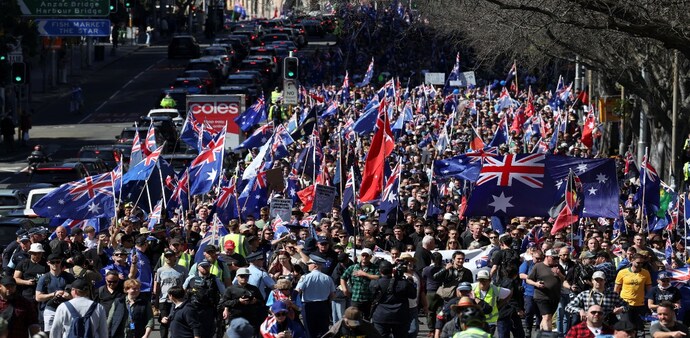
Australian lawmakers condemned anti-immigration rallies that erupted across Sydney and Melbourne over the weekend. Branded the “March for Australia,” the protests drew thousands and provided a platform for far-right figures, including neo-Nazi activists. Flyers and promotional material circulated for the rallies specifically targeted Indian migrants.
No single group formally claimed responsibility for the marches, but authorities identified two far-right influencers as key organisers. A self-styled “freedom fighter” known as Bec Freedom claimed responsibility for the Sydney rally, telling supporters the event aimed to protect “Australian heritage.” In Melbourne, anti-immigration activist Hugo Lennon organised a parallel protest and has promoted the far-right notion of “remigration,” calling for deportations of non-white immigrants and endorsing the “great replacement” conspiracy theory.
The 'mass migration' crisis
The rallies were preceded by flyers depicting mass migration as a “crisis” threatening communities, highlighting a surge of Indian migrants since 2020.
Demographers dismissed the claims as misleading, noting gaps in historical comparisons and drawing parallels to past xenophobic rhetoric against Southern European migrants. Radio host Ben Fordham amplified the narrative in August, claiming “five plane-loads” of migrants arrived daily, though government data showed Net Overseas Migration (NOM) of 446,000 in 2023–24, down from 536,000 the previous year.
Immigration has increased in Australia over the past decade but not at the pace claimed by organisers. NOM rose from 187,000 in 2014 to more than 445,000 in 2024, with numbers dropping sharply during COVID-19 border closures. Data from the Australian Bureau of Statistics cautioned that overseas arrivals and departures do not directly reflect permanent migration or population changes.
Indian migration has grown substantially, making Indians the second-largest migrant group after Britons. As of June 2023, 845,800 Indian-born people lived in Australia, more than double the number a decade earlier. Indians now represent 10.3% of the overseas-born population and 3.2% of the total population, with many working in high-skilled sectors such as IT, healthcare, and engineering.
Australian lawmakers condemned anti-immigration rallies that erupted across Sydney and Melbourne over the weekend. Branded the “March for Australia,” the protests drew thousands and provided a platform for far-right figures, including neo-Nazi activists. Flyers and promotional material circulated for the rallies specifically targeted Indian migrants.
No single group formally claimed responsibility for the marches, but authorities identified two far-right influencers as key organisers. A self-styled “freedom fighter” known as Bec Freedom claimed responsibility for the Sydney rally, telling supporters the event aimed to protect “Australian heritage.” In Melbourne, anti-immigration activist Hugo Lennon organised a parallel protest and has promoted the far-right notion of “remigration,” calling for deportations of non-white immigrants and endorsing the “great replacement” conspiracy theory.
The 'mass migration' crisis
The rallies were preceded by flyers depicting mass migration as a “crisis” threatening communities, highlighting a surge of Indian migrants since 2020.
Demographers dismissed the claims as misleading, noting gaps in historical comparisons and drawing parallels to past xenophobic rhetoric against Southern European migrants. Radio host Ben Fordham amplified the narrative in August, claiming “five plane-loads” of migrants arrived daily, though government data showed Net Overseas Migration (NOM) of 446,000 in 2023–24, down from 536,000 the previous year.
Immigration has increased in Australia over the past decade but not at the pace claimed by organisers. NOM rose from 187,000 in 2014 to more than 445,000 in 2024, with numbers dropping sharply during COVID-19 border closures. Data from the Australian Bureau of Statistics cautioned that overseas arrivals and departures do not directly reflect permanent migration or population changes.
Indian migration has grown substantially, making Indians the second-largest migrant group after Britons. As of June 2023, 845,800 Indian-born people lived in Australia, more than double the number a decade earlier. Indians now represent 10.3% of the overseas-born population and 3.2% of the total population, with many working in high-skilled sectors such as IT, healthcare, and engineering.