
A Chinese visa alternative to US' H-1B? Beijing moves to attract foreign professionals
Rolled out last month, Beijing’s K-visa is part of a broader campaign to position China as a magnet for science and technology talent at a time when U.S. immigration under President Trump has grown more restrictive
- Nov 11, 2025,
- Updated Nov 11, 2025 10:50 AM IST
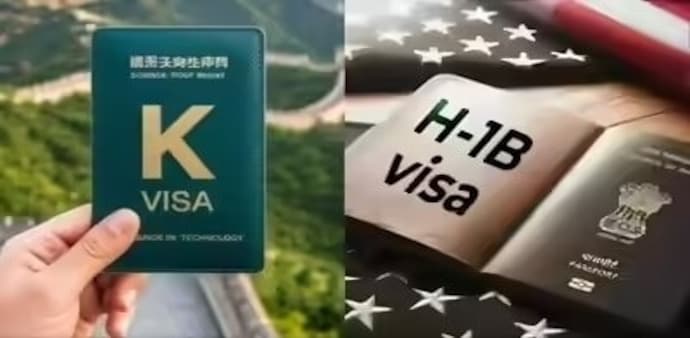
China’s new K-visa is fast emerging as its answer to America’s H-1B, a pathway designed to lure skilled professionals from around the world amid a global race for tech talent.
For Indian professionals like Vaishnavi Srinivasagopalan, who has worked in both India and the U.S., the timing could not be better. “(The) K-visa for China (is) an equivalent to the H-1B for the U.S.,” she said. “It is a good option for people like me to work abroad,” as reported by the Associated Press.
Rolled out last month, Beijing’s K-visa is part of a broader campaign to position China as a magnet for science and technology talent at a time when U.S. immigration under President Donald Trump has grown more restrictive. The new program relaxes requirements; applicants don’t need a job offer upfront, and supplements China’s existing R-visa for foreign experts.
Stricter American policies have made migration tougher. Fees for new H-1B applications have surged to $100,000, while thousands of foreign students and workers face longer scrutiny and rejections. “Students studying in the U.S. hoped for an (H-1B) visa, but currently this is an issue,” said Bikash Kali Das, an Indian student at Sichuan University.
Beijing’s global talent push
The K-visa aligns with China’s significant investment in artificial intelligence, semiconductors, and robotics — sectors crucial to its long-term objectives. “Beijing perceives the tightening of immigration policies in the U.S. as an opportunity to position itself globally as welcoming foreign talent,” said Barbara Kelemen of Dragonfly, a security intelligence firm.
But the strategy comes with complications. Unemployment among young Chinese remains high, hovering near 18%. Some graduates fear that an influx of foreign professionals could heighten competition. “The current job market is already under fierce competition,” said Zhou Xinying, a postgraduate at Zhejiang University.
Still, Chinese state media insists the move will benefit the economy. The Shanghai Observer recently argued that foreign specialists can help close China’s skills gap, particularly in frontier tech. “Beijing will need to emphasize how select foreign talent can create, not take, local jobs,” said Michael Feller of Geopolitical Strategy.
India, U.S. and the migration rethink
The appeal of China’s K-visa may grow as Indian professionals face rising H-1B rejections. In August 2025 alone, 74% of Indian study permit applicants to Canada were denied, and similar bottlenecks persist across Western economies. “China’s a great place to work in tech, if not for the difficult relationship between India and China,” said Nikhil Swaminathan, an Indian H-1B holder now based in the U.S.
Despite Beijing’s outreach, analysts say the U.S. still enjoys a decisive edge. “The U.S. may be sabotaging itself, but it’s doing so from a far more competitive position,” said Feller. “China will need to do far more than offer convenient visa pathways to attract the best."
China’s new K-visa is fast emerging as its answer to America’s H-1B, a pathway designed to lure skilled professionals from around the world amid a global race for tech talent.
For Indian professionals like Vaishnavi Srinivasagopalan, who has worked in both India and the U.S., the timing could not be better. “(The) K-visa for China (is) an equivalent to the H-1B for the U.S.,” she said. “It is a good option for people like me to work abroad,” as reported by the Associated Press.
Rolled out last month, Beijing’s K-visa is part of a broader campaign to position China as a magnet for science and technology talent at a time when U.S. immigration under President Donald Trump has grown more restrictive. The new program relaxes requirements; applicants don’t need a job offer upfront, and supplements China’s existing R-visa for foreign experts.
Stricter American policies have made migration tougher. Fees for new H-1B applications have surged to $100,000, while thousands of foreign students and workers face longer scrutiny and rejections. “Students studying in the U.S. hoped for an (H-1B) visa, but currently this is an issue,” said Bikash Kali Das, an Indian student at Sichuan University.
Beijing’s global talent push
The K-visa aligns with China’s significant investment in artificial intelligence, semiconductors, and robotics — sectors crucial to its long-term objectives. “Beijing perceives the tightening of immigration policies in the U.S. as an opportunity to position itself globally as welcoming foreign talent,” said Barbara Kelemen of Dragonfly, a security intelligence firm.
But the strategy comes with complications. Unemployment among young Chinese remains high, hovering near 18%. Some graduates fear that an influx of foreign professionals could heighten competition. “The current job market is already under fierce competition,” said Zhou Xinying, a postgraduate at Zhejiang University.
Still, Chinese state media insists the move will benefit the economy. The Shanghai Observer recently argued that foreign specialists can help close China’s skills gap, particularly in frontier tech. “Beijing will need to emphasize how select foreign talent can create, not take, local jobs,” said Michael Feller of Geopolitical Strategy.
India, U.S. and the migration rethink
The appeal of China’s K-visa may grow as Indian professionals face rising H-1B rejections. In August 2025 alone, 74% of Indian study permit applicants to Canada were denied, and similar bottlenecks persist across Western economies. “China’s a great place to work in tech, if not for the difficult relationship between India and China,” said Nikhil Swaminathan, an Indian H-1B holder now based in the U.S.
Despite Beijing’s outreach, analysts say the U.S. still enjoys a decisive edge. “The U.S. may be sabotaging itself, but it’s doing so from a far more competitive position,” said Feller. “China will need to do far more than offer convenient visa pathways to attract the best."