
'America’s loss is India’s gain': Amitabh Kant says Trump’s H-1B fee will gut US innovation
Kant, posting on X, said, “Donald Trump’s $100,000 H-1B fee will choke U.S. innovation, and turbocharge India’s. By slamming the door on global talent, America pushes the next wave of labs, patents, innovation and startups to Bangalore and Hyderabad, Pune and Gurgaon.”
- Sep 20, 2025,
- Updated Sep 20, 2025 12:32 PM IST
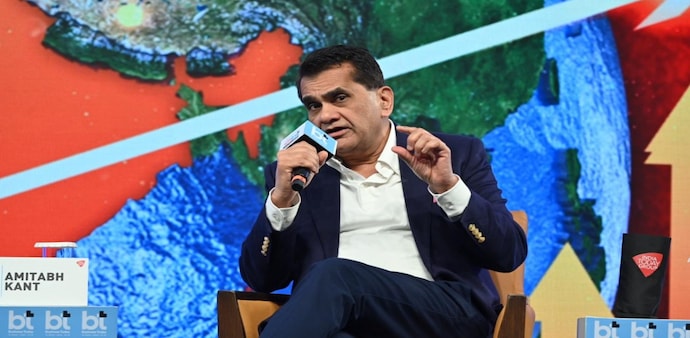
Former NITI Aayog CEO Amitabh Kant warned that Donald Trump’s proposed $100,000 annual H-1B visa fee would throttle U.S. innovation while accelerating India’s rise as a tech powerhouse.
Kant, posting on X, said, “Donald Trump’s $100,000 H-1B fee will choke U.S. innovation, and turbocharge India’s. By slamming the door on global talent, America pushes the next wave of labs, patents, innovation and startups to Bangalore and Hyderabad, Pune and Gurgaon.”
He added that Indian professionals—doctors, engineers, scientists—now have a greater opportunity to drive India’s transformation into a developed nation. “America’s loss will be India’s gain,” he said.
The Trump administration announced that companies must pay $100,000 per H-1B visa annually, marking a drastic overhaul of the U.S. employment-based immigration system. The tech sector, heavily reliant on skilled Indian and Chinese workers, is expected to be hit hardest.
“If you're going to train somebody, you're going to train one of the recent graduates from one of the great universities across our land. Train Americans. Stop bringing in people to take our jobs,” said U.S. Commerce Secretary Howard Lutnick, defending the move.
The policy sparked swift reactions. Internal emails from Microsoft and JPMorgan, reviewed by Reuters, advised H-1B employees to remain in the U.S. Employees abroad were told to return before midnight Saturday, ahead of the policy’s implementation at 0400 GMT Sunday.
Tech companies, which contributed heavily to Trump’s re-election campaign, now face heightened uncertainty over workforce planning and mobility.
The H-1B program has long served as a pipeline for highly skilled international talent, particularly in engineering and IT roles. Kant’s remarks reflect growing sentiment in India that tighter U.S. visa rules could reposition India as a global hub for innovation and entrepreneurship.
Former NITI Aayog CEO Amitabh Kant warned that Donald Trump’s proposed $100,000 annual H-1B visa fee would throttle U.S. innovation while accelerating India’s rise as a tech powerhouse.
Kant, posting on X, said, “Donald Trump’s $100,000 H-1B fee will choke U.S. innovation, and turbocharge India’s. By slamming the door on global talent, America pushes the next wave of labs, patents, innovation and startups to Bangalore and Hyderabad, Pune and Gurgaon.”
He added that Indian professionals—doctors, engineers, scientists—now have a greater opportunity to drive India’s transformation into a developed nation. “America’s loss will be India’s gain,” he said.
The Trump administration announced that companies must pay $100,000 per H-1B visa annually, marking a drastic overhaul of the U.S. employment-based immigration system. The tech sector, heavily reliant on skilled Indian and Chinese workers, is expected to be hit hardest.
“If you're going to train somebody, you're going to train one of the recent graduates from one of the great universities across our land. Train Americans. Stop bringing in people to take our jobs,” said U.S. Commerce Secretary Howard Lutnick, defending the move.
The policy sparked swift reactions. Internal emails from Microsoft and JPMorgan, reviewed by Reuters, advised H-1B employees to remain in the U.S. Employees abroad were told to return before midnight Saturday, ahead of the policy’s implementation at 0400 GMT Sunday.
Tech companies, which contributed heavily to Trump’s re-election campaign, now face heightened uncertainty over workforce planning and mobility.
The H-1B program has long served as a pipeline for highly skilled international talent, particularly in engineering and IT roles. Kant’s remarks reflect growing sentiment in India that tighter U.S. visa rules could reposition India as a global hub for innovation and entrepreneurship.