
How Indian F-1 students can navigate H-1B visa process amid $100K fee hike
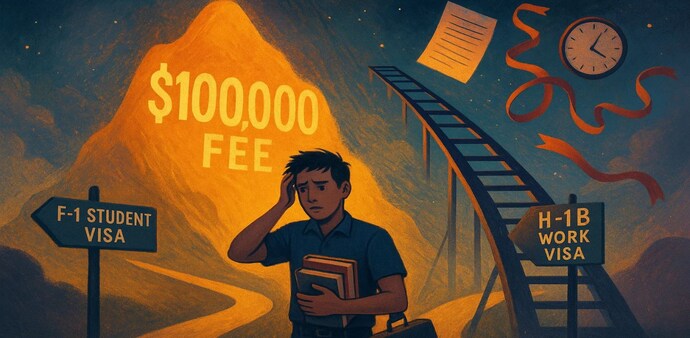
For international students in the US, particularly those from India nearing graduation, the fee increase casts uncertainty over a critical career milestone: transitioning from an F-1 student visa to an H-1B work visa
- Sep 24, 2025,
- Updated Sep 24, 2025 1:32 PM IST
A wave of alarm is sweeping through Indian communities and the global tech sector after the US government announced a $100,000 fee for H-1B visas, the main route for skilled foreign workers to launch careers in America. This unprecedented hike represents one of the most significant shifts in U.S. immigration policy in years, with Indian nationals expected to feel the greatest impact.
For international students in the US, particularly those from India nearing graduation, the fee increase casts uncertainty over a critical career milestone: transitioning from an F-1 student visa to an H-1B work visa. The added cost introduces financial strain and complexity to an already competitive process, disproportionately affecting students juggling tuition, living expenses, and future career plans.
Understanding the F-1 visa
The F-1 visa is a non-immigrant visa for students enrolled in SEVP-approved academic programs in the US. To qualify, students must:
-
Be accepted into a full-time program
-
Demonstrate English proficiency
-
Prove financial capability to cover tuition and living costs
-
Maintain strong ties to their home country
-
Reside outside the US at the time of application
Advertisement
F-1 students can remain in the US for the duration of their program and typically access temporary work authorization through Optional Practical Training (OPT) or Curricular Practical Training (CPT), directly related to their field of study.
What is the H-1B visa and why it matters
The H-1B visa allows US companies to employ foreign workers in specialty occupations requiring at least a bachelor’s degree, such as engineering, IT, healthcare, and finance.
Eligibility criteria
For employers:
-
Job must qualify as a specialty occupation
-
File a Labor Condition Application (LCA) with the Department of Labor
-
Submit Form I-129 to USCIS on behalf of the worker
For employees (F-1 graduates):
-
Minimum bachelor’s degree or equivalent in the relevant field
Advertisement -
Valid job offer from a US employer willing to sponsor the H-1B petition
Transition from F-1 to H-1B
-
Secure an H-1B sponsoring employer: Land a job offer from a US company willing to sponsor the visa.
-
Employer files H-1B petition (Form I-129): H-1B visas are capped annually at 65,000 standard visas, plus 20,000 for US master’s degree holders.
-
Labor Condition Application (LCA): Certifies wage compliance and working conditions.
-
Cap-gap extension (if needed): Allows students to stay and work legally if F-1 expires before October 1.
-
Approval and H-1B start date: Once approved, the visa typically activates on October 1.
Required documents
-
Valid passport
-
Form I-797 (H-1B approval notice)
-
Form I-129 (H-1B petition)
-
Job offer/employment letter
-
Academic transcripts and degree certificates
-
Proof of OPT or CPT status
-
Form I-20
-
Form I-94 (Arrival/Departure record)
Impact of the visa fee hike
Indian students, the largest group of international students in the US, face significant financial pressure. Combined with tuition and living costs often exceeding $50,000 annually, the increased H-1B fee may deter prospective students and complicate transitions to work status. Immigration attorneys warn that legal fees and filing costs can push student budgets to the limit.
What students should do now
-
Begin job searches early, ideally during OPT
-
Coordinate with Designated School Officials (DSOs) for timely filing
-
Stay updated on USCIS deadlines and policy changes
-
Consider backup options such as STEM OPT extensions or graduate studies
A wave of alarm is sweeping through Indian communities and the global tech sector after the US government announced a $100,000 fee for H-1B visas, the main route for skilled foreign workers to launch careers in America. This unprecedented hike represents one of the most significant shifts in U.S. immigration policy in years, with Indian nationals expected to feel the greatest impact.
For international students in the US, particularly those from India nearing graduation, the fee increase casts uncertainty over a critical career milestone: transitioning from an F-1 student visa to an H-1B work visa. The added cost introduces financial strain and complexity to an already competitive process, disproportionately affecting students juggling tuition, living expenses, and future career plans.
Understanding the F-1 visa
The F-1 visa is a non-immigrant visa for students enrolled in SEVP-approved academic programs in the US. To qualify, students must:
-
Be accepted into a full-time program
-
Demonstrate English proficiency
-
Prove financial capability to cover tuition and living costs
-
Maintain strong ties to their home country
-
Reside outside the US at the time of application
Advertisement
F-1 students can remain in the US for the duration of their program and typically access temporary work authorization through Optional Practical Training (OPT) or Curricular Practical Training (CPT), directly related to their field of study.
What is the H-1B visa and why it matters
The H-1B visa allows US companies to employ foreign workers in specialty occupations requiring at least a bachelor’s degree, such as engineering, IT, healthcare, and finance.
Eligibility criteria
For employers:
-
Job must qualify as a specialty occupation
-
File a Labor Condition Application (LCA) with the Department of Labor
-
Submit Form I-129 to USCIS on behalf of the worker
For employees (F-1 graduates):
-
Minimum bachelor’s degree or equivalent in the relevant field
Advertisement -
Valid job offer from a US employer willing to sponsor the H-1B petition
Transition from F-1 to H-1B
-
Secure an H-1B sponsoring employer: Land a job offer from a US company willing to sponsor the visa.
-
Employer files H-1B petition (Form I-129): H-1B visas are capped annually at 65,000 standard visas, plus 20,000 for US master’s degree holders.
-
Labor Condition Application (LCA): Certifies wage compliance and working conditions.
-
Cap-gap extension (if needed): Allows students to stay and work legally if F-1 expires before October 1.
-
Approval and H-1B start date: Once approved, the visa typically activates on October 1.
Required documents
-
Valid passport
-
Form I-797 (H-1B approval notice)
-
Form I-129 (H-1B petition)
-
Job offer/employment letter
-
Academic transcripts and degree certificates
-
Proof of OPT or CPT status
-
Form I-20
-
Form I-94 (Arrival/Departure record)
Impact of the visa fee hike
Indian students, the largest group of international students in the US, face significant financial pressure. Combined with tuition and living costs often exceeding $50,000 annually, the increased H-1B fee may deter prospective students and complicate transitions to work status. Immigration attorneys warn that legal fees and filing costs can push student budgets to the limit.
What students should do now
-
Begin job searches early, ideally during OPT
-
Coordinate with Designated School Officials (DSOs) for timely filing
-
Stay updated on USCIS deadlines and policy changes
-
Consider backup options such as STEM OPT extensions or graduate studies