
'One firm got 5,189 H-1Bs after sacking 16k Americans': White House defends $100K visa fee in 9 points
The fact sheet lays out the administration’s case for the steep new financial barrier, arguing that the H-1B program has been “deliberately exploited” by companies to replace American workers with lower-paid foreign labor.
- Sep 21, 2025,
- Updated Sep 21, 2025 9:20 AM IST
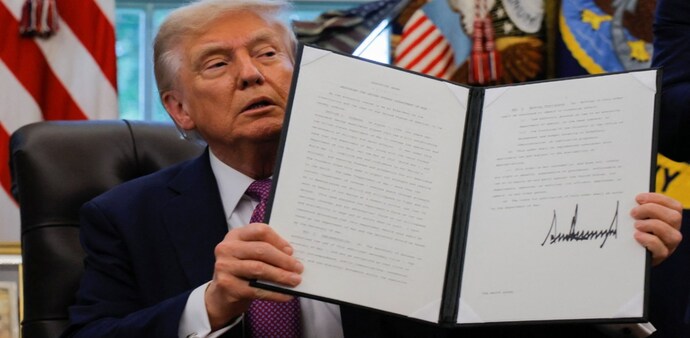
Following President Trump’s proclamation imposing a $100,000 fee on new H-1B visa petitions, the White House released a detailed fact sheet Friday defending the move as a necessary response to widespread program abuse, American job losses, and national security concerns.
The fact sheet lays out the administration’s case for the steep new financial barrier, arguing that the H-1B program has been “deliberately exploited” by companies to replace American workers with lower-paid foreign labor. The $100,000 fee—required for all new H-1B petitions filed from outside the U.S.—is intended to raise the cost of abuse and prioritize high-skilled, high-wage hiring.
Here are the key claims and data points the White House used to justify the policy:
1. Surge in H-1B Use in Tech
- In FY 2003, H-1B workers held 32% of IT jobs.
- By 2025, that figure has jumped to over 65%, indicating a heavy reliance on foreign labor in one of the U.S.’s most critical industries.
2. High Unemployment Among U.S. STEM Graduates
- Unemployment among recent computer science graduates is 6.1%.
- For computer engineering graduates, it’s 7.5%—more than double the rate for graduates in biology or art history.
3. Disconnect Between STEM Employment and Foreign Hiring
- From 2000 to 2019, the number of foreign-born STEM workers more than doubled, while overall STEM employment grew only 44.5%.
- The administration argues this signals a displacement of American talent, not a shortage of it.
4. Mass Layoffs at H-1B-Heavy Firms
The fact sheet highlights specific examples of companies continuing to hire large numbers of H-1B workers while laying off U.S. employees:
- One unnamed firm laid off 16,000 Americans in 2025 after receiving 5,189 H-1B approvals.
- Another secured 1,698 H-1B visas while cutting 2,400 jobs in Oregon.
- A third reduced its U.S. workforce by 27,000 since 2022 but was granted 25,075 H-1B approvals.
- A fourth cut 1,000 American jobs in February while receiving 1,137 H-1B approvals.
5. Training Their Replacements
The fact sheet references reports of American tech workers being forced to train their H-1B replacements under non-disclosure agreements, portraying the program as a vehicle for corporate outsourcing.
6. Long-Term Risks to the Domestic Workforce
The administration claims the current structure of the H-1B program disincentivizes young Americans from entering technical fields, citing lower perceived job security and wage competition.
7. National Security Framing
The fact sheet repeatedly frames the issue as a national security concern, arguing that dependence on foreign labor in critical infrastructure areas, including tech, weakens U.S. resilience and self-reliance.
8. Broader Reforms Coming
Alongside the proclamation, President Trump directed:
- The Department of Labor to revise prevailing wage rules to ensure H-1B workers are not underpaid.
- The Department of Homeland Security to initiate rulemaking that prioritizes visa approvals for higher-paid, high-skill jobs.
9. America-First Employment Stats
The fact sheet claims that since Trump returned to office:
- All job gains have gone to American-born workers, reversing trends from the previous administration.
- Federal workforce programs have been revised to exclude illegal immigrants, ensuring job training resources are reserved for U.S. citizens.
The White House is positioning the $100,000 H-1B visa fee as a direct countermeasure to what it views as a broken system—one that favors foreign labor at the expense of American jobs and security.
Following President Trump’s proclamation imposing a $100,000 fee on new H-1B visa petitions, the White House released a detailed fact sheet Friday defending the move as a necessary response to widespread program abuse, American job losses, and national security concerns.
The fact sheet lays out the administration’s case for the steep new financial barrier, arguing that the H-1B program has been “deliberately exploited” by companies to replace American workers with lower-paid foreign labor. The $100,000 fee—required for all new H-1B petitions filed from outside the U.S.—is intended to raise the cost of abuse and prioritize high-skilled, high-wage hiring.
Here are the key claims and data points the White House used to justify the policy:
1. Surge in H-1B Use in Tech
- In FY 2003, H-1B workers held 32% of IT jobs.
- By 2025, that figure has jumped to over 65%, indicating a heavy reliance on foreign labor in one of the U.S.’s most critical industries.
2. High Unemployment Among U.S. STEM Graduates
- Unemployment among recent computer science graduates is 6.1%.
- For computer engineering graduates, it’s 7.5%—more than double the rate for graduates in biology or art history.
3. Disconnect Between STEM Employment and Foreign Hiring
- From 2000 to 2019, the number of foreign-born STEM workers more than doubled, while overall STEM employment grew only 44.5%.
- The administration argues this signals a displacement of American talent, not a shortage of it.
4. Mass Layoffs at H-1B-Heavy Firms
The fact sheet highlights specific examples of companies continuing to hire large numbers of H-1B workers while laying off U.S. employees:
- One unnamed firm laid off 16,000 Americans in 2025 after receiving 5,189 H-1B approvals.
- Another secured 1,698 H-1B visas while cutting 2,400 jobs in Oregon.
- A third reduced its U.S. workforce by 27,000 since 2022 but was granted 25,075 H-1B approvals.
- A fourth cut 1,000 American jobs in February while receiving 1,137 H-1B approvals.
5. Training Their Replacements
The fact sheet references reports of American tech workers being forced to train their H-1B replacements under non-disclosure agreements, portraying the program as a vehicle for corporate outsourcing.
6. Long-Term Risks to the Domestic Workforce
The administration claims the current structure of the H-1B program disincentivizes young Americans from entering technical fields, citing lower perceived job security and wage competition.
7. National Security Framing
The fact sheet repeatedly frames the issue as a national security concern, arguing that dependence on foreign labor in critical infrastructure areas, including tech, weakens U.S. resilience and self-reliance.
8. Broader Reforms Coming
Alongside the proclamation, President Trump directed:
- The Department of Labor to revise prevailing wage rules to ensure H-1B workers are not underpaid.
- The Department of Homeland Security to initiate rulemaking that prioritizes visa approvals for higher-paid, high-skill jobs.
9. America-First Employment Stats
The fact sheet claims that since Trump returned to office:
- All job gains have gone to American-born workers, reversing trends from the previous administration.
- Federal workforce programs have been revised to exclude illegal immigrants, ensuring job training resources are reserved for U.S. citizens.
The White House is positioning the $100,000 H-1B visa fee as a direct countermeasure to what it views as a broken system—one that favors foreign labor at the expense of American jobs and security.