
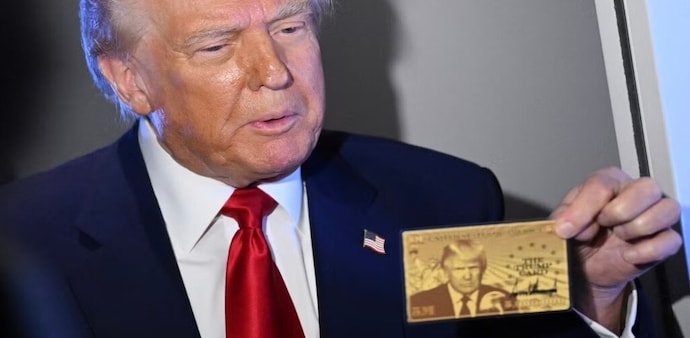
Trump’s Gold Card program nears a December launch, USCIS sends draft I-140G for review
The draft form outlines how foreign nationals can seek permanent residence through the Gold Card pathway, which hinges on making significant donations to the U.S. Treasury
- Nov 20, 2025,
- Updated Nov 20, 2025 4:37 PM IST
U.S. immigration officials have taken a key step toward launching President Donald Trump’s new Gold Card program, sending the draft Form I-140G to the Office of Management and Budget for review, a mandatory checkpoint before the programme can go live by the December 18 deadline set in Trump’s September executive order, according to Fragomen.
The draft form outlines how foreign nationals can seek permanent residence through the Gold Card pathway, which hinges on making significant donations to the U.S. Treasury. Under the proposal, individual applicants would be required to donate $1 million, while employer-sponsored applicants would face a $2 million requirement. Successful petitioners could qualify under the EB-1 category for individuals of extraordinary ability or the EB-2 National Interest Waiver route.
What the draft reveals about the new process
According to draft instructions, the government is planning a multi-agency application sequence. First, a Gold Card request would be filed with the Department of Commerce. Applicants would then pay a non-refundable $15,000 fee through pay.gov before submitting the Form I-140G petition to USCIS.
USCIS would use the new form to determine eligibility and verify the lawful origin of the donated funds. Once approved, and once an immigrant visa number becomes available, applicants “must complete consular processing with the U.S. Department of State at an embassy or consulate to get an immigrant visa and travel to the United States to be admitted as a lawful permanent resident,” the draft states.
The document does not address whether beneficiaries can file for adjustment of status from within the United States, though that option is expected to be available. USCIS projects that roughly 1,000 people will file Form I-140G each year.
What comes next
Though a major procedural milestone, the program is not yet active. Neither USCIS nor the Department of Commerce is accepting applications, and several operational details are still being finalised ahead of the December 18 deadline.
The government has also not released specifics about a related “Platinum Card” option, which appears on the administration’s Gold Card website but was not part of Trump’s executive order. According to the website, the Platinum Card would allow a foreign national who pays $5 million, plus fees, to live in the United States for up to 270 days a year without being subject to U.S. taxes on non-U.S. income.
More clarity on both programs is expected in the coming weeks.
U.S. immigration officials have taken a key step toward launching President Donald Trump’s new Gold Card program, sending the draft Form I-140G to the Office of Management and Budget for review, a mandatory checkpoint before the programme can go live by the December 18 deadline set in Trump’s September executive order, according to Fragomen.
The draft form outlines how foreign nationals can seek permanent residence through the Gold Card pathway, which hinges on making significant donations to the U.S. Treasury. Under the proposal, individual applicants would be required to donate $1 million, while employer-sponsored applicants would face a $2 million requirement. Successful petitioners could qualify under the EB-1 category for individuals of extraordinary ability or the EB-2 National Interest Waiver route.
What the draft reveals about the new process
According to draft instructions, the government is planning a multi-agency application sequence. First, a Gold Card request would be filed with the Department of Commerce. Applicants would then pay a non-refundable $15,000 fee through pay.gov before submitting the Form I-140G petition to USCIS.
USCIS would use the new form to determine eligibility and verify the lawful origin of the donated funds. Once approved, and once an immigrant visa number becomes available, applicants “must complete consular processing with the U.S. Department of State at an embassy or consulate to get an immigrant visa and travel to the United States to be admitted as a lawful permanent resident,” the draft states.
The document does not address whether beneficiaries can file for adjustment of status from within the United States, though that option is expected to be available. USCIS projects that roughly 1,000 people will file Form I-140G each year.
What comes next
Though a major procedural milestone, the program is not yet active. Neither USCIS nor the Department of Commerce is accepting applications, and several operational details are still being finalised ahead of the December 18 deadline.
The government has also not released specifics about a related “Platinum Card” option, which appears on the administration’s Gold Card website but was not part of Trump’s executive order. According to the website, the Platinum Card would allow a foreign national who pays $5 million, plus fees, to live in the United States for up to 270 days a year without being subject to U.S. taxes on non-U.S. income.
More clarity on both programs is expected in the coming weeks.