
US imposes up to $20,000 visa bond on 50 countries, India left out
The bond can be paid by the applicant or a third party, such as a friend, family member or business associate.
- Oct 5, 2026,
- Updated Oct 5, 2026 6:28 PM IST
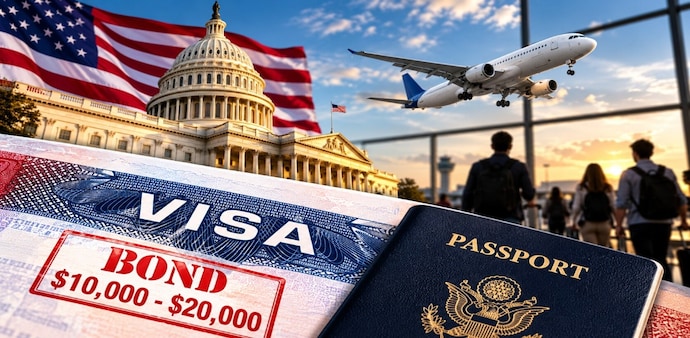
The United States has put 50 countries under a new visa bond programme that requires their citizens to deposit up to $20,000 before getting a B1/B2 tourist or business visa. India is not on the list, while neighbouring countries including Bangladesh, Bhutan and Nepal are covered by the rule.
The US Department of State updated the list on October 2, 2026. Applicants from the listed countries who are otherwise eligible for a B1/B2 visa must pay a bond of $10,000, $15,000 or $20,000. The exact amount will be decided by a consular officer during the visa interview.
The rule applies regardless of where the applicant applies for the visa.
Countries on the list
The 50 countries include Algeria, Angola, Antigua and Barbuda, Bangladesh, Benin, Bhutan, Botswana, Burundi, Cabo Verde, Cambodia, Central African Republic, Cote D’Ivoire, Cuba, Djibouti, Dominica, Ethiopia, Fiji, Gabon, The Gambia, Georgia, Grenada, Guinea, Guinea-Bissau, Kyrgyz Republic, Lesotho, Malawi, Mauritania, Mauritius, Mongolia, Mozambique, Namibia, Nepal, Nicaragua, Nigeria, Papua New Guinea, Sao Tome and Principe, Senegal, Seychelles, Tajikistan, Tanzania, Togo, Tonga, Tunisia, Turkmenistan, Tuvalu, Uganda, Vanuatu, Venezuela, Zambia and Zimbabwe.
Bangladesh and Nepal have been under the programme since January 21, 2026, while Bhutan was added from January 1. Several other countries were added on April 2.
How the bond works
Applicants must submit Department of Homeland Security Form I-352 and pay through the US Treasury’s Pay.gov platform, but only after a consular officer asks them to do so.
The bond can be paid by the applicant or a third party, such as a friend, family member or business associate.
The bond does not guarantee that a visa will be issued. It is returned if the applicant follows the bond conditions, including leaving the US on time through a commercial air port of entry.
Visa bond holders can enter and exit the US only through commercial air ports of entry, including Customs and Border Protection preclearance locations. They cannot use land, sea, charter air or general aviation ports.
The bond can be breached if the visa holder overstays, violates the bond conditions or makes certain untimely immigration applications. Filing for asylum or other humanitarian protection through Form I-589 is also listed as a possible breach.
The United States has put 50 countries under a new visa bond programme that requires their citizens to deposit up to $20,000 before getting a B1/B2 tourist or business visa. India is not on the list, while neighbouring countries including Bangladesh, Bhutan and Nepal are covered by the rule.
The US Department of State updated the list on October 2, 2026. Applicants from the listed countries who are otherwise eligible for a B1/B2 visa must pay a bond of $10,000, $15,000 or $20,000. The exact amount will be decided by a consular officer during the visa interview.
The rule applies regardless of where the applicant applies for the visa.
Countries on the list
The 50 countries include Algeria, Angola, Antigua and Barbuda, Bangladesh, Benin, Bhutan, Botswana, Burundi, Cabo Verde, Cambodia, Central African Republic, Cote D’Ivoire, Cuba, Djibouti, Dominica, Ethiopia, Fiji, Gabon, The Gambia, Georgia, Grenada, Guinea, Guinea-Bissau, Kyrgyz Republic, Lesotho, Malawi, Mauritania, Mauritius, Mongolia, Mozambique, Namibia, Nepal, Nicaragua, Nigeria, Papua New Guinea, Sao Tome and Principe, Senegal, Seychelles, Tajikistan, Tanzania, Togo, Tonga, Tunisia, Turkmenistan, Tuvalu, Uganda, Vanuatu, Venezuela, Zambia and Zimbabwe.
Bangladesh and Nepal have been under the programme since January 21, 2026, while Bhutan was added from January 1. Several other countries were added on April 2.
How the bond works
Applicants must submit Department of Homeland Security Form I-352 and pay through the US Treasury’s Pay.gov platform, but only after a consular officer asks them to do so.
The bond can be paid by the applicant or a third party, such as a friend, family member or business associate.
The bond does not guarantee that a visa will be issued. It is returned if the applicant follows the bond conditions, including leaving the US on time through a commercial air port of entry.
Visa bond holders can enter and exit the US only through commercial air ports of entry, including Customs and Border Protection preclearance locations. They cannot use land, sea, charter air or general aviation ports.
The bond can be breached if the visa holder overstays, violates the bond conditions or makes certain untimely immigration applications. Filing for asylum or other humanitarian protection through Form I-589 is also listed as a possible breach.