
BT Explainer: Silver prices fall below ₹2 lakh: Should silver ETF investors buy more, hold or sell?
BT Explainer: Silver prices fall below ₹2 lakh: Should silver ETF investors buy more, hold or sell?
With silver prices under pressure from global economic uncertainty and rising interest-rate concerns, investors face a difficult choice between buying the dip and limiting further losses. Experts outline what investors should consider before changing their Silver ETF holdings.
Basudha Das
- Oct 24, 2026,
- Updated Oct 24, 2026 6:00 AM IST
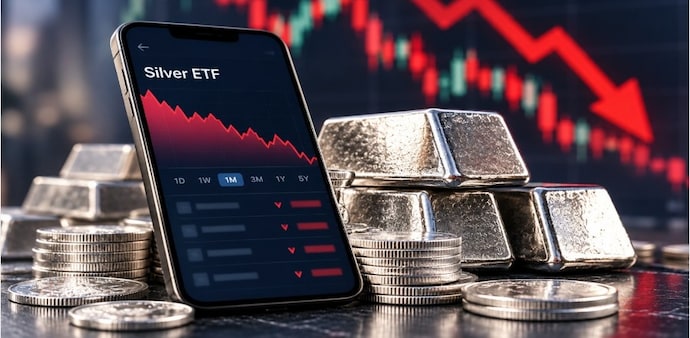
Silver price crash: Silver rates have plunged ₹56,000 per kg from their August peak, leaving investors who bought at higher levels grappling with a crucial decision: should they hold their Silver Exchange-Traded Funds (ETFs), invest more to lower their average purchase cost or cut their losses?
Silver extended its decline on Friday, with domestic prices falling more than ₹6,000 per kg to around ₹1.93 lakh. The sell-off has intensified amid concerns over global growth, rising bond yields and the outlook for US interest rates. International spot silver also fell more than 5% on Thursday, reflecting mounting pressure on precious metals.
Advertisement
For investors, however, a sharp correction does not automatically mean it is time to buy more or exit. The decision should depend on the size of their existing exposure, investment horizon and ability to absorb further losses, according to Niharika Tripathi, Head of Products & Research at Wealthy.in, a wealth management platform for mutual fund distributors.
“Buying silver at a higher price does not automatically mean the investment should be sold, just as a correction does not necessarily justify buying more,” Tripathi said.
Hold, buy more or exit?
Investors who allocated a relatively small portion of their portfolio to silver for the long term may consider holding their investments if their financial circumstances and investment objectives remain unchanged.
Advertisement
However, those who committed a substantial amount expecting quick returns should reassess how much additional volatility they can withstand. The key is to distinguish between a temporary fall in investment value and a position that has become too risky for the portfolio.
Averaging down — buying more after prices fall to reduce the average purchase cost — can increase the capital exposed to further losses.
“For example, investing another ₹1 lakh after an existing ₹1 lakh silver investment has declined increases the total capital exposed to ₹2 lakh. It may lower the average purchase cost, but it also increases the amount vulnerable to further losses,” Tripathi said.
Investors should therefore avoid adding to their holdings simply because prices have fallen. Any decision to hold, buy more or reduce exposure should reflect their financial capacity and intended allocation to precious metals.
Advertisement
Is the silver price crash a buying opportunity?
The correction could prompt investors to consider deploying fresh money during Diwali. But the extent of the decline alone does not establish whether silver offers attractive value.
Silver ETFs attracted net inflows of ₹1,974 crore in September, indicating strong investor interest. However, these inflows do not predict the direction of prices.
Investors with a long investment horizon and room within their planned precious-metals allocation could consider deploying money in smaller instalments rather than committing the entire amount at once. Staggered purchases can reduce the risk of investing everything at a single price, although they cannot eliminate market risk.
Those who already have adequate silver exposure need not increase it merely because the metal has corrected. Waiting for prices to stabilise is also a valid option.
How much further could silver prices fall?
Technical indicators suggest that the near-term outlook remains weak.
Ponmudi R, CEO of Enrich Money, said MCX silver opened sharply lower near ₹1,96,590 and was trading around ₹1,96,050, down 1.78%, in the market snapshot he cited. The metal had slipped below the ₹2 lakh–₹2.02 lakh support zone, which now acts as immediate resistance.
Advertisement
“On the downside, support lies at ₹1,92,000–₹1,94,000, with the next support zone at ₹1,83,000–₹1,85,000,” Ponmudi said.
He noted that the Relative Strength Index (RSI), near 24, was deep in oversold territory, while the Moving Average Convergence Divergence (MACD) remained below its signal line, indicating that selling pressure had yet to ease. An oversold reading, however, does not by itself confirm that prices are about to rebound.
In international markets, COMEX silver futures were trading near $54, after opening around $54.70. Ponmudi identified $53.50–$54 as an important support zone, with a possible further decline towards $52 if prices break decisively below it. A sustained move above $55 would be needed to improve the near-term outlook.
Silver has also underperformed gold since October 9, falling around 9.3% compared with gold’s 3.4% decline, Ponmudi said. Silver’s industrial-demand exposure makes it more vulnerable to concerns about economic growth, while firmer interest-rate expectations have weighed on precious metals more broadly.
Should investors rebalance their portfolios?
Investors should pay particular attention to concentration risk. Tripathi illustrated this with a ₹10 lakh portfolio containing ₹2.5 lakh in Silver ETFs. Silver would account for 25% of the portfolio, and a further 10% fall in the metal would reduce the portfolio’s value by ₹25,000, assuming other investments remained unchanged.
Advertisement
If silver exposure has become excessive, rebalancing may be appropriate even if it means selling at a loss. Investors should consider their liquidity requirements, transaction costs and tax implications instead of waiting solely for prices to return to their purchase levels.
Silver ETFs may also be unsuitable for money needed within the next one or two years. Someone investing ₹3 lakh for a payment due in 18 months would face a ₹45,000 shortfall if silver fell 15%.
For near-term financial goals, preserving the required amount and ensuring access to it when needed should take priority over chasing a potential recovery.
The takeaway: Silver’s sharp correction may create opportunities for investors with a long horizon and room in their portfolios, but falling prices are not, by themselves, a reason to average down. Investors should first assess their exposure, risk tolerance and financial goals before deciding their next move.
Read more!