
23 years after Concorde's retirement: NASA's X-59 could make supersonic travel roar back
When Concorde entered service in 1976, it transformed long-distance travel. Cruising at more than twice the speed of sound, the aircraft could connect London and New York in under three-and-a-half hours — an achievement that remains unmatched in commercial aviation.
- Jul 2, 2026,
- Updated Jul 2, 2026 4:16 PM IST
Will the world witness another era of commercial supersonic flight after Concorde? For more than two decades, the answer seemed firmly rooted in the past. Then NASA's X-59 quietly broke the sound barrier.
It wasn't chasing speed records — it was testing whether aircraft can fly faster than sound without unleashing the deafening sonic boom that grounded the dream of overland supersonic travel. If successful, the milestone could mark the beginning of aviation's next high-speed chapter.
NASA announced that the X-59 successfully completed its first supersonic flight on June 5, reaching Mach 1.1 (around 1,147 km/h) at an altitude of 43,400 feet during an 81-minute test flight. The achievement kicks off the aircraft's dedicated supersonic testing campaign under NASA's Quesst mission.
Why Concorde disappeared
When Concorde entered service in 1976, it transformed long-distance travel. Cruising at more than twice the speed of sound, the aircraft could connect London and New York in under three-and-a-half hours — an achievement that remains unmatched in commercial aviation.
Despite being decades ahead of its time, Concorde's greatest strength was also its greatest weakness.
Every time Concorde crossed the sound barrier, it produced a powerful sonic boom that could be heard for miles, rattling buildings and unsettling communities. As a result, several countries, including the United States, prohibited routine commercial supersonic flights over land.
That restriction confined Concorde largely to transatlantic routes. Combined with high operating costs, fuel consumption, and declining demand following the Air France crash in 2000, the iconic aircraft was retired in 2003.
X-59 isn't faster — it's designed to be quieter
Unlike Concorde, the X-59 has been built around a single engineering challenge: eliminating the disruptive sonic boom.
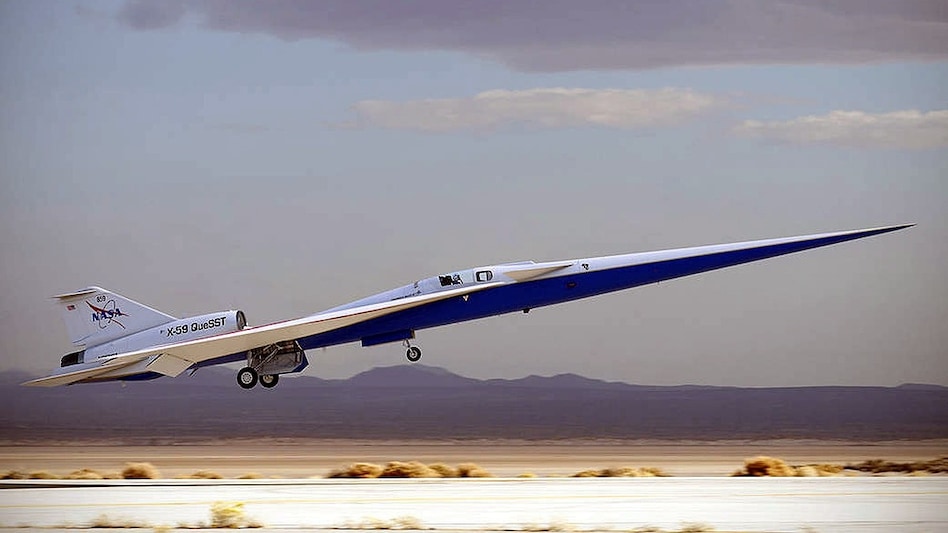
Its unusually long and slender nose reshapes the shock waves generated during supersonic flight so they reach the ground as a much softer "thump" rather than an explosive boom. The engine has also been positioned on top of the aircraft to further reduce noise directed toward the ground.
The design is so unconventional that the aircraft has no traditional forward-facing cockpit window. Instead, pilots rely on NASA's eXternal Vision System, which combines high-definition cameras with augmented reality displays to provide a clear view ahead.
Why the first supersonic flight matters
Crossing Mach 1 was an essential proof of capability. The flight confirmed that the X-59 can safely transition into supersonic speeds, allowing NASA to begin the most important phase of the programme — testing whether the aircraft can consistently produce its signature "quiet thump."
NASA has since expanded testing, with the X-59 reaching Mach 1.4 at 55,000 feet. Future flights will take the aircraft over selected communities across the United States, where residents will be asked to report how they perceive the sound produced by the aircraft.
The data will help regulators determine whether decades-old restrictions on overland supersonic flight can eventually be replaced with modern, noise-based standards.
What could change if the experiment succeeds?
If the X-59 delivers on its promise, it could reshape the future of commercial aviation.
Overland supersonic routes that have been impossible for more than 50 years could become viable again, dramatically reducing travel times between major cities. Journeys such as New York to Los Angeles or Delhi to Singapore could eventually be completed in nearly half the time taken by today's conventional aircraft.
NASA isn't building the next generation of passenger airliners. Its goal is to provide the technology, data and scientific evidence that aircraft manufacturers and aviation regulators need to bring quieter supersonic travel into commercial service.
Will the world witness another era of commercial supersonic flight after Concorde? For more than two decades, the answer seemed firmly rooted in the past. Then NASA's X-59 quietly broke the sound barrier.
It wasn't chasing speed records — it was testing whether aircraft can fly faster than sound without unleashing the deafening sonic boom that grounded the dream of overland supersonic travel. If successful, the milestone could mark the beginning of aviation's next high-speed chapter.
NASA announced that the X-59 successfully completed its first supersonic flight on June 5, reaching Mach 1.1 (around 1,147 km/h) at an altitude of 43,400 feet during an 81-minute test flight. The achievement kicks off the aircraft's dedicated supersonic testing campaign under NASA's Quesst mission.
Why Concorde disappeared
When Concorde entered service in 1976, it transformed long-distance travel. Cruising at more than twice the speed of sound, the aircraft could connect London and New York in under three-and-a-half hours — an achievement that remains unmatched in commercial aviation.
Despite being decades ahead of its time, Concorde's greatest strength was also its greatest weakness.
Every time Concorde crossed the sound barrier, it produced a powerful sonic boom that could be heard for miles, rattling buildings and unsettling communities. As a result, several countries, including the United States, prohibited routine commercial supersonic flights over land.
That restriction confined Concorde largely to transatlantic routes. Combined with high operating costs, fuel consumption, and declining demand following the Air France crash in 2000, the iconic aircraft was retired in 2003.
X-59 isn't faster — it's designed to be quieter
Unlike Concorde, the X-59 has been built around a single engineering challenge: eliminating the disruptive sonic boom.
Its unusually long and slender nose reshapes the shock waves generated during supersonic flight so they reach the ground as a much softer "thump" rather than an explosive boom. The engine has also been positioned on top of the aircraft to further reduce noise directed toward the ground.
The design is so unconventional that the aircraft has no traditional forward-facing cockpit window. Instead, pilots rely on NASA's eXternal Vision System, which combines high-definition cameras with augmented reality displays to provide a clear view ahead.
Why the first supersonic flight matters
Crossing Mach 1 was an essential proof of capability. The flight confirmed that the X-59 can safely transition into supersonic speeds, allowing NASA to begin the most important phase of the programme — testing whether the aircraft can consistently produce its signature "quiet thump."
NASA has since expanded testing, with the X-59 reaching Mach 1.4 at 55,000 feet. Future flights will take the aircraft over selected communities across the United States, where residents will be asked to report how they perceive the sound produced by the aircraft.
The data will help regulators determine whether decades-old restrictions on overland supersonic flight can eventually be replaced with modern, noise-based standards.
What could change if the experiment succeeds?
If the X-59 delivers on its promise, it could reshape the future of commercial aviation.
Overland supersonic routes that have been impossible for more than 50 years could become viable again, dramatically reducing travel times between major cities. Journeys such as New York to Los Angeles or Delhi to Singapore could eventually be completed in nearly half the time taken by today's conventional aircraft.
NASA isn't building the next generation of passenger airliners. Its goal is to provide the technology, data and scientific evidence that aircraft manufacturers and aviation regulators need to bring quieter supersonic travel into commercial service.