
Astronomers discover rare white dwarf that would look green to human eyes. Here’s what makes it unusual
White dwarfs are the dense remnants of Sun-like stars that have died.
- Oct 19, 2026,
- Updated Oct 19, 2026 3:00 AM IST
Astronomers have found a white dwarf that would appear green to human eyes, a rare colour among stars that could also offer clues about the remains of planets once orbiting it, CNN reported on Friday.
The green-coloured star was identified after researchers analysed 151 known white dwarfs within 20 parsecs, or around 65 light years, of Earth. Most stars appear in a limited range of colours, but the unusual chemistry in the outer layers of some white dwarfs can produce much bigger changes in their spectrum.
Lead study author Mark Hollands, an astrophysicist at the University of Warwick, said normal stars are generally orange, white or blue. White dwarfs usually show similar colours, but some are different because of what is happening in their atmospheres.
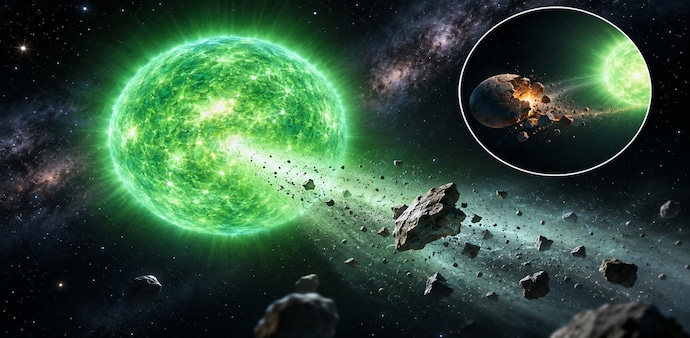
The green white dwarf contains mainly calcium, sodium and lithium, Hollands said. These elements interact with helium in the star's atmosphere and change the spectrum in a way that would make the star appear green to the human eye.
White dwarfs are the dense remnants of Sun-like stars that have died. Their surfaces can also contain elements such as iron, magnesium and sodium, which may have come from rocky material left behind by a former planetary system.
White dwarfs can reveal what planets were made of
An asteroid or other rocky material that ventures too close to a white dwarf can be torn apart. The resulting dust and debris falls onto the star and becomes mixed into its outer layers.
“And then you can actually use that to measure what the rocky stuff was made of,” Hollands said.
“So we can actually use the white dwarf as a sort of diagnostic tool to actually measure the chemistry of planetary material,” he added.
Adam Burgasser, a professor of astronomy and astrophysics at the University of California San Diego, described the white dwarf as a “crime scene” where astronomers can piece together evidence about planets that existed long ago.
Don't Miss: Marilyn Monroe’s ‘Doll House’ in Palm Springs sells for $2.81 million
The researchers also found another white dwarf that would appear almost salmon pink because of a high density of carbon molecules.
More unusual colours could emerge
Hollands calculated the stars' colours using spectrum data, which acts as a fingerprint of the light emitted by a star. Agnès Kim, an astrophysicist and professor of physics at Penn State Scranton, said the work was a “cool intersection of physics and biology”.
Hollands plans to analyse more white dwarf spectra as new surveys begin providing data from more distant stars.
“We’ll be getting a tenfold increase in the number of white dwarfs that have spectra,” Hollands said. “And so maybe if we’re lucky, we’ll go from one or maybe two green white dwarfs to 10 or 20.”
The study was published in the journal RAS Techniques and Instruments, or RASTI.
Astronomers have found a white dwarf that would appear green to human eyes, a rare colour among stars that could also offer clues about the remains of planets once orbiting it, CNN reported on Friday.
The green-coloured star was identified after researchers analysed 151 known white dwarfs within 20 parsecs, or around 65 light years, of Earth. Most stars appear in a limited range of colours, but the unusual chemistry in the outer layers of some white dwarfs can produce much bigger changes in their spectrum.
Lead study author Mark Hollands, an astrophysicist at the University of Warwick, said normal stars are generally orange, white or blue. White dwarfs usually show similar colours, but some are different because of what is happening in their atmospheres.
The green white dwarf contains mainly calcium, sodium and lithium, Hollands said. These elements interact with helium in the star's atmosphere and change the spectrum in a way that would make the star appear green to the human eye.
White dwarfs are the dense remnants of Sun-like stars that have died. Their surfaces can also contain elements such as iron, magnesium and sodium, which may have come from rocky material left behind by a former planetary system.
White dwarfs can reveal what planets were made of
An asteroid or other rocky material that ventures too close to a white dwarf can be torn apart. The resulting dust and debris falls onto the star and becomes mixed into its outer layers.
“And then you can actually use that to measure what the rocky stuff was made of,” Hollands said.
“So we can actually use the white dwarf as a sort of diagnostic tool to actually measure the chemistry of planetary material,” he added.
Adam Burgasser, a professor of astronomy and astrophysics at the University of California San Diego, described the white dwarf as a “crime scene” where astronomers can piece together evidence about planets that existed long ago.
Don't Miss: Marilyn Monroe’s ‘Doll House’ in Palm Springs sells for $2.81 million
The researchers also found another white dwarf that would appear almost salmon pink because of a high density of carbon molecules.
More unusual colours could emerge
Hollands calculated the stars' colours using spectrum data, which acts as a fingerprint of the light emitted by a star. Agnès Kim, an astrophysicist and professor of physics at Penn State Scranton, said the work was a “cool intersection of physics and biology”.
Hollands plans to analyse more white dwarf spectra as new surveys begin providing data from more distant stars.
“We’ll be getting a tenfold increase in the number of white dwarfs that have spectra,” Hollands said. “And so maybe if we’re lucky, we’ll go from one or maybe two green white dwarfs to 10 or 20.”
The study was published in the journal RAS Techniques and Instruments, or RASTI.