
Bold plan: NASA’s $30 million mission to keep Swift observatory from falling on Earth
The observatory’s work is far from trivial. It captures gamma-ray, X-ray, ultraviolet, and optical data in real time, studying black holes, supernovae, neutron stars, and other cosmic phenomena.
- Sep 29, 2025,
- Updated Sep 29, 2025 6:14 PM IST
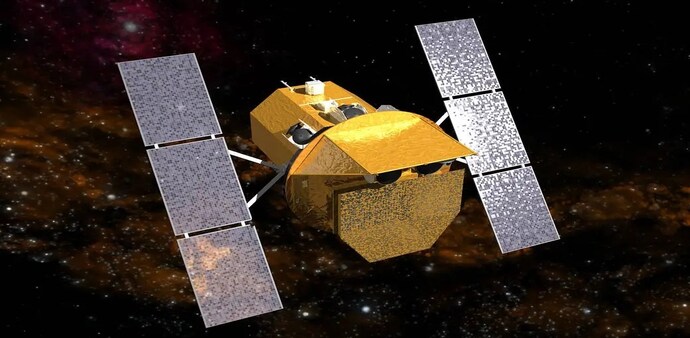
NASA’s 1.4-ton Neil Gehrels Swift Observatory, a pioneering space telescope launched in 2004, is slowly falling toward Earth’s atmosphere — but a daring rescue mission is now underway. The observatory, famed for detecting gamma-ray bursts — the universe’s most powerful explosions — faces a 90% chance of burning up in the atmosphere by late 2026 if no action is taken.
To prevent this cosmic catastrophe, NASA has awarded a $30 million contract to Arizona-based start-up Katalyst Space Technologies to conduct a complex orbital servicing operation. The mission will see a modified version of Katalyst’s “Link” spacecraft rendezvous with Swift, attach to the observatory using a robotic system, and push it into a higher orbit, giving the telescope several more years of life.
“Swift was never designed for servicing,” said Katalyst CEO Andy Lee. “It has no onboard propulsion or docking aids. Our team has devised a way to grip the small metal flanges built for pre-launch transport and carefully nudge it into a stable orbit.”
The observatory’s work is far from trivial. It captures gamma-ray, X-ray, ultraviolet, and optical data in real time, studying black holes, supernovae, neutron stars, and other cosmic phenomena. Preserving its functionality is crucial for NASA’s ongoing efforts to understand the most violent and mysterious events in the universe.
This operation also serves as a proving ground for emerging satellite servicing technologies, which are increasingly important for both civil and military applications. With no room for error, the Pentagon and NASA will closely monitor the docking procedure, while the move comes amid heightened geopolitical rivalries in space, as nations like China advance satellite grappling and maneuvering capabilities.
For NASA, the mission is a high-stakes blend of science, innovation, and orbital maintenance — a race to save one of humanity’s most ambitious eyes on the cosmos before it’s too late.
NASA’s 1.4-ton Neil Gehrels Swift Observatory, a pioneering space telescope launched in 2004, is slowly falling toward Earth’s atmosphere — but a daring rescue mission is now underway. The observatory, famed for detecting gamma-ray bursts — the universe’s most powerful explosions — faces a 90% chance of burning up in the atmosphere by late 2026 if no action is taken.
To prevent this cosmic catastrophe, NASA has awarded a $30 million contract to Arizona-based start-up Katalyst Space Technologies to conduct a complex orbital servicing operation. The mission will see a modified version of Katalyst’s “Link” spacecraft rendezvous with Swift, attach to the observatory using a robotic system, and push it into a higher orbit, giving the telescope several more years of life.
“Swift was never designed for servicing,” said Katalyst CEO Andy Lee. “It has no onboard propulsion or docking aids. Our team has devised a way to grip the small metal flanges built for pre-launch transport and carefully nudge it into a stable orbit.”
The observatory’s work is far from trivial. It captures gamma-ray, X-ray, ultraviolet, and optical data in real time, studying black holes, supernovae, neutron stars, and other cosmic phenomena. Preserving its functionality is crucial for NASA’s ongoing efforts to understand the most violent and mysterious events in the universe.
This operation also serves as a proving ground for emerging satellite servicing technologies, which are increasingly important for both civil and military applications. With no room for error, the Pentagon and NASA will closely monitor the docking procedure, while the move comes amid heightened geopolitical rivalries in space, as nations like China advance satellite grappling and maneuvering capabilities.
For NASA, the mission is a high-stakes blend of science, innovation, and orbital maintenance — a race to save one of humanity’s most ambitious eyes on the cosmos before it’s too late.