
Chandrayaan-2 detects signs of hidden Moon ice: Why it matters for lunar bases
Researchers analyzed radar data from Chandrayaan-2’s Dual Frequency Synthetic Aperture Radar (DFSAR). The study identified several “doubly shadowed” craters near the lunar south pole where radar signatures strongly suggest buried ice beneath the surface layer.
- May 29, 2026,
- Updated May 29, 2026 11:30 AM IST
India’s latest lunar breakthrough may have brought the idea of a permanent Moon base a step closer to reality. Scientists using data from Indian Space Research Organisation’s Chandrayaan-2 mission have found strong evidence of possible subsurface ice hidden beneath some of the coldest craters near the Moon’s south pole.
The discovery, announced by ISRO and researchers at Ahmedabad’s Physical Research Laboratory (PRL), focuses on “permanently shadowed regions” — areas that never receive sunlight and remain colder than many outer planets. The finding matters because water ice is considered one of the most valuable resources for future human settlement on the Moon.
What exactly did India discover?
Researchers analyzed radar data from Chandrayaan-2’s Dual Frequency Synthetic Aperture Radar (DFSAR), an instrument capable of probing below the lunar surface. The study identified several “doubly shadowed” craters near the lunar south pole where radar signatures strongly suggest buried ice beneath the surface layer.
One crater inside the Faustini region reportedly showed especially strong evidence of subsurface ice deposits. Scientists believe these ultra-cold zones, with temperatures around 25 Kelvin (-248°C), may have preserved frozen water for millions or even billions of years.
Why is water ice such a big deal on the Moon?
Because water changes everything.
A long-term lunar base cannot depend entirely on supplies launched from Earth. Transporting water into space is extremely expensive, and astronauts require large quantities for survival and operations.
If lunar ice can be mined and processed locally, it could provide:
- Drinking water for astronauts
- Oxygen for breathable air
- Hydrogen and oxygen for rocket fuel
- Water for agriculture and food production
- Radiation shielding for habitats
In simple terms, water ice could allow humans to “live off the land” on the Moon instead of constantly resupplying from Earth.
That concept is known as In-Situ Resource Utilization (ISRU) — one of the central pillars of future lunar colonisation plans.
Why the Moon’s south pole matters
The lunar south pole has become the most strategically important region on the Moon because scientists suspect it contains the largest stable water reserves.
Unlike most of the Moon, certain polar craters never receive sunlight due to the Moon’s low axial tilt. These permanently shadowed regions act like deep freezers, trapping water molecules delivered by ancient comets, asteroids, or solar wind interactions.
India’s Chandrayaan-3 mission already drew global attention by becoming the first spacecraft to land near the Moon’s south polar region in 2023. Now, Chandrayaan-2’s new findings strengthen the case that this region could become humanity’s first long-term lunar settlement zone.
How this could help build a lunar base
A lunar base needs three things above all else:
- Reliable energy
- Shelter and thermal protection
- Sustainable local resources
- Water ice directly supports the third requirement.
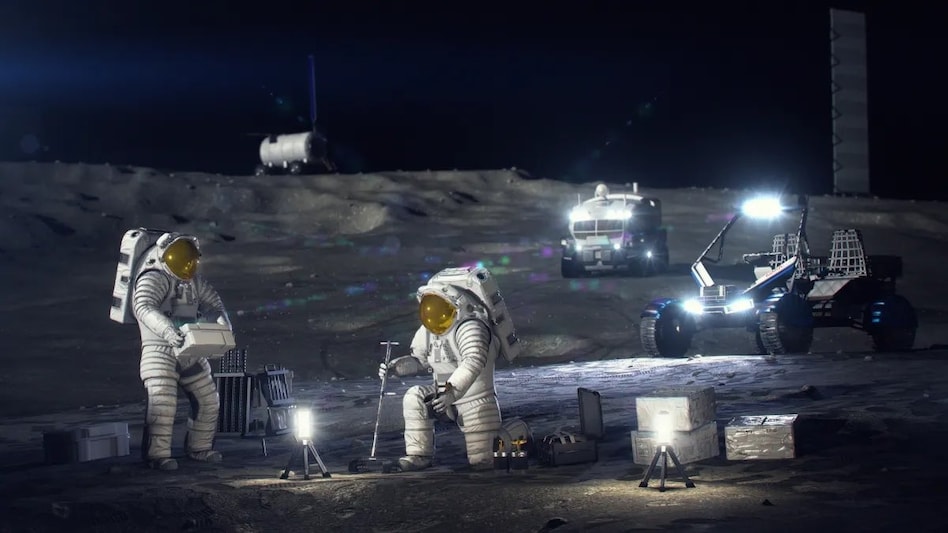
Future lunar missions may use robotic mining systems to extract ice from beneath the surface, purify it, and split it into hydrogen and oxygen through electrolysis.
That would reduce dependence on Earth launches and dramatically lower the cost of deep-space missions. In fact, the Moon could eventually become a refuelling station for missions to Mars and beyond. The discovery also strengthens India’s position in the global lunar race.
The United States, China, Russia, Japan, and Europe are all planning future missions targeting the Moon’s polar regions. NASA’s Artemis programme, for example, aims to establish a sustained human presence near the south pole later this decade.
By contributing critical data about potential lunar water reserves, India is emerging as a major scientific and strategic player in future Moon exploration.
For decades, the Moon was viewed mainly as a scientific destination. But discoveries like these are changing that perception.
The Moon is increasingly being seen as:
- A future industrial zone
- A deep-space launch platform
- A testing ground for Mars missions
- A strategic geopolitical frontier
And if water truly exists in accessible quantities beneath the lunar surface, the dream of a permanent Moon base may move from science fiction to engineering reality much sooner than expected.
India’s latest lunar breakthrough may have brought the idea of a permanent Moon base a step closer to reality. Scientists using data from Indian Space Research Organisation’s Chandrayaan-2 mission have found strong evidence of possible subsurface ice hidden beneath some of the coldest craters near the Moon’s south pole.
The discovery, announced by ISRO and researchers at Ahmedabad’s Physical Research Laboratory (PRL), focuses on “permanently shadowed regions” — areas that never receive sunlight and remain colder than many outer planets. The finding matters because water ice is considered one of the most valuable resources for future human settlement on the Moon.
What exactly did India discover?
Researchers analyzed radar data from Chandrayaan-2’s Dual Frequency Synthetic Aperture Radar (DFSAR), an instrument capable of probing below the lunar surface. The study identified several “doubly shadowed” craters near the lunar south pole where radar signatures strongly suggest buried ice beneath the surface layer.
One crater inside the Faustini region reportedly showed especially strong evidence of subsurface ice deposits. Scientists believe these ultra-cold zones, with temperatures around 25 Kelvin (-248°C), may have preserved frozen water for millions or even billions of years.
Why is water ice such a big deal on the Moon?
Because water changes everything.
A long-term lunar base cannot depend entirely on supplies launched from Earth. Transporting water into space is extremely expensive, and astronauts require large quantities for survival and operations.
If lunar ice can be mined and processed locally, it could provide:
- Drinking water for astronauts
- Oxygen for breathable air
- Hydrogen and oxygen for rocket fuel
- Water for agriculture and food production
- Radiation shielding for habitats
In simple terms, water ice could allow humans to “live off the land” on the Moon instead of constantly resupplying from Earth.
That concept is known as In-Situ Resource Utilization (ISRU) — one of the central pillars of future lunar colonisation plans.
Why the Moon’s south pole matters
The lunar south pole has become the most strategically important region on the Moon because scientists suspect it contains the largest stable water reserves.
Unlike most of the Moon, certain polar craters never receive sunlight due to the Moon’s low axial tilt. These permanently shadowed regions act like deep freezers, trapping water molecules delivered by ancient comets, asteroids, or solar wind interactions.
India’s Chandrayaan-3 mission already drew global attention by becoming the first spacecraft to land near the Moon’s south polar region in 2023. Now, Chandrayaan-2’s new findings strengthen the case that this region could become humanity’s first long-term lunar settlement zone.
How this could help build a lunar base
A lunar base needs three things above all else:
- Reliable energy
- Shelter and thermal protection
- Sustainable local resources
- Water ice directly supports the third requirement.
Future lunar missions may use robotic mining systems to extract ice from beneath the surface, purify it, and split it into hydrogen and oxygen through electrolysis.
That would reduce dependence on Earth launches and dramatically lower the cost of deep-space missions. In fact, the Moon could eventually become a refuelling station for missions to Mars and beyond. The discovery also strengthens India’s position in the global lunar race.
The United States, China, Russia, Japan, and Europe are all planning future missions targeting the Moon’s polar regions. NASA’s Artemis programme, for example, aims to establish a sustained human presence near the south pole later this decade.
By contributing critical data about potential lunar water reserves, India is emerging as a major scientific and strategic player in future Moon exploration.
For decades, the Moon was viewed mainly as a scientific destination. But discoveries like these are changing that perception.
The Moon is increasingly being seen as:
- A future industrial zone
- A deep-space launch platform
- A testing ground for Mars missions
- A strategic geopolitical frontier
And if water truly exists in accessible quantities beneath the lunar surface, the dream of a permanent Moon base may move from science fiction to engineering reality much sooner than expected.