
China completes giant 582-tonne magnet for ‘artificial sun’, Targets fusion energy by 2030
China has laid out a three-stage roadmap aimed at moving fusion technology from experimental research towards electricity generation
- Aug 18, 2026,
- Updated Aug 18, 2026 2:35 AM IST
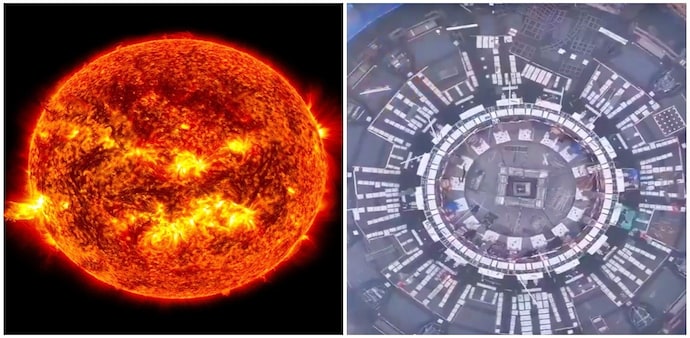
China has completed and tested a 582-tonne superconducting magnet, marking a major engineering milestone in its ambitious pursuit of nuclear fusion and its so-called “Artificial Sun” programme. The development could strengthen Beijing’s push to demonstrate fusion-based electricity generation by around 2030.
Built by the Institute of Plasma Physics in Hefei, the giant magnet is reportedly the largest fusion-reactor magnet constructed so far. The toroidal-field magnet measures around 21 metres in length and is designed to generate the powerful magnetic fields required to confine the extremely hot plasma inside a fusion reactor, according to Forbes.
READ THIS: Can’t have both: Washington to ask countries to choose between US or China in the AI race
Why the magnet matters
Nuclear fusion seeks to reproduce the process that powers the Sun. In a fusion reactor, hydrogen isotopes are heated to temperatures exceeding 100 million degrees Celsius, allowing atomic nuclei to fuse and release enormous amounts of energy. At such temperatures, no conventional material can physically contain the plasma. Instead, tokamak reactors use powerful magnetic fields to keep the superheated plasma away from the reactor walls.
The newly completed magnet is therefore a critical component in China's next-generation fusion programme. According to reports, it has around 1.3 times the volume and three times the stored energy of comparable magnets developed for the International Thermonuclear Experimental Reactor (ITER).
China’s 2030 fusion ambition
China has laid out a three-stage roadmap aimed at moving fusion technology from experimental research towards electricity generation. A key project is the Burning Plasma Experimental Superconducting Tokamak (BEST) in Hefei, which is expected to be completed by the end of 2027. The facility is intended to help demonstrate sustained fusion conditions and advance China’s goal of generating fusion electricity around 2030.
The longer-term plan involves the China Fusion Engineering Demonstration Reactor (CFETR), which is envisioned as a major step towards a demonstration-scale fusion power plant.
A global race for fusion energy
China’s progress comes amid a growing international race to commercialise nuclear fusion. The technology is attracting increasing attention because successful fusion power could provide a low-carbon source of electricity using relatively abundant fuel resources. Forbes has previously described commercial fusion as a strategic race between China and the United States, noting Beijing’s state-backed investments, large research infrastructure and growing scientific workforce in the sector.
China is also pursuing multiple approaches to fusion, including magnetic-confinement and laser-based research. Its expanding programme has made fusion a significant part of the country’s broader strategy to develop future energy technologies.
Fusion power is still a major challenge
Despite the scale of the latest achievement, the completion of the magnet does not mean commercial fusion power is ready.
Researchers still need to demonstrate that a fusion reactor can operate reliably for long periods, generate more usable energy than the overall system consumes and eventually produce electricity at a commercially competitive cost. Reactor assembly, plasma stability, materials and heat management remain major technical challenges.
China has completed and tested a 582-tonne superconducting magnet, marking a major engineering milestone in its ambitious pursuit of nuclear fusion and its so-called “Artificial Sun” programme. The development could strengthen Beijing’s push to demonstrate fusion-based electricity generation by around 2030.
Built by the Institute of Plasma Physics in Hefei, the giant magnet is reportedly the largest fusion-reactor magnet constructed so far. The toroidal-field magnet measures around 21 metres in length and is designed to generate the powerful magnetic fields required to confine the extremely hot plasma inside a fusion reactor, according to Forbes.
READ THIS: Can’t have both: Washington to ask countries to choose between US or China in the AI race
Why the magnet matters
Nuclear fusion seeks to reproduce the process that powers the Sun. In a fusion reactor, hydrogen isotopes are heated to temperatures exceeding 100 million degrees Celsius, allowing atomic nuclei to fuse and release enormous amounts of energy. At such temperatures, no conventional material can physically contain the plasma. Instead, tokamak reactors use powerful magnetic fields to keep the superheated plasma away from the reactor walls.
The newly completed magnet is therefore a critical component in China's next-generation fusion programme. According to reports, it has around 1.3 times the volume and three times the stored energy of comparable magnets developed for the International Thermonuclear Experimental Reactor (ITER).
China’s 2030 fusion ambition
China has laid out a three-stage roadmap aimed at moving fusion technology from experimental research towards electricity generation. A key project is the Burning Plasma Experimental Superconducting Tokamak (BEST) in Hefei, which is expected to be completed by the end of 2027. The facility is intended to help demonstrate sustained fusion conditions and advance China’s goal of generating fusion electricity around 2030.
The longer-term plan involves the China Fusion Engineering Demonstration Reactor (CFETR), which is envisioned as a major step towards a demonstration-scale fusion power plant.
A global race for fusion energy
China’s progress comes amid a growing international race to commercialise nuclear fusion. The technology is attracting increasing attention because successful fusion power could provide a low-carbon source of electricity using relatively abundant fuel resources. Forbes has previously described commercial fusion as a strategic race between China and the United States, noting Beijing’s state-backed investments, large research infrastructure and growing scientific workforce in the sector.
China is also pursuing multiple approaches to fusion, including magnetic-confinement and laser-based research. Its expanding programme has made fusion a significant part of the country’s broader strategy to develop future energy technologies.
Fusion power is still a major challenge
Despite the scale of the latest achievement, the completion of the magnet does not mean commercial fusion power is ready.
Researchers still need to demonstrate that a fusion reactor can operate reliably for long periods, generate more usable energy than the overall system consumes and eventually produce electricity at a commercially competitive cost. Reactor assembly, plasma stability, materials and heat management remain major technical challenges.