
Cosmic twist: James Webb detects hints of water on world’s priciest asteroid worth $100,000 quadrillion
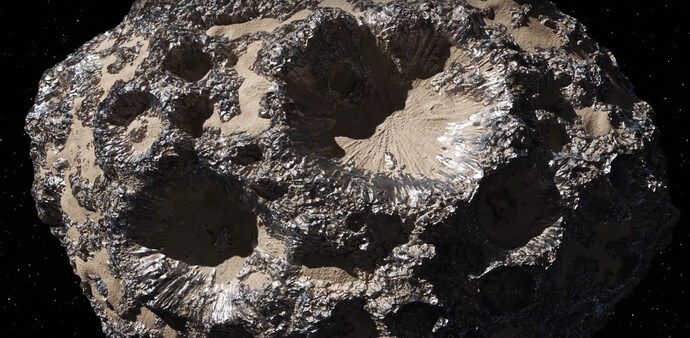
Psyche, spanning 173 miles (280 km) at its widest, stands out in the asteroid belt. Long thought to be the exposed metallic core of a shattered planetesimal, new data has gradually chipped away at this theory. Instead, Psyche seems to be a complex mix of metal and silicate materials.
- Jul 7, 2025,
- Updated Jul 7, 2025 9:43 PM IST
Once branded a naked chunk of planetary metal drifting through space, asteroid 16 Psyche is revealing a surprising secret. A new study using the James Webb Space Telescope (JWST) has detected signs of hydration on its surface, hinting that Psyche’s past might be far messier — and wetter — than scientists ever imagined. Instead of being purely metallic, this colossal asteroid now appears to be a hybrid world, shaped by cosmic collisions and traces of water, rewriting what we know about the building blocks of our solar system.
In March 2023, astronomers turned JWST’s powerful gaze toward Psyche’s north pole. Using its Near Infrared Spectrograph (NIRSpec) and Mid-Infrared Instrument (MIRI), they uncovered a distinctive hydroxyl signature — a chemical hint that water, in the form of rust, may be present on the asteroid’s surface.
Stephanie Jarmak, a planetary scientist at the Harvard and Smithsonian Center for Astrophysics, explained that detecting hydroxyl groups with JWST is a major leap. “It has helped other astronomers detect widespread molecular water on the Moon but had not yet been used for asteroids.”
While NIRSpec confirmed hydroxyl’s presence, MIRI’s longer-wavelength scans found no definitive water signature. Yet Jarmak remains cautious, noting that water could still exist on Psyche in quantities too small for MIRI to detect. Researchers plan further observations, especially of the asteroid’s south pole, to map how these hydrated materials are distributed.
Psyche, spanning 173 miles (280 km) at its widest, stands out in the asteroid belt. Long thought to be the exposed metallic core of a shattered planetesimal, new data has gradually chipped away at this theory. Instead, Psyche seems to be a complex mix of metal and silicate materials.
JWST’s latest findings reinforce the view that Psyche isn’t a pure metal world. The detection of hydroxyl groups suggests that, like Earth and other planetary bodies, Psyche’s surface may have been transformed by interactions with water. Scientists believe impacts from hydrated asteroids might have delivered water-bearing minerals, reshaping the asteroid’s surface composition and history. These revelations could offer critical insights into how similar objects formed and evolved in the early solar system.
Yet the story of Psyche is far from complete. NASA’s Psyche mission, launched in 2023 and expected to arrive at the asteroid in 2029, promises an even closer look. Researchers are eager to pinpoint where hydrated metals cluster on Psyche’s surface. “Future plans include studying exactly where the hydrated metals are found on Psyche’s surface,” said Jarmak.
A giant crater at Psyche’s south pole — possibly the scar of a collision with a hydrated impactor — is high on scientists’ target list, potentially holding clues to how water-bearing material came to be scattered across this enigmatic asteroid.
Once branded a naked chunk of planetary metal drifting through space, asteroid 16 Psyche is revealing a surprising secret. A new study using the James Webb Space Telescope (JWST) has detected signs of hydration on its surface, hinting that Psyche’s past might be far messier — and wetter — than scientists ever imagined. Instead of being purely metallic, this colossal asteroid now appears to be a hybrid world, shaped by cosmic collisions and traces of water, rewriting what we know about the building blocks of our solar system.
In March 2023, astronomers turned JWST’s powerful gaze toward Psyche’s north pole. Using its Near Infrared Spectrograph (NIRSpec) and Mid-Infrared Instrument (MIRI), they uncovered a distinctive hydroxyl signature — a chemical hint that water, in the form of rust, may be present on the asteroid’s surface.
Stephanie Jarmak, a planetary scientist at the Harvard and Smithsonian Center for Astrophysics, explained that detecting hydroxyl groups with JWST is a major leap. “It has helped other astronomers detect widespread molecular water on the Moon but had not yet been used for asteroids.”
While NIRSpec confirmed hydroxyl’s presence, MIRI’s longer-wavelength scans found no definitive water signature. Yet Jarmak remains cautious, noting that water could still exist on Psyche in quantities too small for MIRI to detect. Researchers plan further observations, especially of the asteroid’s south pole, to map how these hydrated materials are distributed.
Psyche, spanning 173 miles (280 km) at its widest, stands out in the asteroid belt. Long thought to be the exposed metallic core of a shattered planetesimal, new data has gradually chipped away at this theory. Instead, Psyche seems to be a complex mix of metal and silicate materials.
JWST’s latest findings reinforce the view that Psyche isn’t a pure metal world. The detection of hydroxyl groups suggests that, like Earth and other planetary bodies, Psyche’s surface may have been transformed by interactions with water. Scientists believe impacts from hydrated asteroids might have delivered water-bearing minerals, reshaping the asteroid’s surface composition and history. These revelations could offer critical insights into how similar objects formed and evolved in the early solar system.
Yet the story of Psyche is far from complete. NASA’s Psyche mission, launched in 2023 and expected to arrive at the asteroid in 2029, promises an even closer look. Researchers are eager to pinpoint where hydrated metals cluster on Psyche’s surface. “Future plans include studying exactly where the hydrated metals are found on Psyche’s surface,” said Jarmak.
A giant crater at Psyche’s south pole — possibly the scar of a collision with a hydrated impactor — is high on scientists’ target list, potentially holding clues to how water-bearing material came to be scattered across this enigmatic asteroid.