
Could today's 40-year-olds live forever? Renowned futurist says aging to end in 2032
What sets Kurzweil apart from many futurists is his track record. Over several decades, he correctly anticipated the rise of the internet as a dominant global communications platform, the emergence of smartphones, and the growing capabilities of artificial intelligence.
- Jun 20, 2026,
- Updated Jun 20, 2026 2:32 PM IST
For centuries, aging has been humanity's most unavoidable reality. But if futurist and computer scientist Ray Kurzweil is correct, that reality could change dramatically within the next decade.
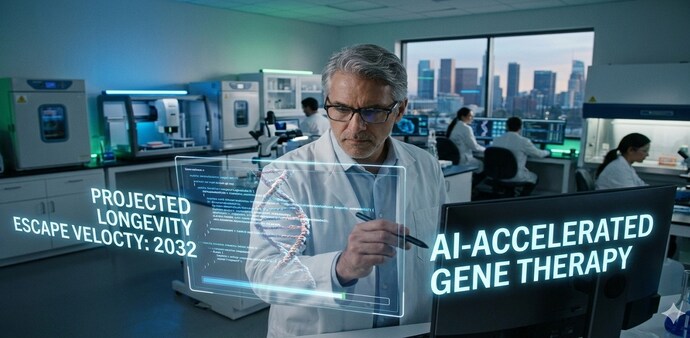
Kurzweil, known for a string of accurate high-profile technology predictions, claims that humans could reach "longevity escape velocity" by 2032. This is the tipping point where advances in medicine and biotechnology extend life expectancy faster than the body ages.
While the concept sounds like science fiction, Kurzweil argues it is grounded in accelerating breakthroughs in artificial intelligence, biotechnology, and drug discovery.
Understanding Longevity Escape Velocity
Modern medicine already extends human lifespan through better treatments, diagnostics, and preventive care. Kurzweil estimates that for every year a person lives today, scientific progress adds about five months to their life expectancy.
Currently, aging is winning the race; medical advances cannot yet offset biological decline. Longevity escape velocity reverses this equation. Once medical progress adds more than 12 months of life expectancy for every calendar year lived, science could theoretically extend life faster than time reduces it. Essentially, the biological clock would slow down faster than it ticks.
AI at the center of the revolution
Kurzweil identifies artificial intelligence as the primary force behind this transformation. Traditional drug development is notoriously slow, often taking more than a decade and billions of dollars to move a treatment from the lab to patients. AI changes this timeline by dramatically accelerating the search for new therapies.
Advanced machine-learning systems can analyze enormous biological datasets, identify promising drug targets, design potential compounds, and predict outcomes at speeds impossible for human researchers.
Kurzweil argues that by the end of the decade, AI systems could generate and test millions of drug candidates. Sophisticated digital simulations may also allow researchers to model biological responses before human trials even begin, compressing decades of medical research into weeks or months.
Pushing scientific boundaries
Discussions about longevity frequently cite Harvard geneticist David Sinclair, whose work focuses on the biological mechanisms of aging. Sinclair’s laboratory has explored ways to reverse cellular aging and restore biological function in animal models, drawing global attention for experiments involving vision restoration and age-related degeneration in mice.
The broader field of longevity science is expanding rapidly. Researchers worldwide are investigating gene therapies, cellular reprogramming, senolytic drugs that remove damaged cells, and treatments designed to reverse aspects of biological aging. AI increasingly screens vast numbers of molecules to identify these promising therapeutic candidates.
However, many of these technologies remain experimental. Translating success in animal models into safe, effective treatments for humans remains one of biomedical science's greatest challenges.
Grounding the optimism
What sets Kurzweil apart from many futurists is his track record. Over several decades, he correctly anticipated the rise of the internet as a dominant global communications platform, the emergence of smartphones, and the growing capabilities of artificial intelligence. This credibility has brought mainstream attention to his predictions on aging, even among skeptics.
Despite the excitement, many scientists caution that extending a healthy lifespan is not the same as eliminating aging. Experts note that aging is an extraordinarily complex biological process involving countless interacting systems. Many therapies that show promise in laboratory settings face immediate setbacks during human testing due to safety concerns, regulatory hurdles, and sheer biological complexity.
For Kurzweil, the message remains straightforward: individuals who maintain their health through the coming decade may live long enough to benefit from a new generation of therapies capable of fundamentally extending human life. Whether 2032 marks the year aging loses its grip remains uncertain, but advances in AI and biotechnology continue to push the boundaries of modern medicine.
FAQs
- +−
What is longevity escape velocity, and why is it important?
Longevity escape velocity is the point where medical progress adds more than one year to human life expectancy for every year lived. It is important because, in theory, it means science could extend life faster than the body ages.
- +−
Why does Ray Kurzweil believe humans could reach longevity escape velocity by 2032?
Ray Kurzweil believes this could happen by 2032 because of fast advances in artificial intelligence, biotechnology, and drug discovery. He argues that these fields are improving quickly enough to change how ageing is treated in the coming decade.
- +−
How can artificial intelligence help in anti-ageing research and drug discovery?
Artificial intelligence can study huge biological datasets, find promising drug targets, design compounds, and predict results much faster than traditional methods. This can reduce the time and cost of developing therapies for ageing and age-related diseases.
- +−
What kinds of treatments are being explored to slow or reverse ageing?
Researchers are studying gene therapies, cellular reprogramming, senolytic drugs that remove damaged cells, and other treatments aimed at reversing parts of biological ageing. Some studies, including animal research, have shown encouraging early results, but most approaches are still experimental.
- +−
Are scientists confident that ageing can be defeated soon?
Scientists are optimistic about healthier and longer lifespans, but many remain cautious. Ageing is a highly complex biological process, and treatments that work in animals often face safety, regulatory, and effectiveness challenges before they can help humans.
For centuries, aging has been humanity's most unavoidable reality. But if futurist and computer scientist Ray Kurzweil is correct, that reality could change dramatically within the next decade.
Kurzweil, known for a string of accurate high-profile technology predictions, claims that humans could reach "longevity escape velocity" by 2032. This is the tipping point where advances in medicine and biotechnology extend life expectancy faster than the body ages.
While the concept sounds like science fiction, Kurzweil argues it is grounded in accelerating breakthroughs in artificial intelligence, biotechnology, and drug discovery.
Understanding Longevity Escape Velocity
Modern medicine already extends human lifespan through better treatments, diagnostics, and preventive care. Kurzweil estimates that for every year a person lives today, scientific progress adds about five months to their life expectancy.
Currently, aging is winning the race; medical advances cannot yet offset biological decline. Longevity escape velocity reverses this equation. Once medical progress adds more than 12 months of life expectancy for every calendar year lived, science could theoretically extend life faster than time reduces it. Essentially, the biological clock would slow down faster than it ticks.
AI at the center of the revolution
Kurzweil identifies artificial intelligence as the primary force behind this transformation. Traditional drug development is notoriously slow, often taking more than a decade and billions of dollars to move a treatment from the lab to patients. AI changes this timeline by dramatically accelerating the search for new therapies.
Advanced machine-learning systems can analyze enormous biological datasets, identify promising drug targets, design potential compounds, and predict outcomes at speeds impossible for human researchers.
Kurzweil argues that by the end of the decade, AI systems could generate and test millions of drug candidates. Sophisticated digital simulations may also allow researchers to model biological responses before human trials even begin, compressing decades of medical research into weeks or months.
Pushing scientific boundaries
Discussions about longevity frequently cite Harvard geneticist David Sinclair, whose work focuses on the biological mechanisms of aging. Sinclair’s laboratory has explored ways to reverse cellular aging and restore biological function in animal models, drawing global attention for experiments involving vision restoration and age-related degeneration in mice.
The broader field of longevity science is expanding rapidly. Researchers worldwide are investigating gene therapies, cellular reprogramming, senolytic drugs that remove damaged cells, and treatments designed to reverse aspects of biological aging. AI increasingly screens vast numbers of molecules to identify these promising therapeutic candidates.
However, many of these technologies remain experimental. Translating success in animal models into safe, effective treatments for humans remains one of biomedical science's greatest challenges.
Grounding the optimism
What sets Kurzweil apart from many futurists is his track record. Over several decades, he correctly anticipated the rise of the internet as a dominant global communications platform, the emergence of smartphones, and the growing capabilities of artificial intelligence. This credibility has brought mainstream attention to his predictions on aging, even among skeptics.
Despite the excitement, many scientists caution that extending a healthy lifespan is not the same as eliminating aging. Experts note that aging is an extraordinarily complex biological process involving countless interacting systems. Many therapies that show promise in laboratory settings face immediate setbacks during human testing due to safety concerns, regulatory hurdles, and sheer biological complexity.
For Kurzweil, the message remains straightforward: individuals who maintain their health through the coming decade may live long enough to benefit from a new generation of therapies capable of fundamentally extending human life. Whether 2032 marks the year aging loses its grip remains uncertain, but advances in AI and biotechnology continue to push the boundaries of modern medicine.