
Found in 1939, used as a doorstop for decades: Michigan rock identified as meteorite
The specimen came under closer scrutiny after another meteorite fell near Hamburg, Michigan, in January 2018.
- Oct 6, 2026,
- Updated Oct 6, 2026 2:00 AM IST
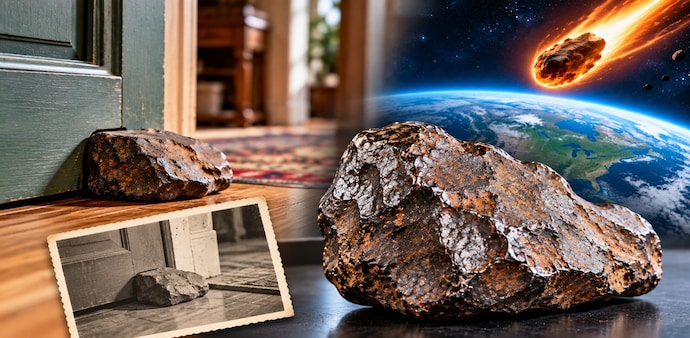
A 10.22-kilogram rock that spent decades being used as a barn doorstop on a Michigan farm has been identified as a new IIIAB iron meteorite. The rock, reportedly seen falling near Edmore in 1939, was later examined by scientists at Central Michigan University and the Smithsonian Institution, The Times of India reported.
The rock was recovered by the farm’s owner after it was reportedly seen to fall on the property in 1939. Instead of being studied, it became part of everyday farm life and was eventually used as a doorstop in a barn.
The farm later changed hands, but the story of the unusual rock was passed on to its new owners.
The specimen came under closer scrutiny after another meteorite fell near Hamburg, Michigan, in January 2018. The event prompted the Edmore farm’s later owners to reconsider the rock they had inherited and question whether it could also be a meteorite.
They eventually took it to Central Michigan University in Mt. Pleasant for examination.
Meteorite clues in its shape and surface
The roughly triangular specimen measures about 17 x 20 x 23 centimetres and weighs 10.22 kilograms. It has several large indentations and parts of its exterior are covered by a light-brown fusion crust.
Don't Miss: Welcome to the world, little ones: Indian-born Cheetah gives birth to 5 cubs at Kuno National Park
A fusion crust can form when a meteoroid passes through Earth’s atmosphere at high speed. The intense heat melts its outer surface, which then cools rapidly, leaving a thin layer around the meteorite.
Scientists found that the rock had characteristics consistent with an iron meteorite and sent a slice to the Smithsonian Institution for further analysis.
Tests revealed its internal structure
Researchers examined the sample using a Nova NanoSEM 600 scanning electron microscope under low vacuum and energy-dispersive X-ray spectroscopy. The polished slice was treated with 10% Nital and alcohol, revealing a Widmanstätten pattern.
The structure showed that Edmore was a medium octahedrite containing kamacite, taenite and schreibersite. Kamacite lamellae were about 0.8 millimetres wide, while schreibersite grains reached up to 4 millimetres and showed extensive fracturing.
Chemical analysis, including iridium data, placed Edmore in the IIIAB group of iron meteorites.
Officially recognised in 2019
The Widmanstätten pattern also provided evidence of the meteorite’s slow cooling history. Such patterns form when molten metal cools over extremely long periods inside a parent body.
The specimen was officially recognised in 2019 as Edmore, Michigan, and listed in the Meteoritical Bulletin as an Iron, IIIAB meteorite.
The discovery turned a decades-old farm doorstop into a scientifically recognised meteorite, after its possible extraterrestrial origin remained unnoticed for years.
A 10.22-kilogram rock that spent decades being used as a barn doorstop on a Michigan farm has been identified as a new IIIAB iron meteorite. The rock, reportedly seen falling near Edmore in 1939, was later examined by scientists at Central Michigan University and the Smithsonian Institution, The Times of India reported.
The rock was recovered by the farm’s owner after it was reportedly seen to fall on the property in 1939. Instead of being studied, it became part of everyday farm life and was eventually used as a doorstop in a barn.
The farm later changed hands, but the story of the unusual rock was passed on to its new owners.
The specimen came under closer scrutiny after another meteorite fell near Hamburg, Michigan, in January 2018. The event prompted the Edmore farm’s later owners to reconsider the rock they had inherited and question whether it could also be a meteorite.
They eventually took it to Central Michigan University in Mt. Pleasant for examination.
Meteorite clues in its shape and surface
The roughly triangular specimen measures about 17 x 20 x 23 centimetres and weighs 10.22 kilograms. It has several large indentations and parts of its exterior are covered by a light-brown fusion crust.
Don't Miss: Welcome to the world, little ones: Indian-born Cheetah gives birth to 5 cubs at Kuno National Park
A fusion crust can form when a meteoroid passes through Earth’s atmosphere at high speed. The intense heat melts its outer surface, which then cools rapidly, leaving a thin layer around the meteorite.
Scientists found that the rock had characteristics consistent with an iron meteorite and sent a slice to the Smithsonian Institution for further analysis.
Tests revealed its internal structure
Researchers examined the sample using a Nova NanoSEM 600 scanning electron microscope under low vacuum and energy-dispersive X-ray spectroscopy. The polished slice was treated with 10% Nital and alcohol, revealing a Widmanstätten pattern.
The structure showed that Edmore was a medium octahedrite containing kamacite, taenite and schreibersite. Kamacite lamellae were about 0.8 millimetres wide, while schreibersite grains reached up to 4 millimetres and showed extensive fracturing.
Chemical analysis, including iridium data, placed Edmore in the IIIAB group of iron meteorites.
Officially recognised in 2019
The Widmanstätten pattern also provided evidence of the meteorite’s slow cooling history. Such patterns form when molten metal cools over extremely long periods inside a parent body.
The specimen was officially recognised in 2019 as Edmore, Michigan, and listed in the Meteoritical Bulletin as an Iron, IIIAB meteorite.
The discovery turned a decades-old farm doorstop into a scientifically recognised meteorite, after its possible extraterrestrial origin remained unnoticed for years.