
From school lab to state award: 16-year-old from MP builds ‘water-run’ kerosene stove, wins top science prize
For many Indian households, especially in rural and semi-urban areas, kerosene remains a key cooking fuel despite rising costs and health concerns from indoor smoke.
- Sep 14, 2026,
- Updated Sep 14, 2026 3:29 PM IST
A Class 11 student from Madhya Pradesh has turned heads with a low-cost hybrid stove that uses water along with kerosene to cut fuel use and smoke, earning him a top prize at a state science exhibition.
Vyasji Mishra, a 16-year-old and a resident of Devsar in Madhya Pradesh, developed the innovation while studying in Class 11, according to NIF. He had been interested in science and practical applications from an early age and had already participated in multiple science competitions before this breakthrough. His earlier work included a model drip-irrigation system that won first prize at a science exhibition in 2000.
ALSO READ: From a school trip to a smart invention: How a teen built an AI trash robot
How the ‘water-run’ stove works
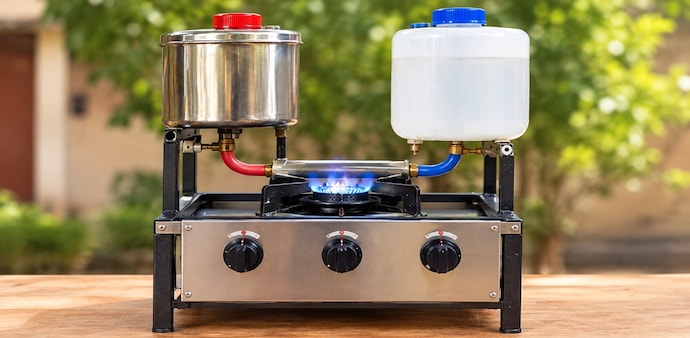
The device is essentially a hybrid kerosene-steam stove built by combining two conventional kerosene stoves and adding three regulators. One regulator controls kerosene flow, another controls water, and the third switches the burner on and off. The invention features two tanks — one for kerosene and one for water — both connected to a common burner, allowing steam to assist combustion.
Mishra developed the prototype with help from his elder brother, aiming to reduce kerosene consumption and smoke from traditional stoves. Later testing by IIT Guwahati optimised the design and estimated fuel savings of about 20 per cent. The total cost to build the initial prototype was around ₹600, making it an affordable option for households that rely on kerosene.
Recognition and support
The hybrid stove drew attention at local science exhibitions and in newspapers before clinching first prize at a state-level exhibition, where it was awarded by then Education Minister Indrajit Kumar Patel in 2003.
Following the recognition, the National Innovation Foundation (NIF), working with the Grassroots Innovations Augmentation Network (GIANs), sanctioned ₹37,250 from its Micro Venture Innovation Fund to support prototype development and market research for the water–kerosene stove and three other innovations.
DO CHECKOUT: Think cardboard belongs in the trash? This young innovator from Kerala is turning it into robots & smart home gadgets
For many Indian households, especially in rural and semi-urban areas, kerosene remains a key cooking fuel despite rising costs and health concerns from indoor smoke. A low-cost modification that can trim fuel use by roughly a fifth while cutting emissions addresses both household expenses and public-health priorities.
A Class 11 student from Madhya Pradesh has turned heads with a low-cost hybrid stove that uses water along with kerosene to cut fuel use and smoke, earning him a top prize at a state science exhibition.
Vyasji Mishra, a 16-year-old and a resident of Devsar in Madhya Pradesh, developed the innovation while studying in Class 11, according to NIF. He had been interested in science and practical applications from an early age and had already participated in multiple science competitions before this breakthrough. His earlier work included a model drip-irrigation system that won first prize at a science exhibition in 2000.
ALSO READ: From a school trip to a smart invention: How a teen built an AI trash robot
How the ‘water-run’ stove works
The device is essentially a hybrid kerosene-steam stove built by combining two conventional kerosene stoves and adding three regulators. One regulator controls kerosene flow, another controls water, and the third switches the burner on and off. The invention features two tanks — one for kerosene and one for water — both connected to a common burner, allowing steam to assist combustion.
Mishra developed the prototype with help from his elder brother, aiming to reduce kerosene consumption and smoke from traditional stoves. Later testing by IIT Guwahati optimised the design and estimated fuel savings of about 20 per cent. The total cost to build the initial prototype was around ₹600, making it an affordable option for households that rely on kerosene.
Recognition and support
The hybrid stove drew attention at local science exhibitions and in newspapers before clinching first prize at a state-level exhibition, where it was awarded by then Education Minister Indrajit Kumar Patel in 2003.
Following the recognition, the National Innovation Foundation (NIF), working with the Grassroots Innovations Augmentation Network (GIANs), sanctioned ₹37,250 from its Micro Venture Innovation Fund to support prototype development and market research for the water–kerosene stove and three other innovations.
DO CHECKOUT: Think cardboard belongs in the trash? This young innovator from Kerala is turning it into robots & smart home gadgets
For many Indian households, especially in rural and semi-urban areas, kerosene remains a key cooking fuel despite rising costs and health concerns from indoor smoke. A low-cost modification that can trim fuel use by roughly a fifth while cutting emissions addresses both household expenses and public-health priorities.